Department of Population, Family and Reproductive Health, Johns Hopkins Bloomberg School of Public Health, Baltimore, MD 21205, USA.
Ruby Cup by Ruby Life, Nairobi 00100, Kenya.
Int J Environ Res Public Health. 2020 Apr 12;17(8):2633. doi: 10.3390/ijerph17082633.
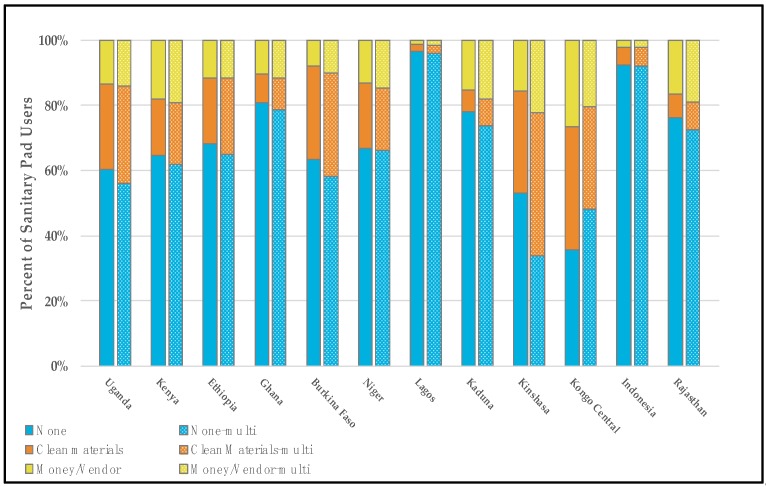
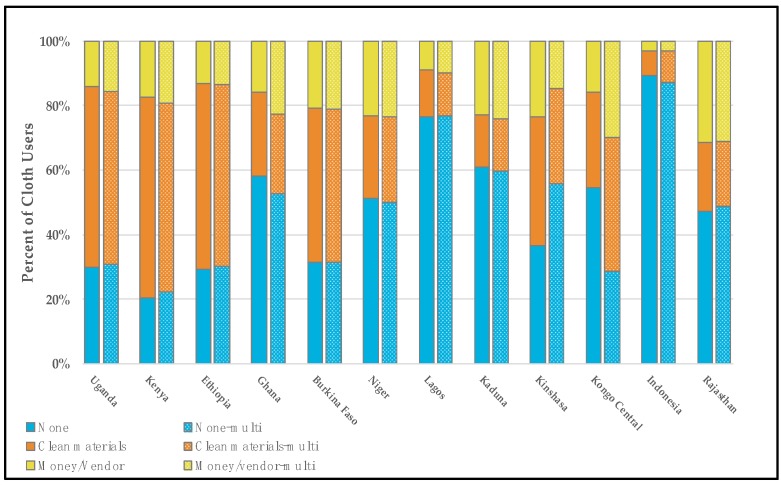
Surveys monitoring population health and sanitation are increasingly seeking to monitor menstrual health. In the absence of established indicators, these surveys have most often collected data on the type of menstrual material used. This study investigated whether such data provides a useful indication of women's menstrual material needs being met. Using data from 12 national or state representative surveys from the Performance Monitoring and Accountability 2020 program, we compared self-reported menstrual material use against respondents' reported menstrual material needs (including needing clean materials, money, or access to a vendor). The use of menstrual pads did not indicate that menstrual material needs were met for many respondents. Of those exclusively using pads, a pooled 26.4% (95% Confidence Interval 17.1-38.5) of respondents reported that they had unmet material needs. More disadvantaged groups were particularly misrepresented; of rural women exclusively using pads, a pooled 38.5% (95%CI 27.3-51.1) reported unmet material needs, compared to 17.1% (95%CI 12.4-23.0) of urban women. Similar disparities were observed for levels of education and wealth, with a pooled 45.9% (95%CI 29.2-63.6) of women in the lowest wealth quintile reporting unmet material needs. Findings suggest that caution is needed when using menstrual material use as an indicator for menstrual health.
监测人口健康和卫生的调查越来越多地寻求监测月经健康。在缺乏既定指标的情况下,这些调查通常收集了有关使用的月经材料类型的数据。本研究调查了这些数据是否能很好地表明妇女的月经材料需求得到了满足。本研究使用了来自绩效监测和问责制 2020 计划的 12 项国家或州代表性调查的数据,将自我报告的月经材料使用情况与受访者报告的月经材料需求(包括需要清洁材料、金钱或供应商)进行了比较。许多受访者报告说,使用卫生巾并不表明她们的月经材料需求得到了满足。在仅使用卫生巾的人群中,有 26.4%(95%置信区间 17.1-38.5)的受访者表示她们有未满足的材料需求。处境更为不利的群体尤其代表性不足;在仅使用卫生巾的农村妇女中,有 38.5%(95%置信区间 27.3-51.1)的人报告有未满足的材料需求,而城市妇女中这一比例为 17.1%(95%置信区间 12.4-23.0)。在教育程度和财富水平方面也观察到类似的差异,在财富最低五分位数的女性中,有 45.9%(95%置信区间 29.2-63.6)的人报告有未满足的材料需求。研究结果表明,在将月经材料使用作为月经健康的指标使用时,需要谨慎。