Department of Clinical Sciences, Liverpool School of Tropical Medicine, Liverpool, UK.
Population Health Sciences, Institute of Epidemiology and Health Care, University College London, London, UK.
Lancet Public Health. 2019 Aug;4(8):e376-e393. doi: 10.1016/S2468-2667(19)30111-2. Epub 2019 Jul 16.
Girls and women need effective, safe, and affordable menstrual products. Single-use products are regularly selected by agencies for resource-poor settings; the menstrual cup is a less known alternative. We reviewed international studies on menstrual cup leakage, acceptability, and safety and explored menstrual cup availability to inform programmes.
In this systematic review and meta-analysis, we searched PubMed, Cochrane Library, Web of Science, Popline, Cinahl, Global Health database, Emerald, Google Scholar, Science.gov, and WorldWideScience from database inception to May 14, 2019, for quantitative or qualitative studies published in English on experiences and leakage associated with menstrual cups, and adverse event reports. We also screened the Manufacturer and User Facility Device Experience database from the US Food and Drug Administration for events related to menstrual cups. To be eligible for inclusion, the material needed to have information on leakage, acceptability, or safety of menstrual cups. The main outcome of interest was menstrual blood leakage when using a menstrual cup. Safety outcomes of interest included serious adverse events; vaginal abrasions and effects on vaginal microflora; effects on the reproductive, digestive, or urinary tract; and safety in poor sanitary conditions. Findings were tabulated or combined by use of forest plots (random-effects meta-analysis). We also did preliminary estimates on costs and environmental savings potentially associated with cups. This systematic review is registered on PROSPERO, number CRD42016047845.
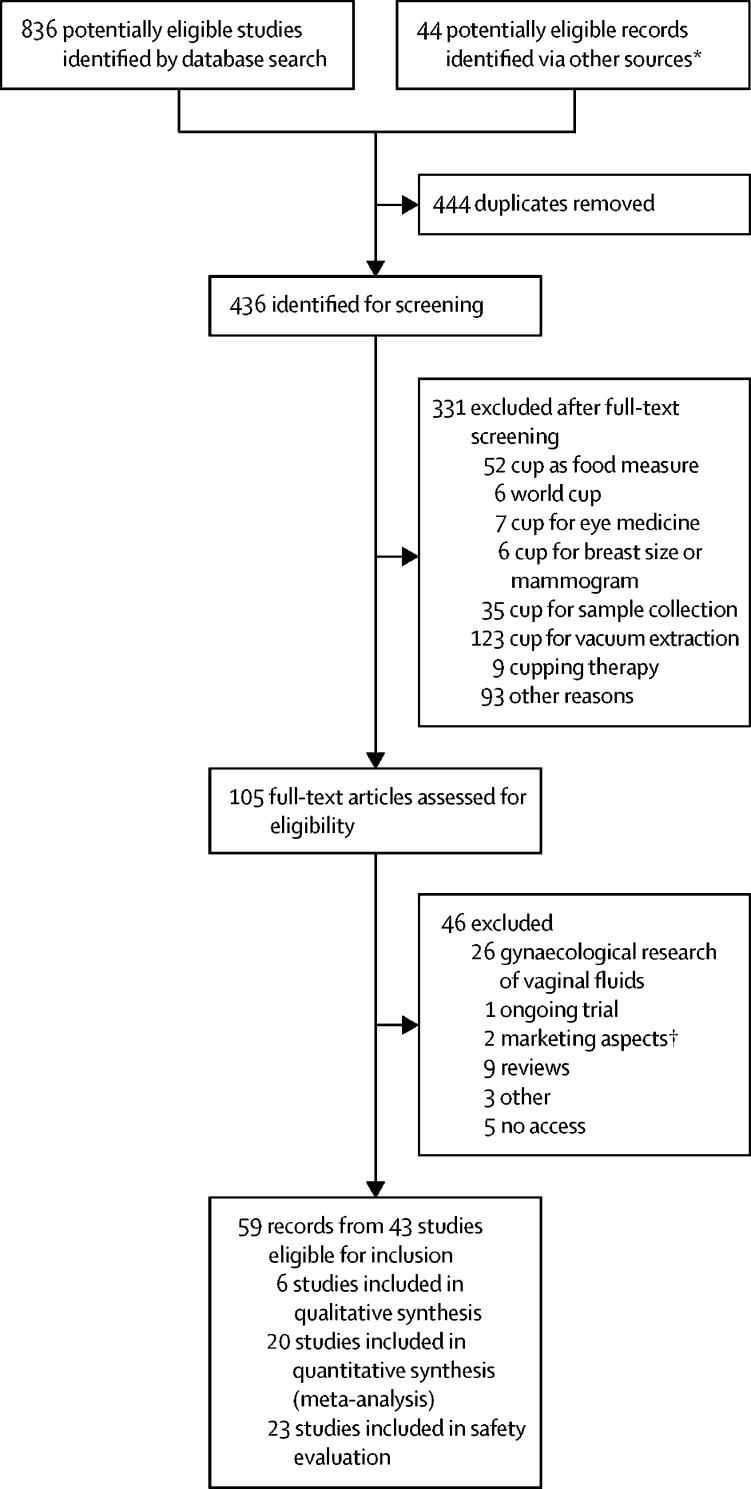
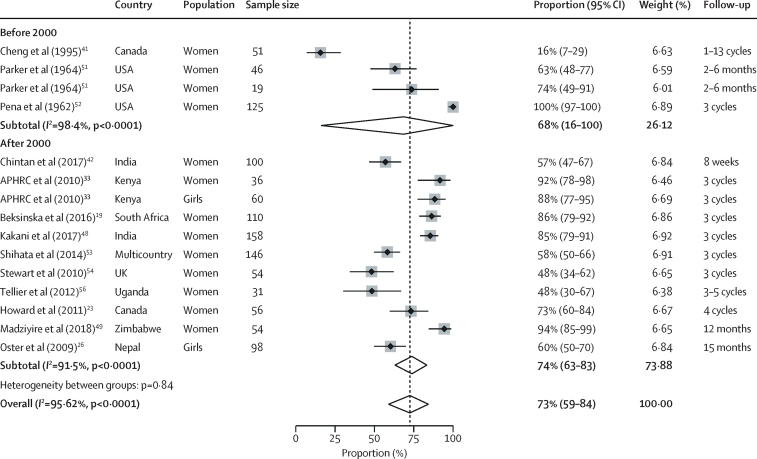
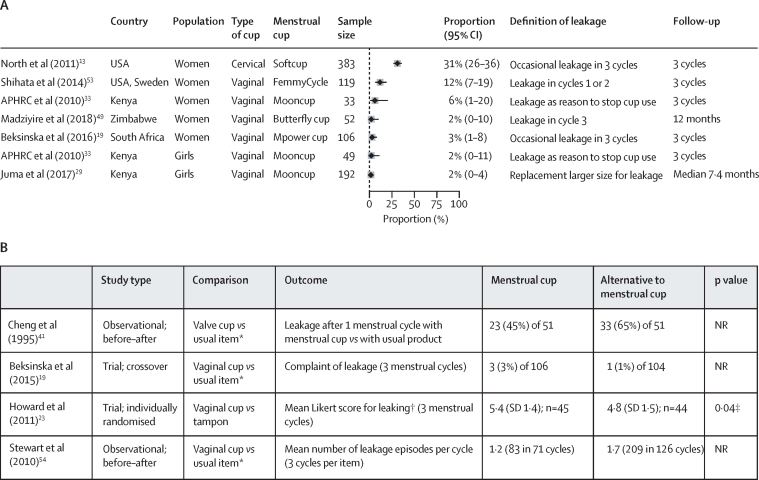
Of 436 records identified, 43 studies were eligible for analysis (3319 participants). Most studies reported on vaginal cups (27 [63%] vaginal cups, five [12%] cervical cups, and 11 [25%] mixed types of cups or unknown) and 15 were from low-income and middle-income countries. 22 studies were included in qualitative or quantitative syntheses, of which only three were of moderate-to-high quality. Four studies made a direct comparison between menstrual cups and usual products for the main outcome of leakage and reported leakage was similar or lower for menstrual cups than for disposable pads or tampons (n=293). In all qualitative studies, the adoption of the menstrual cup required a familiarisation phase over several menstrual cycles and peer support improved uptake (two studies in developing countries). In 13 studies, 73% (pooled estimate: n=1144; 95% CI 59-84, I=96%) of participants wished to continue use of the menstrual cup at study completion. Use of the menstrual cup showed no adverse effects on the vaginal flora (four studies, 507 women). We identified five women who reported severe pain or vaginal wounds, six reports of allergies or rashes, nine of urinary tract complaints (three with hydronephrosis), and five of toxic shock syndrome after use of the menstrual cup. Dislodgement of an intrauterine device was reported in 13 women who used the menstrual cup (eight in case reports, and five in one study) between 1 week and 13 months of insertion of the intrauterine device. Professional assistance to aid removal of menstrual cup was reported among 47 cervical cup users and two vaginal cup users. We identified 199 brands of menstrual cup, and availability in 99 countries with prices ranging US$0·72-46·72 (median $23·3, 145 brands).
Our review indicates that menstrual cups are a safe option for menstruation management and are being used internationally. Good quality studies in this field are needed. Further studies are needed on cost-effectiveness and environmental effect comparing different menstrual products.
UK Medical Research Council, Department for International Development, and Wellcome Trust.
女孩和妇女需要有效、安全且负担得起的经期用品。一次性产品通常由机构在资源匮乏的环境中选择;而月经杯则是一种鲜为人知的替代品。我们对月经杯的泄漏、可接受性和安全性的国际研究进行了综述,并对月经杯的可获得性进行了调查,以向相关项目提供信息。
在这项系统评价和荟萃分析中,我们检索了 PubMed、Cochrane 图书馆、Web of Science、Popline、Cinahl、全球健康数据库、Emerald、Google Scholar、Science.gov 和 WorldWideScience,从数据库建立到 2019 年 5 月 14 日,以获取发表在英语期刊上的关于月经杯相关经验和泄漏以及不良事件报告的定量或定性研究。我们还筛查了美国食品和药物管理局的制造商和用户设施设备体验数据库,以获取与月经杯相关的事件报告。为了符合纳入标准,材料必须包含月经杯泄漏、可接受性或安全性的信息。主要结局是使用月经杯时经血泄漏。感兴趣的安全性结局包括严重不良事件;阴道擦伤和对阴道微生物群的影响;对生殖、消化或泌尿系统的影响;以及在卫生条件差的情况下的安全性。我们通过森林图(随机效应荟萃分析)对结果进行了列表或合并。我们还对与杯子相关的潜在成本和环境节约进行了初步估计。本系统评价已在 PROSPERO 注册,编号为 CRD42016047845。
在 436 条记录中,有 43 项研究符合分析条件(3319 名参与者)。大多数研究报告的是阴道杯(27 [63%] 阴道杯、5 [12%] 宫颈杯和 11 [25%] 混合类型杯子或未知),15 项研究来自低收入和中等收入国家。22 项研究纳入了定性或定量综合分析,其中只有 3 项研究质量为中等到高。四项研究对月经杯的主要结局(泄漏)进行了直接比较,并报告了月经杯的泄漏情况与一次性垫或卫生棉条相似或更低(293 名参与者)。在所有定性研究中,月经杯的采用需要经过几个月经周期的适应期,并且同伴支持可以提高采用率(发展中国家的两项研究)。在 13 项研究中,73%(汇总估计值:n=1144;95%CI 59-84,I=96%)的参与者在研究结束时希望继续使用月经杯。使用月经杯对阴道菌群没有不良影响(四项研究,507 名女性)。我们确定了 5 名报告严重疼痛或阴道创伤的女性、6 名报告过敏或皮疹的女性、9 名报告泌尿系统投诉的女性(其中 3 名患有肾盂积水)和 5 名报告使用月经杯后发生中毒性休克综合征的女性。在放置宫内节育器后 1 周到 13 个月,有 13 名使用月经杯的女性(8 例病例报告和 5 例在一项研究中)报告了宫内节育器脱落。在 47 名宫颈杯使用者和 2 名阴道杯使用者中,报告了需要专业帮助来取出月经杯。我们确定了 199 个月经杯品牌,这些品牌在 99 个国家有销售,价格范围为 0.72-46.72 美元(中位数为 23.3 美元,涉及 145 个品牌)。
我们的综述表明,月经杯是一种安全的经期管理选择,并且在国际上得到了使用。该领域需要高质量的研究。需要进一步研究不同月经产品的成本效益和环境影响。
英国医学研究理事会、国际发展部和惠康信托基金会。