Hospital Santa Cruz Centro Hospitalar Lisboa Ocidental Nova Medical School Faculdade de Ciências Médicas Lisbon Portugal.
Hospital da Luz Lisbon Portugal.
J Am Heart Assoc. 2020 Apr 21;9(8):e015177. doi: 10.1161/JAHA.119.015177. Epub 2020 Apr 15.
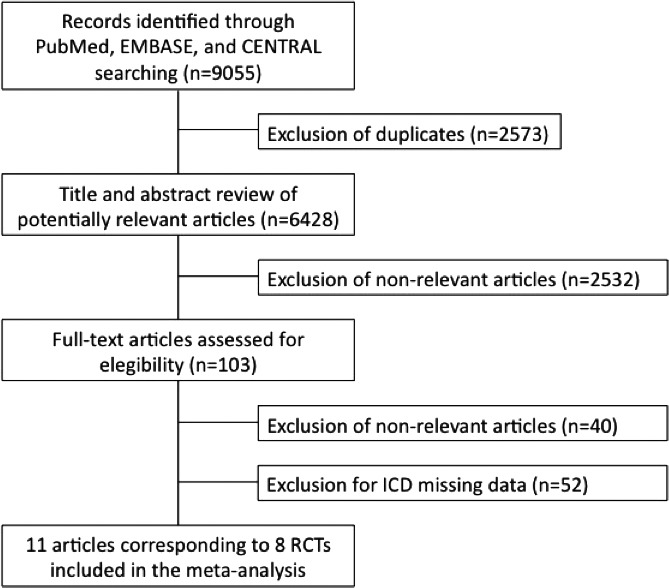
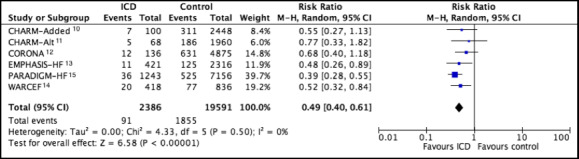
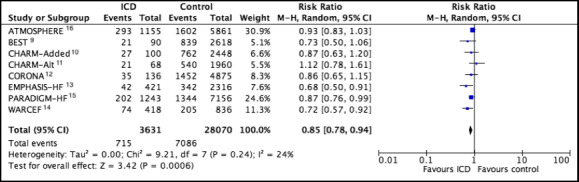
BACKGROUND Medical therapy for heart failure with reduced ejection fraction evolved since trials validated the use of implantable cardioverter-defibrillators (ICDs). We sought to evaluate the performance of ICDs in reducing mortality in the era of modern medical therapy by means of a systematic review and meta-analysis of contemporary randomized clinical trials of drug therapy for heart failure with reduced ejection fraction. METHODS AND RESULTS We systematically identified randomized clinical trials that evaluated drug therapy in patients with heart failure with reduced ejection fraction that reported mortality. Studies that enrolled <1000 patients, patients with left ventricular ejection fraction >40%, or patients in the acute phase of heart failure and study treatment with devices were excluded. We identified 8 randomized clinical trials, including 31 701 patients of whom 3631 (11.5%) had an ICD. ICDs were associated with a lower risk of all-cause mortality (relative risk [RR], 0.85; 95% CI, 0.78-0.94) and sudden cardiac death (RR, 0.49; 95% CI, 0.40-0.61). Results were consistent among studies published before and after 2010. In meta-regression analysis, the proportion of nonischemic etiology did not affect the associated benefit of ICD. CONCLUSIONS In our meta-analysis of contemporary randomized trials of drug therapy for heart failure with reduced ejection fraction, the rate of ICD use was low and associated with a decreased risk in both all-cause mortality and sudden cardiac death. This benefit was still present in trials with new medical therapy.
自植入式心脏复律除颤器(ICD)的使用得到临床试验验证以来,射血分数降低的心力衰竭的医学治疗方法不断发展。我们通过对射血分数降低的心力衰竭的药物治疗的当代随机临床试验进行系统评价和荟萃分析,旨在评估在现代医学治疗时代,ICD 在降低死亡率方面的作用。
我们系统地确定了评估药物治疗射血分数降低的心力衰竭患者死亡率的随机临床试验。排除了纳入患者<1000 例、左心室射血分数>40%或心力衰竭急性阶段的患者以及接受设备治疗的研究。我们确定了 8 项随机临床试验,包括 31701 名患者,其中 3631 名(11.5%)接受了 ICD 治疗。ICD 与全因死亡率(相对风险 [RR],0.85;95%置信区间,0.78-0.94)和心源性猝死(RR,0.49;95%置信区间,0.40-0.61)风险降低相关。2010 年之前和之后发表的研究结果一致。在荟萃回归分析中,非缺血性病因的比例并不影响 ICD 的相关获益。
在我们对射血分数降低的心力衰竭的药物治疗的当代随机试验的荟萃分析中,ICD 的使用率较低,与全因死亡率和心源性猝死风险降低相关。这种获益在具有新医学治疗的试验中仍然存在。