Department of Infectious Diseases, Tangdu Hospital, The Fourth Military Medical University, Xi'an, China.
Department of Immunology, The Fourth Military Medical University, Xi'an, China.
Front Immunol. 2020 Mar 27;11:535. doi: 10.3389/fimmu.2020.00535. eCollection 2020.
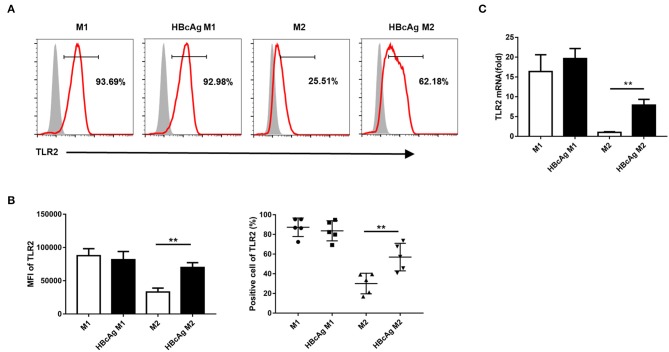
Although several evidences suggesting the vital roles that innate immunity plays in the persistence and elimination of chronic hepatitis B virus (CHB) infection, the exact mechanism is still complicated. Here, we successfully polarized monocytes derived from healthy human peripheral blood mononuclear cells (PBMCs) into M1/M2 macrophages and detected the effects of hepatitis B core antigen (HBcAg) on the polarization and function of macrophages via the Toll-like receptor (TLR) 2 signaling pathway. The results showed that HBcAg had a negligible impact on M1 polarization, while it effectively impaired M2 polarization and promoted the production of pro-inflammatory cytokines such as IL-6 and TNF-α. Additionally, HBcAg treatment increased TLR2 expression on M2 macrophages and TLR2 blockade abolished the effects of HBcAg on the impaired phenotype and pro-inflammatory cytokine productions of M2 macrophages. Signaling pathway analysis revealed that the nuclear factor κB (NF-κB) pathway, the downstream of TLR2, was upregulated upon HBcAg treatment in both M1 and M2 macrophages. Furthermore, a CD8 T-macrophage coculture system implied that compared with PBS stimulation, HBcAg-stimulated M2 macrophages regained their ability to activate CD8 T cells with higher secretion of IFN-γ. Finally, we found impaired expression of M2-related molecules and increased levels of pro-inflammation cytokines in M2 macrophages from CHB patients upon HBcAg stimulation. In conclusion, these results imply a favorable role of HBcAg in the establishment of a pro-inflammatory microenvironment by macrophages, which may suggest a potential therapeutic strategy of HBcAg-induced macrophage activation in CHB infection.
尽管有一些证据表明先天免疫在慢性乙型肝炎病毒 (CHB) 感染的持续和消除中起着重要作用,但确切的机制仍然很复杂。在这里,我们成功地将健康人外周血单核细胞 (PBMC) 衍生的单核细胞极化为 M1/M2 巨噬细胞,并通过 Toll 样受体 (TLR) 2 信号通路检测乙型肝炎核心抗原 (HBcAg) 对巨噬细胞极化和功能的影响。结果表明,HBcAg 对 M1 极化几乎没有影响,而有效抑制 M2 极化,并促进促炎细胞因子如 IL-6 和 TNF-α的产生。此外,HBcAg 处理增加了 M2 巨噬细胞上 TLR2 的表达,而 TLR2 阻断消除了 HBcAg 对 M2 巨噬细胞受损表型和促炎细胞因子产生的影响。信号通路分析表明,核因子 κB (NF-κB) 通路是 TLR2 的下游,在 M1 和 M2 巨噬细胞中均被 HBcAg 处理上调。此外,CD8 T 巨噬细胞共培养系统表明,与 PBS 刺激相比,HBcAg 刺激的 M2 巨噬细胞恢复了激活 CD8 T 细胞的能力,IFN-γ的分泌更高。最后,我们发现 CHB 患者 M2 巨噬细胞中 M2 相关分子表达受损,促炎细胞因子水平升高。总之,这些结果表明 HBcAg 在巨噬细胞中诱导形成促炎微环境中发挥有利作用,这可能提示 HBcAg 诱导的巨噬细胞活化在 CHB 感染中具有潜在的治疗策略。