International Institute for Population Sciences, Mumbai, Maharashtra, 400088, India.
Department of Mathematical Demography and Statistics, International Institute for Population Sciences, Mumbai, India.
BMC Pregnancy Childbirth. 2020 Mar 23;20(1):181. doi: 10.1186/s12884-020-2839-9.
This paper discusses length of stay (LOS) following childbirth as an indicator of quality of postnatal care in health institutions. This research aims to describe LOS according to both vaginal and cesarean deliveries in public and private health care institutions in India, and to identify any association of LOS with postnatal care and post-delivery complications.
We use recently released nationally-representative data from the National Family Health Survey-4 (2015-16) and apply the Cox proportional hazard model to determine the factors associated with LOS at the health facility after childbirth during a five-year period preceding the survey.
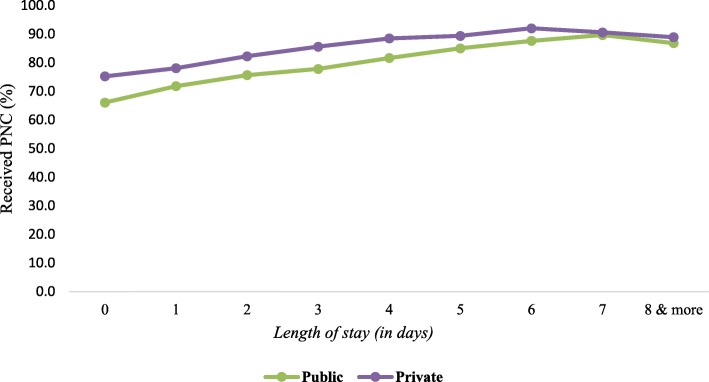
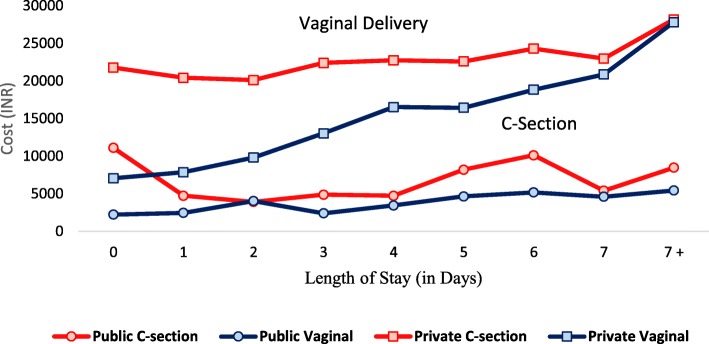
Overall, the average LOS after childbirth is 3.4 days; 2.1 days for vaginal deliveries and 8.6 days for cesarean section (CS) deliveries. Strikingly, half of the women are discharged within 48 h. Women who give birth in private hospitals have a more prolonged stay than those who give birth in public health facilities. For vaginal birth in public hospitals, one-fourth of the women are discharged with insufficient LOS as against only 19.2% women in private hospitals. LOS is significantly related to the cost of delivery only in the case of private facilities. Uneducated women belonging to lower wealth quintile households and those living in rural areas stay for a shorter duration for vaginal deliveries but for a longer duration in case of cesarean deliveries. Women who get four or more antenatal check-ups (ANC) done have a longer stay, while those who receive benefits under the Janani Suraksha Yojna (JSY) have a shorter stay. Another key finding is that women who are discharged on the same day report lower levels of postnatal care and a higher proportion of post-delivery complications.
The study concludes that early discharge has a negative association with maternal health outcomes, which has important program implications. Therefore, it is essential to maintain an adequate LOS at a facility after childbirth. We recommend that government programs should strengthen the JSY scheme not only to improve delivery care, but also to provide effective postnatal care by promoting sufficient LOS at facilities.
本文讨论了分娩后住院时间(LOS)作为医疗机构产后护理质量的指标。本研究旨在描述印度公立和私立医疗机构中阴道分娩和剖宫产的 LOS,并确定 LOS 与产后护理和产后并发症之间的任何关联。
我们使用最近发布的全国代表性数据,来自国家家庭健康调查-4(2015-16 年),并应用 Cox 比例风险模型来确定在调查前五年期间在分娩后在医疗机构中 LOS 的相关因素。
总体而言,分娩后 LOS 的平均值为 3.4 天;阴道分娩 2.1 天,剖宫产 8.6 天。令人惊讶的是,一半的女性在 48 小时内出院。在私立医院分娩的女性比在公立医院分娩的女性住院时间更长。在公立医院进行阴道分娩时,四分之一的女性出院时 LOS 不足,而在私立医院只有 19.2%的女性。只有在私立医院,LOS 与分娩费用显著相关。属于较低财富五分位数家庭和居住在农村地区的未受过教育的女性,阴道分娩的住院时间较短,但剖宫产的住院时间较长。完成四次或更多次产前检查(ANC)的女性住院时间较长,而受益于 Janani Suraksha Yojna(JSY)的女性住院时间较短。另一个重要发现是,当天出院的女性报告产后护理水平较低,产后并发症比例较高。
研究得出结论,提前出院与产妇健康结果呈负相关,这对项目具有重要意义。因此,在分娩后维持设施中的足够 LOS 至关重要。我们建议政府计划不仅应加强 JSY 计划以改善分娩护理,还应通过促进设施中足够的 LOS 来提供有效的产后护理。