Department of Oncology and Hematology, University Children's Hospital in Krakow, Jagiellonian University Medical College, Wielicka St. 265, 30-663, Krakow, Poland.
Department of Oncology and Hematology, University Children's Hospital in Krakow, Wielicka St. 265, 30-663, Krakow, Poland.
BMC Cancer. 2020 Apr 15;20(1):306. doi: 10.1186/s12885-020-06790-9.
Gastrointestinal tract function and it's integrity are controlled by a number of peptides whose secretion is influenced by severe inflammation. In stomach the main regulatory peptide is ghrelin. For upper small intestine cholecystokinin and lower small intestine glucagon-like peptide- 1 are secreted, while fibroblast growth factor-21 is secreted by several organs, including the liver, pancreas, and adipose tissue [12]. Hematopoietic stem cell transplantation causes serious mucosal damage, which can reflect on this peptides.
The aim of the study was to determine fasting plasma concentrations of ghrelin, cholecystokinin, glucagon- like peptide-1, and fibroblast growth factor-21, and their gene expressions, before and 6 months after hematopoietic stem cell transplantation.27 children were studied, control group included 26 healthy children.
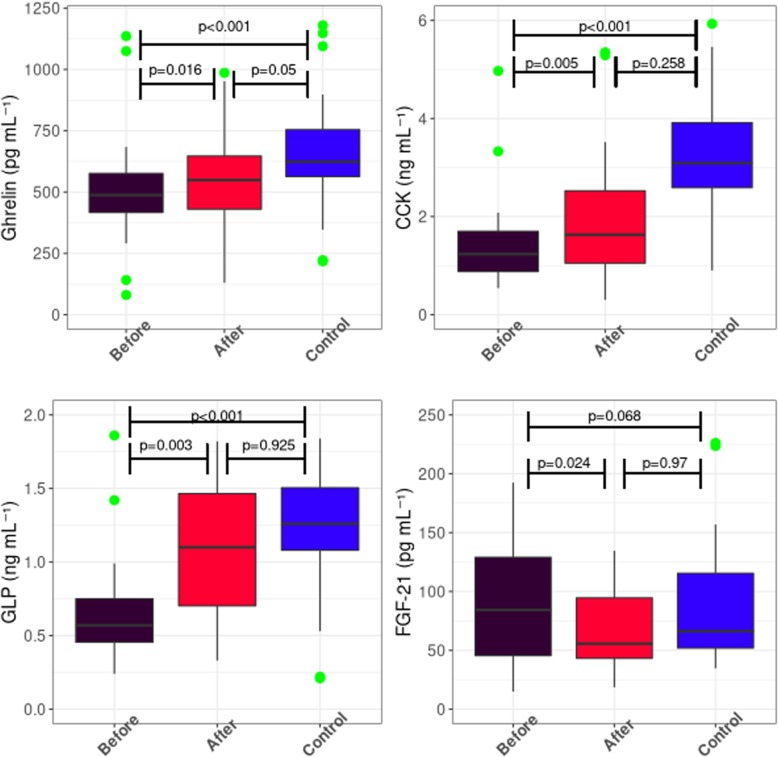
Acute graft versus host disease was diagnosed in 11 patients (41%, n = 27). Median pre-transplantation concentrations of gastrointestinal peptides, as well as their gene expressions, were significantly lower in studied group compared with the control group. Only median of fibroblast growth factor-21 concentration was near-significantly higher before stem cell transplantation than in the control group. The post-hematopoietic transplant results revealed significantly higher concentrations of the studied peptides (except fibroblast growth factor-21) and respective gene expressions as compare to pre transplant results. Median glucagone like peptide-1 concentrations were significantly decreased in patients with features of acute graft versus host disease. Moreover, negative correlation between glucagone like peptide-1 concentrations and acute graft versus host disease severity was found.
Increased concentrations and gene expressions of gastrointestinal tract regulation peptides can be caused by stimulation of regeneration in the severe injured organ. Measurement of these parameters may be a useful method of assessment of severity of gastrointestinal tract complications of hematopoietic stem cell transplantation.
胃肠道功能及其完整性受多种肽类物质的控制,这些肽类物质的分泌受严重炎症的影响。在胃中,主要的调节肽是胃饥饿素。在上小肠中分泌胆囊收缩素,在下小肠中分泌胰高血糖素样肽-1,而成纤维细胞生长因子-21 则由包括肝脏、胰腺和脂肪组织在内的多个器官分泌。造血干细胞移植会导致严重的黏膜损伤,这会反映在这些肽类物质上。
本研究旨在确定造血干细胞移植前后空腹血浆中胃饥饿素、胆囊收缩素、胰高血糖素样肽-1 和成纤维细胞生长因子-21 的浓度及其基因表达。研究了 27 名儿童,对照组包括 26 名健康儿童。
11 名患者(41%,n=27)被诊断为急性移植物抗宿主病。与对照组相比,研究组移植前胃肠肽的中位数浓度及其基因表达均显著降低。只有成纤维细胞生长因子-21 的中位数浓度在干细胞移植前略高于对照组。造血移植后的结果显示,研究的肽(成纤维细胞生长因子-21 除外)及其各自的基因表达浓度均显著高于移植前。在有急性移植物抗宿主病特征的患者中,胰高血糖素样肽-1 的浓度显著降低。此外,还发现胰高血糖素样肽-1 浓度与急性移植物抗宿主病严重程度呈负相关。
严重受损器官再生的刺激可能导致胃肠道调节肽浓度和基因表达增加。这些参数的测量可能是评估造血干细胞移植后胃肠道并发症严重程度的有用方法。