Leuven Mindfulness Centre, Faculty of Psychology and Educational Sciences, University of Leuven, Tiensestraat 102, 3000, Leuven, Belgium.
Department of Imaging and Pathology, KU Leuven, Herestraat 49, 3000, Leuven, Belgium.
Trials. 2020 Mar 23;21(1):290. doi: 10.1186/s13063-020-4204-8.
Mindfulness has been applied to improve cancer care by enhancing psychological well-being. However, little is known about its impact on cognitive impairment experienced by cancer patients after chemotherapy. Mindfulness may be relevant in tackling cognitive impairment by decreasing emotional distress and fatigue, by decreasing inflammation, and by strengthening functional brain connectivity. The aim of the present study protocol is to evaluate the efficacy and mechanisms of a mindfulness-based intervention to reduce cognitive impairment in breast cancer patients after chemotherapy.
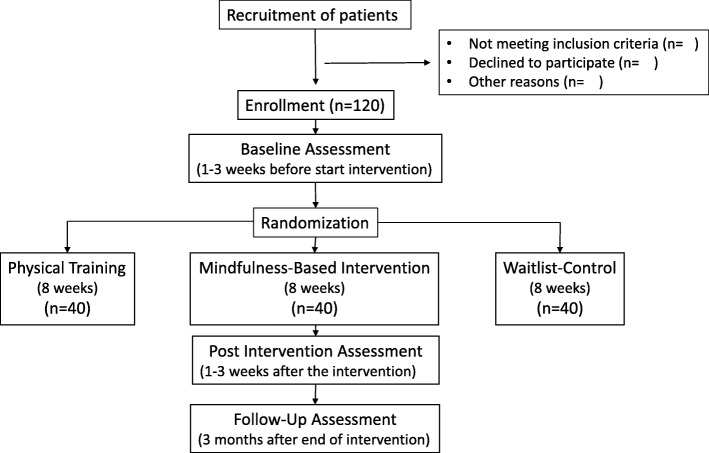
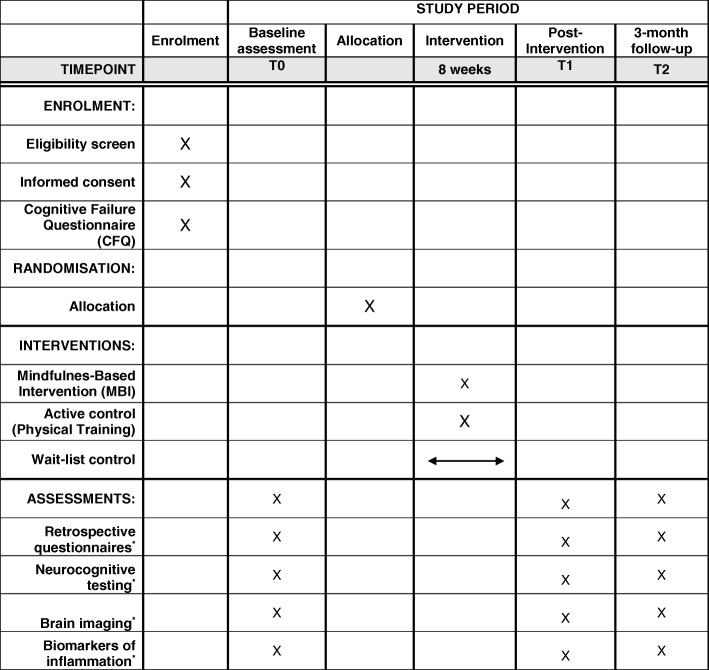
METHODS/DESIGN: The present study is a three-arm, parallel-group, randomized controlled trial with assessments at baseline, 1 to 3 weeks after the intervention and at 3 months' follow-up. One hundred and twenty breast cancer patients who ended treatment a minimum of 6 months and a maximum of 5 years before, and who have cognitive complaints, will be enrolled. They will be randomized into one of the following three study arms: (1) a mindfulness-based intervention group (n = 40), (2) an active control condition based on physical training (n = 40), or (3) a treatment as usual (TAU) control group (n = 40). Both the mindfulness-based intervention and the active control condition consist of four group sessions (3 h for the mindfulness condition and 2 h for the physical training) spread over 8 weeks. The primary outcomes will be cognitive symptoms as measured by the Cognitive Failure Questionnaire and changes in functional brain connectivity in the attention network. Secondary outcomes will be (1) levels of emotional distress, fatigue, mindfulness, quality of life; (2) neurocognitive tests; (3) structural and functional brain changes using MR imaging and (4) measures of inflammation.
The study will examine the impact of a mindfulness-based intervention on cognitive impairment in breast cancer patients. If the findings of this study confirm the effectiveness of a mindfulness-based program to reduce cognitive impairment, it will be possible to improve quality of life for ex-cancer patients. We will inform health care providers about the potential use of a mindfulness-based intervention as a non-pharmaceutical, low-threshold mental health intervention to improve cognitive impairment after cancer.
ClinicalTrials.gov, ID: NCT03736460. Retrospectively registered on 8 November 2018.
正念已被应用于通过增强心理幸福感来改善癌症护理。然而,对于正念对癌症患者化疗后认知障碍的影响知之甚少。正念可能通过减轻情绪困扰和疲劳、减轻炎症和增强功能性大脑连接来解决认知障碍问题。本研究方案的目的是评估基于正念的干预措施对化疗后乳腺癌患者认知障碍的疗效和机制。
方法/设计:本研究是一项三臂、平行组、随机对照试验,在基线、干预后 1 至 3 周和 3 个月随访时进行评估。招募 120 名至少结束治疗 6 个月、最长 5 年且有认知主诉的乳腺癌患者。他们将被随机分配到以下三个研究组之一:(1)基于正念的干预组(n=40)、(2)基于身体训练的积极对照组(n=40)或(3)常规治疗(TAU)对照组(n=40)。基于正念的干预和积极对照组均包括四个小组课程(正念条件下 3 小时,身体训练条件下 2 小时),共 8 周。主要结局将是认知失败问卷测量的认知症状和注意力网络中功能性大脑连接的变化。次要结局将是:(1)情绪困扰、疲劳、正念、生活质量水平;(2)神经认知测试;(3)使用磁共振成像测量结构和功能脑变化;(4)炎症测量。
本研究将检查基于正念的干预对乳腺癌患者认知障碍的影响。如果这项研究的结果证实基于正念的方案可以减少认知障碍,那么就有可能提高癌症患者的生活质量。我们将向医疗保健提供者通报将基于正念的干预作为一种非药物、低门槛的心理健康干预措施用于改善癌症后的认知障碍的潜在用途。
ClinicalTrials.gov,编号:NCT03736460。于 2018 年 11 月 8 日回顾性注册。