Ma David D F, Fennessy Kate, Kliman David
Department of Haematology and Bone Marrow Transplant, St Vincent's Hospital Sydney, 390 Victoria Street, Darlinghurst, NSW, Australia.
Department of Haematology, Royal North Shore Hospital, Sydney, NSW, Australia.
BMC Sports Sci Med Rehabil. 2022 Sep 5;14(1):167. doi: 10.1186/s13102-022-00554-7.
Impaired quality of life (QOL) including reduced physical fitness is a recognized late effect of hemopoietic cell transplantation (HCT). Guided exercise and mindfulness-based stress management (MBSM) programs have shown promise, mainly in the inpatient setting. We aimed to examine the feasibility of a virtual, home-based, combined exercise and MBSM program.
Patients attending post-HCT clinic were invited to participate in this single-arm pre-post study. Eligibility criteria included age 18-75 years, > 6 months post allogeneic HCT. Consented participants attended an in-person session, followed by weekly exercise and MBSM training for 6 weeks via videoconferencing. Assessments were performed pre-training, and at 3-, 6- and 12-months and compared using a linear mixed effects model.
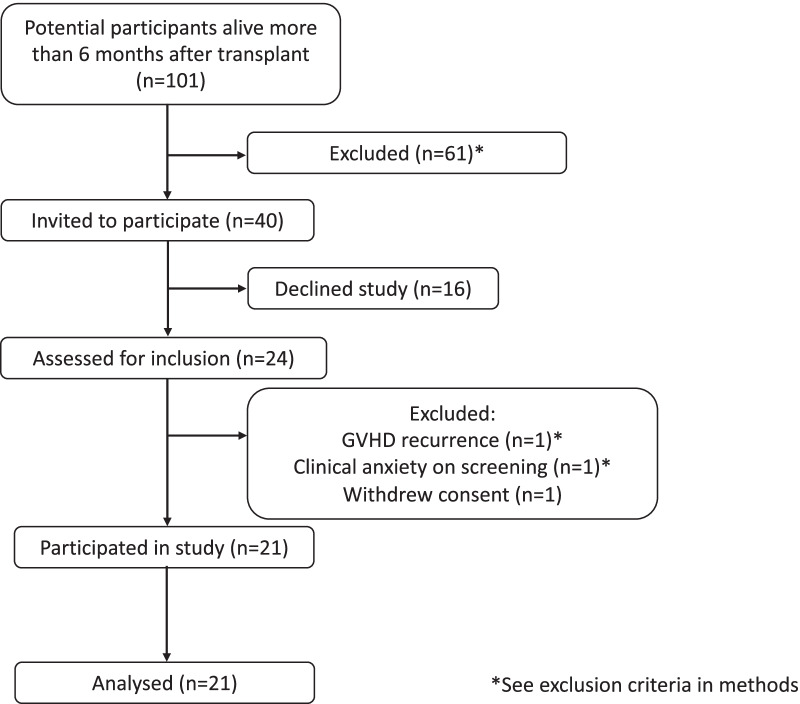
21 of 24 patients consenting to the study completed the program (median age 56 years [IQR 46-62], median time post-HCT 37 months [IQR 26-46]). Six-minute walk test scores were significantly higher at 3 (mean difference 79.6, 95%CI 28-131, ES 0.55) and 12 months (mean difference 48.4, 95%CI 13-84, ES 0.33) compared to baseline. Sit-to-stand test was significantly higher at 3 (mean difference 4.4, 95%CI 1.4-7.4, ES 0.68) and 12 months (mean difference 3.9, 95%CI 0.24-7.6, ES 0.61). Dominant hand grip was significantly stronger at 3 (mean difference 0.16, 95%CI 0.04-0.28, ES 0.45), and 12 months (mean difference 0.21, 95%CI 0.08-0.24, ES 0.62). Significantly higher FACT-BMT total (mean difference 6.9, 95%CI 1.5-12.4, ES 0.49) and FACT-G scores (mean difference 5.2, 95%CI 1.4-9.1, ES 0.48) were found at 3 months. Over 80% of participants rated the virtual combined modal program highly and no adverse events were reported.
A 6-week virtual, home-based exercise and MBSM program was an acceptable, and potentially effective intervention for sustained improvement of some physical capacity and QOL outcomes in HCT survivors. Virtual-based healthcare service is highly relevant particularly during pandemics. To our knowledge, this study has the longest follow-up observation period for Internet based combined modality training program reported to date and warrants additional investigation. Trial Registration Research protocol approved by St Vincent's Hospital Ethics Committee (HREC 12/SVH/175), approved 27/09/2012, trial commenced 24/05/13 and the first participant 07/06/13. Retrospectively registered with ANZCTR (ACTRN12613001054707) 23/09/2013.
生活质量受损,包括身体素质下降,是造血细胞移植(HCT)公认的晚期效应。有指导的运动和基于正念的压力管理(MBSM)计划已显示出前景,主要是在住院环境中。我们旨在研究虚拟的、基于家庭的运动与MBSM联合计划的可行性。
邀请参加HCT后门诊的患者参与这项单臂前后对照研究。纳入标准包括年龄18 - 75岁,异基因HCT后超过6个月。同意参与的参与者参加一次面对面会议,随后通过视频会议进行为期6周的每周运动和MBSM训练。在训练前、3个月、6个月和12个月进行评估,并使用线性混合效应模型进行比较。
24名同意参与研究的患者中有21名完成了该计划(中位年龄56岁[四分位间距46 - 62],HCT后中位时间37个月[四分位间距26 - 46])。与基线相比,6分钟步行试验评分在3个月时显著更高(平均差异79.6,95%可信区间28 - 131,效应量0.55),在12个月时也显著更高(平均差异48.4,95%可信区间13 - 84,效应量0.33)。坐立试验在3个月时显著更高(平均差异4.4,95%可信区间1.4 - 7.4,效应量0.68),在12个月时也显著更高(平均差异3.9,95%可信区间0.24 - 7.6,效应量0.61)。优势手握力在3个月时显著更强(平均差异0.16,95%可信区间0.04 - 0.28,效应量0.45),在12个月时也显著更强(平均差异0.21,95%可信区间0.08 - 0.34,效应量0.62)。在3个月时发现FACT - BMT总分显著更高(平均差异6.9,95%可信区间1.5 - 12.4,效应量0.49)和FACT - G评分显著更高(平均差异5.2,95%可信区间1.4 - 9.仁效应量0.48)。超过80%的参与者对虚拟联合模式计划给予高度评价,且未报告不良事件。
为期6周的虚拟、基于家庭的运动和MBSM计划是一种可接受的、可能有效的干预措施,可使HCT幸存者的某些身体能力和生活质量结果持续改善。基于虚拟的医疗服务尤其在大流行期间具有高度相关性。据我们所知,本研究是迄今为止报道的基于互联网的联合模式训练计划随访观察期最长的研究,值得进一步研究。试验注册:研究方案经圣文森特医院伦理委员会批准(HREC 12/SVH/175),批准日期为2012年9月27日,试验于2013年5月24日开始,首位参与者于2013年6月7日参与。于2013年9月23日在澳大利亚和新西兰临床试验注册中心(ANZCTR)进行回顾性注册(ACTRN12613001054707)。