Slightam Cindie, Gregory Amy J, Hu Jiaqi, Jacobs Josephine, Gurmessa Tolessa, Kimerling Rachel, Blonigen Daniel, Zulman Donna M
Center for Innovation to Implementation, Veterans Affairs Palo Alto Health Care System, Menlo Park, CA, United States.
Division of Primary Care and Population Health, Stanford University School of Medicine, Stanford, CA, United States.
J Med Internet Res. 2020 Apr 15;22(4):e15682. doi: 10.2196/15682.
Video-based health care can help address access gaps for patients and is rapidly being offered by health care organizations. However, patients who lack access to technology may be left behind in these initiatives. In 2016, the US Department of Veterans Affairs (VA) began distributing video-enabled tablets to provide video visits to veterans with health care access barriers.
This study aimed to evaluate veterans' experiences with VA-issued tablets and identify patient characteristics associated with preferences for video visits vs in-person care.
A baseline survey was sent to the tablet recipients, and a follow-up survey was sent to the respondents 3 to 6 months later. Multivariate logistic regression was used to identify patient characteristics associated with preferences for care, and we examined qualitative themes around care preferences using standard content analysis methods for coding the data collected in the open-ended questions.
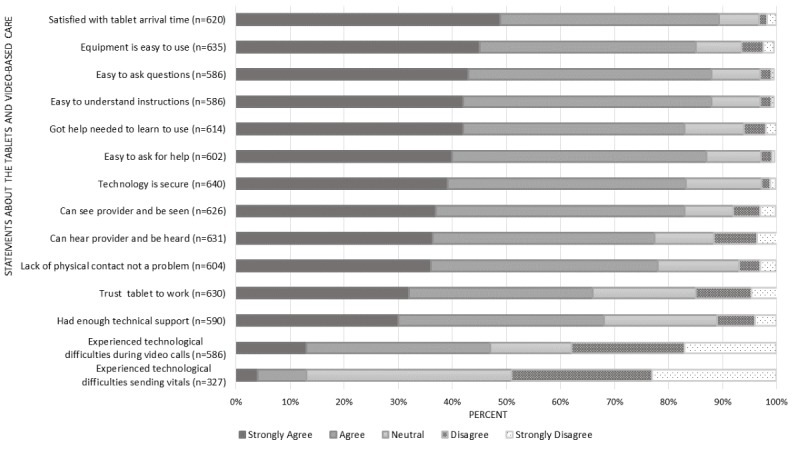
Patient-reported access barriers centered around transportation and health-related challenges, outside commitments, and feeling uncomfortable or uneasy at the VA. Satisfaction with the tablet program was high, and in the follow-up survey, approximately two-thirds of tablet recipients preferred care via a tablet (194/604, 32.1%) or expressed that video-based and in-person care were "about the same" (216/604, 35.7%), whereas one-third (192/604, 31.7%) indicated a preference for in-person care. Patients were significantly more likely to report a preference for video visits (vs a preference for in-person visits or rating them "about the same") if they felt uncomfortable in a VA setting, reported a collaborative communication style with their doctor, had a substance use disorder diagnosis, or lived in a place with better broadband coverage. Patients were less likely to report a preference for video visits if they had more chronic conditions. Qualitative analyses identified four themes related to preferences for video-based care: perceived improvements in access to care, perceived differential quality of care, feasibility of obtaining necessary care, and technology-related challenges.
Many recipients of VA-issued tablets report that video care is equivalent to or preferred to in-person care. Results may inform efforts to identify good candidates for virtual care and interventions to support individuals who experience technical challenges.
基于视频的医疗保健有助于解决患者的就医差距问题,并且医疗保健机构正在迅速提供此类服务。然而,那些无法使用技术的患者可能会在这些举措中被落下。2016年,美国退伍军人事务部(VA)开始分发具备视频功能的平板电脑,以便为有医疗保健获取障碍的退伍军人提供视频问诊服务。
本研究旨在评估退伍军人使用VA发放的平板电脑的体验,并确定与视频问诊偏好相对于面对面护理偏好相关的患者特征。
向平板电脑接收者发送了一份基线调查问卷,并在3至6个月后向受访者发送了一份随访调查问卷。使用多变量逻辑回归来确定与护理偏好相关的患者特征,并且我们使用标准内容分析方法对开放式问题中收集的数据进行编码,从而研究围绕护理偏好的定性主题。
患者报告的就医障碍集中在交通和与健康相关的挑战、外部事务,以及在VA感到不舒服或不安。对平板电脑项目的满意度很高,在随访调查中,大约三分之二的平板电脑接收者更喜欢通过平板电脑接受护理(194/604,32.1%),或者表示基于视频的护理和面对面护理“差不多”(216/604,35.7%),而三分之一(192/604,31.7%)的人表示更喜欢面对面护理。如果患者在VA环境中感到不舒服、报告与医生采用协作式沟通方式、有物质使用障碍诊断,或者居住在宽带覆盖较好的地方,那么他们更有可能报告更喜欢视频问诊(相对于更喜欢面对面问诊或将两者评为“差不多”)。如果患者患有更多慢性病,那么他们报告更喜欢视频问诊的可能性较小。定性分析确定了与基于视频的护理偏好相关的四个主题:就医机会的感知改善、护理质量的感知差异、获得必要护理的可行性,以及与技术相关的挑战。
许多VA发放的平板电脑接收者报告称,视频护理等同于或优于面对面护理。研究结果可能为确定虚拟护理的合适人选以及支持遇到技术挑战的个人的干预措施提供参考。