WHO Collaborating Centre for Reference and Research on Influenza, at the Peter Doherty Institute for Infection and Immunity, Melbourne, Australia.
Department of Infectious Disease, Imperial College London, London, United Kingdom.
PLoS Pathog. 2020 Apr 15;16(4):e1008395. doi: 10.1371/journal.ppat.1008395. eCollection 2020 Apr.
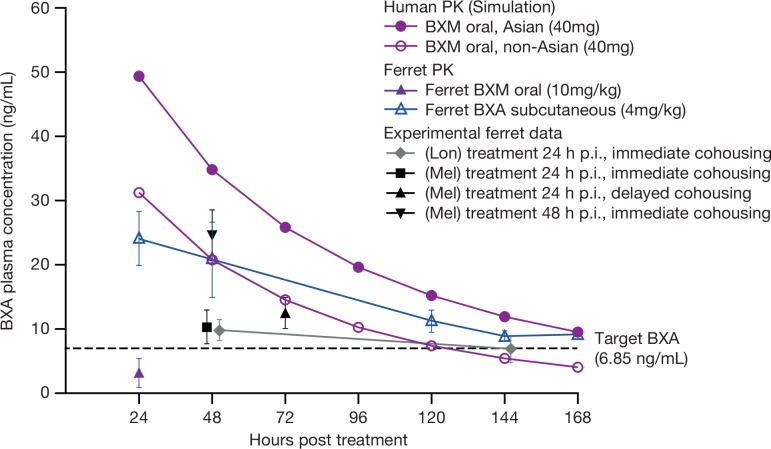
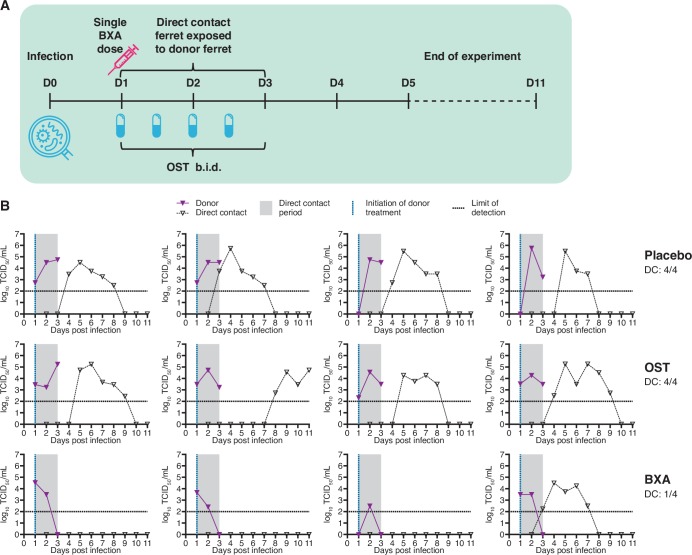
Influenza viruses cause seasonal outbreaks and pose a continuous pandemic threat. Although vaccines are available for influenza control, their efficacy varies each season and a vaccine for a novel pandemic virus manufactured using current technology will not be available fast enough to mitigate the effect of the first pandemic wave. Antivirals can be effective against many different influenza viruses but have not thus far been used extensively for outbreak control. Baloxavir, a recently licensed antiviral drug that targets the influenza virus endonuclease, has been shown to reduce virus shedding more effectively than oseltamivir, a widely used neuraminidase inhibitor drug. Thus it is possible that treatment with baloxavir might also interrupt onward virus transmission. To test this, we utilized the ferret model, which is the most commonly used animal model to study influenza virus transmission. We established a subcutaneous baloxavir administration method in ferrets which achieved similar pharmacokinetics to the approved human oral dose. Transmission studies were then conducted in two different locations with different experimental setups to compare the onward transmission of A(H1N1)pdm09 virus from infected ferrets treated with baloxavir, oseltamivir or placebo to naïve sentinel ferrets exposed either indirectly in adjacent cages or directly by co-housing. We found that baloxavir treatment reduced infectious viral shedding in the upper respiratory tract of ferrets compared to placebo, and reduced the frequency of transmission amongst sentinels in both experimental setups, even when treatment was delayed until 2 days post-infection. In contrast, oseltamivir treatment did not substantially affect viral shedding or transmission compared to placebo. We did not detect the emergence of baloxavir-resistant variants in treated animals or in untreated sentinels. Our results support the concept that antivirals which decrease viral shedding could also reduce influenza transmission in the community.
流感病毒会引起季节性爆发,并持续构成大流行威胁。虽然有针对流感的疫苗,但它们在每个季节的效果各不相同,而且使用当前技术制造的针对新型大流行病毒的疫苗无法快速供应,不足以减轻第一波大流行的影响。抗病毒药物可有效对抗许多不同的流感病毒,但迄今为止尚未广泛用于疫情控制。巴洛沙韦是一种最近获得许可的抗病毒药物,针对流感病毒内切酶,已被证明比广泛使用的神经氨酸酶抑制剂奥司他韦更有效地减少病毒脱落。因此,用巴洛沙韦治疗也有可能阻断病毒的进一步传播。为了验证这一点,我们利用了雪貂模型,这是最常用于研究流感病毒传播的动物模型。我们在雪貂中建立了一种皮下巴洛沙韦给药方法,其药代动力学与批准的人类口服剂量相似。然后,我们在两个不同的地点进行了传播研究,采用不同的实验设置,比较了经巴洛沙韦、奥司他韦或安慰剂治疗的感染雪貂向未感染的哨雪貂传播 A(H1N1)pdm09 病毒的情况,哨雪貂通过间接在相邻笼子中或直接共同饲养暴露于病毒。我们发现,与安慰剂相比,巴洛沙韦治疗降低了雪貂上呼吸道的传染性病毒脱落,并且降低了两种实验设置中哨雪貂之间的传播频率,即使治疗延迟到感染后 2 天。相比之下,奥司他韦治疗与安慰剂相比,并未显著影响病毒脱落或传播。我们在治疗动物或未治疗的哨雪貂中均未检测到巴洛沙韦耐药变异体的出现。我们的结果支持这样一种概念,即减少病毒脱落的抗病毒药物也可以减少社区中的流感传播。