Department of Cellular and Molecular Biology, The University of Texas Health Science Center at Tyler, Tyler, TX; and.
Coagulation Biology Laboratory, Oklahoma Medical Research Foundation, Oklahoma City, OK.
Blood. 2020 Jun 18;135(25):2211-2223. doi: 10.1182/blood.2019003824.
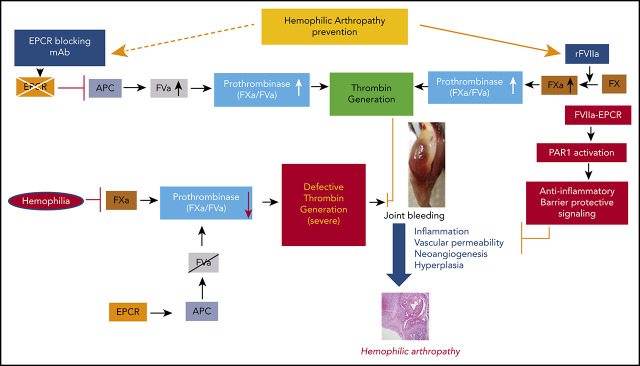
We recently showed that clotting factor VIIa (FVIIa) binding to endothelial cell protein C receptor (EPCR) induces anti-inflammatory signaling and protects vascular barrier integrity. Inflammation and vascular permeability are thought to be major contributors to the development of hemophilic arthropathy following hemarthrosis. The present study was designed to investigate the potential influence of FVIIa interaction with EPCR in the pathogenesis of hemophilic arthropathy and its treatment with recombinant FVIIa (rFVIIa). For this, we first generated hemophilia A (FVIII-/-) mice lacking EPCR (EPCR-/-FVIII-/-) or overexpressing EPCR (EPCR++ FVIII-/-). Joint bleeding was induced in FVIII-/-, EPCR-/-FVIII-/-, and EPCR++FVIII-/- mice by needle puncture injury. Hemophilic synovitis was evaluated by monitoring joint bleeding, change in joint diameter, and histopathological analysis of joint tissue sections. EPCR deficiency in FVIII-/- mice significantly reduced the severity of hemophilic synovitis. EPCR deficiency attenuated the elaboration of interleukin-6, infiltration of macrophages, and neoangiogenesis in the synovium following hemarthrosis. A single dose of rFVIIa was sufficient to fully prevent the development of milder hemophilic synovitis in EPCR-/-FVIII-/- mice. The development of hemophilic arthropathy in EPCR-overexpressing FVIII-/- mice did not significantly differ from that of FVIII-/- mice, and 3 doses of rFVIIa partly protected against hemophilic synovitis in these mice. Consistent with the data that EPCR deficiency protects against developing hemophilic arthropathy, administration of a single dose of EPCR-blocking monoclonal antibodies markedly reduced hemophilic synovitis in FVIII-/- mice subjected to joint bleeding. The present data indicate that EPCR could be an attractive new target to prevent joint damage in hemophilia patients.
我们最近表明,凝血因子 VIIa(FVIIa)与内皮细胞蛋白 C 受体(EPCR)结合可诱导抗炎信号,并保护血管屏障完整性。炎症和血管通透性被认为是血友病性关节炎在关节积血后发展的主要原因。本研究旨在探讨 FVIIa 与 EPCR 相互作用在血友病性关节炎发病机制中的潜在影响及其用重组 FVIIa(rFVIIa)治疗。为此,我们首先生成缺乏 EPCR(EPCR-/-FVIII-/-)或过表达 EPCR(EPCR++FVIII-/-)的血友病 A(FVIII-/-)小鼠。通过针穿刺损伤诱导 FVIII-/-, EPCR-/-FVIII-/-和 EPCR++FVIII-/-小鼠关节出血。通过监测关节出血、关节直径变化和关节组织切片的组织学分析来评估血友病性滑膜炎。FVIII-/-小鼠中 EPCR 的缺失显著降低了血友病性滑膜炎的严重程度。EPCR 缺失可减弱关节积血后滑膜中白细胞介素 6 的产生、巨噬细胞浸润和新血管生成。单次 rFVIIa 剂量足以完全预防 EPCR-/-FVIII-/-小鼠中更轻微的血友病性滑膜炎的发生。EPCR 过表达 FVIII-/-小鼠中血友病性关节炎的发展与 FVIII-/-小鼠无明显差异,3 次 rFVIIa 剂量部分保护了这些小鼠的血友病性滑膜炎。与 EPCR 缺失可预防血友病性关节炎发展的数据一致,单次给予 EPCR 阻断单克隆抗体可显著减轻接受关节出血的 FVIII-/-小鼠的血友病性滑膜炎。本数据表明 EPCR 可能成为预防血友病患者关节损伤的一个有吸引力的新靶点。