Department of Genetics, Physiology and Microbiology, School of Biology, Complutense University, 28040 Madrid, Spain.
Department of Physiology, School of Veterinary Medicine, Complutense University of Madrid, 28040 Madrid, Spain.
Int J Mol Sci. 2022 Jul 27;23(15):8283. doi: 10.3390/ijms23158283.
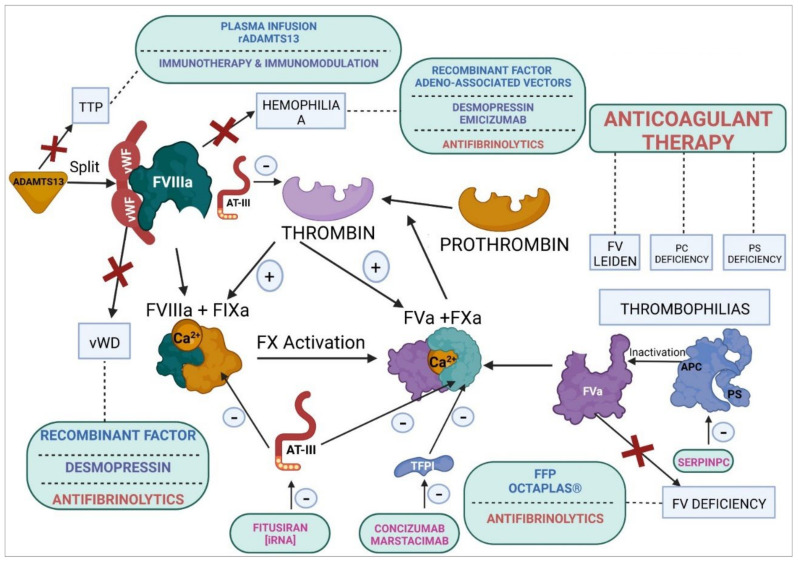
The vascular endothelium has several important functions, including hemostasis. The homeostasis of hemostasis is based on a fine balance between procoagulant and anticoagulant proteins and between fibrinolytic and antifibrinolytic ones. Coagulopathies are characterized by a mutation-induced alteration of the function of certain coagulation factors or by a disturbed balance between the mechanisms responsible for regulating coagulation. Homeostatic therapies consist in replacement and nonreplacement treatments or in the administration of antifibrinolytic agents. Rebalancing products reestablish hemostasis by inhibiting natural anticoagulant pathways. These agents include monoclonal antibodies, such as concizumab and marstacimab, which target the tissue factor pathway inhibitor; interfering RNA therapies, such as fitusiran, which targets antithrombin III; and protease inhibitors, such as serpinPC, which targets active protein C. In cases of thrombophilia (deficiency of protein C, protein S, or factor V Leiden), treatment may consist in direct oral anticoagulants, replacement therapy (plasma or recombinant ADAMTS13) in cases of a congenital deficiency of ADAMTS13, or immunomodulators (prednisone) if the thrombophilia is autoimmune. Monoclonal-antibody-based anti-vWF immunotherapy (caplacizumab) is used in the context of severe thrombophilia, regardless of the cause of the disorder. In cases of disseminated intravascular coagulation, the treatment of choice consists in administration of antifibrinolytics, all-trans-retinoic acid, and recombinant soluble human thrombomodulin.
血管内皮具有多种重要功能,包括止血。止血的动态平衡基于促凝和抗凝蛋白以及纤维蛋白溶解和抗纤维蛋白溶解蛋白之间的精细平衡。凝血异常的特征是某些凝血因子的功能因突变而改变,或者是调节凝血的机制之间的平衡失调。稳态治疗包括替代和非替代治疗,或给予抗纤维蛋白溶解剂。平衡恢复治疗通过抑制天然抗凝途径来恢复止血。这些药物包括单克隆抗体,如 concizumab 和 marstacimab,其靶向组织因子途径抑制剂;干扰 RNA 疗法,如 fitusiran,其靶向抗凝血酶 III;以及蛋白酶抑制剂,如 serpinc,其靶向活性蛋白 C。在血栓形成倾向(蛋白 C、蛋白 S 或因子 V 莱顿缺乏)的情况下,治疗可能包括直接口服抗凝剂、ADAMTS13 先天性缺乏时的替代疗法(血浆或重组 ADAMTS13),或自身免疫性血栓形成倾向时的免疫调节剂(泼尼松)。基于单克隆抗体的抗 vWF 免疫疗法(caplacizumab)用于严重血栓形成倾向,无论疾病的原因如何。在弥漫性血管内凝血的情况下,首选的治疗方法是给予抗纤维蛋白溶解剂、全反式维甲酸和重组可溶性人血栓调节蛋白。