Lassalle Sandra, Hofman Véronique, Heeke Simon, Benzaquen Jonathan, Long Elodie, Poudenx Michel, Lantéri Elisabeth, Boutros Jacques, Tanga Virginie, Zahaf Katia, Lalvée Salomé, Lespinet Virginie, Bordone Olivier, Félix Jean-Marc, Bonnetaud Christelle, Marquette Charles, Ilie Marius, Hofman Paul
Laboratory of Clinical and Experimental Pathology, Pasteur Hospital, University Côte d'Azur, 30 avenue de la voie romaine, 06000 Nice, France.
Hospital-Related Biobank (BB-0033-00025), Pasteur Hospital, University Côte d'Azur, 30 avenue de la voie romaine, 06000 Nice, France.
Cancers (Basel). 2020 Apr 13;12(4):955. doi: 10.3390/cancers12040955.
Assessment of actionable mutations is mandatory for treatment-naïve advanced or metastatic non-squamous lung carcinoma (NSLC), but the results need to be obtained in less than 10 working days. For rapid testing, an -specific polymerase chain reaction (PCR) assay is an alternative and simple approach compared to next generation sequencing (NGS). Here, we describe how a rapid -specific PCR assay can be implemented in a single laboratory center (LPCE, Nice, France) as reflex testing in treatment-naïve NSLC.
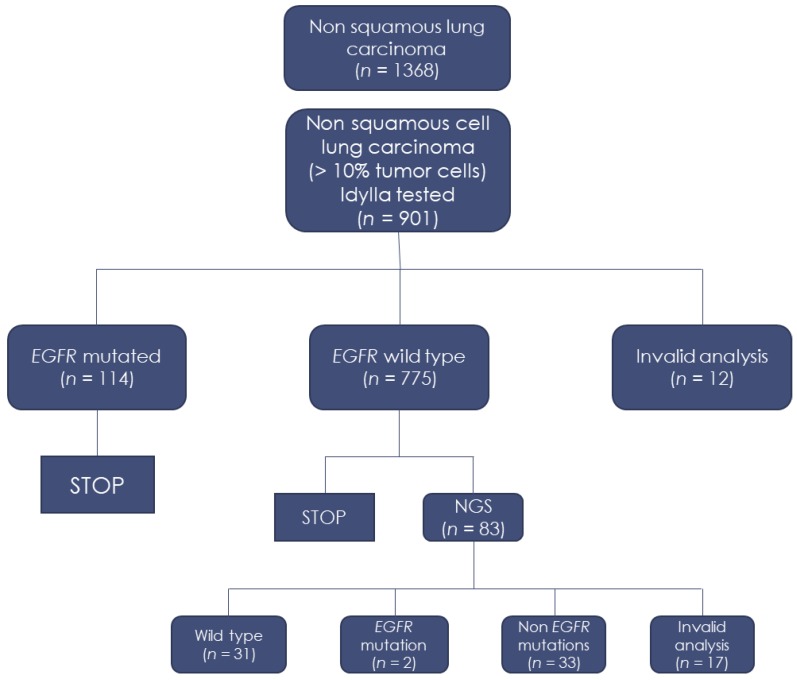
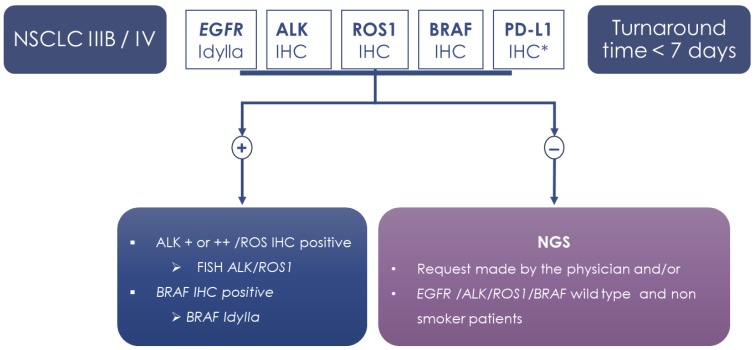
A total of 901 biopsies from NSLC with more than 10% of tumor cells were prospectively and consecutively evaluated for mutation status between November 2017 and December 2019 using the Idylla system (Biocartis NV, Mechelen, Belgium). NGS was performed for nonsmokers with NSLC wild type for , , , and and with less than 50% PD-L1 positive cells using the Hotspot panel (Thermo Fisher Scientific, Waltham, MA, USA).
Results were obtained from 889/901 (97%) biopsies with detection of mutations in 114/889 (13%) cases using the Idylla system. Among the 562 wild type tumors identified with Idylla, NGS detected one actionable and one nonactionable mutation.
Rapid and targeted assessment of mutations in treatment-naïve NSLC can be implemented in routine clinical practice. However, it is mandatory to integrate this approach into a molecular algorithm that allows evaluation of potentially actionable genomic alterations other than mutations.
对于初治的晚期或转移性非鳞状非小细胞肺癌(NSLC),评估可操作的突变是必要的,但结果需要在不到10个工作日内获得。对于快速检测,与下一代测序(NGS)相比,一种特异性聚合酶链反应(PCR)检测是一种替代且简单的方法。在此,我们描述了如何在单个实验室中心(法国尼斯的LPCE)将快速特异性PCR检测作为初治NSLC的补充检测实施。
2017年11月至2019年12月期间,使用Idylla系统(比利时梅赫伦的Biocartis NV)对901例肿瘤细胞占比超过10%的NSLC活检样本进行前瞻性连续评估,以确定其突变状态。对非吸烟的NSLC患者进行NGS检测,这些患者的 、 、 和 为野生型且PD-L1阳性细胞少于50%,使用热点基因panel(美国马萨诸塞州沃尔瑟姆的赛默飞世尔科技公司)。
889/901(97%)例活检样本获得了结果,使用Idylla系统在114/889(13%)例病例中检测到 突变。在通过Idylla鉴定出的562例 野生型肿瘤中,NGS检测到1个可操作的和1个不可操作的 突变。
初治NSLC中 突变的快速靶向评估可在常规临床实践中实施。然而,必须将这种方法整合到分子算法中,以允许评估除 突变之外的潜在可操作的基因组改变。