Fjaeldstad Alexander W, Fernandes Henrique M
Flavour Institute, Aarhus University, Palle Juul-Jensens Boulevard 99, 8200 Aarhus N, Denmark.
Flavour Clinic, ENT Department, Holstebro Regional Hospital, Laegaardsvej 12, 7500 Holstebro, Denmark.
Foods. 2020 Apr 14;9(4):493. doi: 10.3390/foods9040493.
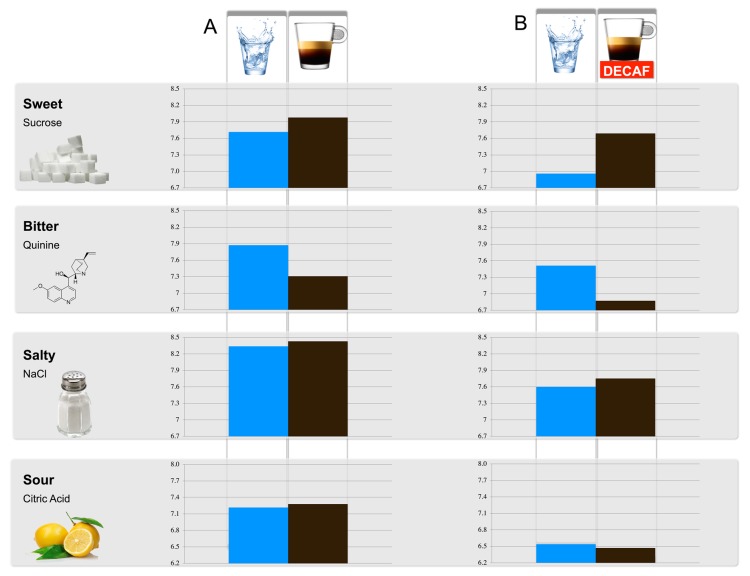
Chemosensory sensitivity has great variation between individuals. This variation complicates the chemosensory diagnostics, as well as the creation of a meal with universally high hedonic value. To ensure accurate characterization of chemosensory function, a common rule of thumb is to avoid food/beverages one hour before chemosensory testing. However, the scientific foundation of this time of fast remains unclear. Furthermore, the role of coffee on immediate chemosensitivity is not known and may have implications for optimization of gastronomy and hedonia. The aim of this study is to investigate the modularity effects of coffee consumption on immediate gustatory and olfactory sensitivity. We included 155 participants. By applying tests for olfactory and gustatory sensitivity before and after coffee intake, we found no changes in olfactory sensitivity, but significantly altered sensitivity for some basic tastants. We repeated our experimental paradigm using decaffeinated coffee and found similar results. Our results demonstrate that coffee (regular and decaffeinated) alters the subsequent perception of taste, specifically by increasing the sensitivity to sweet and decreasing the sensitivity to bitter. Our findings provide the first evidence of how coffee impacts short-term taste sensitivity and consequently the way we sense and perceive food following coffee intake-an important insight in the context of gastronomy, as well as in chemosensory testing procedures.
化学感觉敏感性在个体之间存在很大差异。这种差异使化学感觉诊断以及制作具有普遍高享乐价值的餐食变得复杂。为确保准确表征化学感觉功能,一个常见的经验法则是在化学感觉测试前一小时避免食用食物/饮料。然而,这种禁食时间的科学依据仍不清楚。此外,咖啡对即时化学敏感性的作用尚不清楚,可能对美食学和享乐主义的优化有影响。本研究的目的是调查饮用咖啡对即时味觉和嗅觉敏感性的模块化影响。我们纳入了155名参与者。通过在摄入咖啡前后进行嗅觉和味觉敏感性测试,我们发现嗅觉敏感性没有变化,但一些基本味觉物质的敏感性有显著改变。我们使用脱咖啡因咖啡重复了我们的实验范式,发现了类似的结果。我们的结果表明,咖啡(普通咖啡和脱咖啡因咖啡)会改变随后的味觉感知,具体表现为增加对甜味的敏感性并降低对苦味的敏感性。我们的研究结果首次证明了咖啡如何影响短期味觉敏感性,进而影响我们在摄入咖啡后感知食物的方式——这在美食学以及化学感觉测试程序方面是一个重要的见解。