Malongane Florence, McGaw Lyndy Joy, Debusho Legesse Kassa, Mudau Fhatuwani Nixwell
Department of Life and Consumer Sciences, College of Agriculture and Environmental Sciences, University of South Africa, Private Bag X6, Florida 1710, South Africa.
Phytomedicine Programme, Department of Paraclinical Sciences, University of Pretoria, Private Bag X04, Onderstepoort, Pretoria 0110, South Africa.
Foods. 2020 Apr 14;9(4):496. doi: 10.3390/foods9040496.
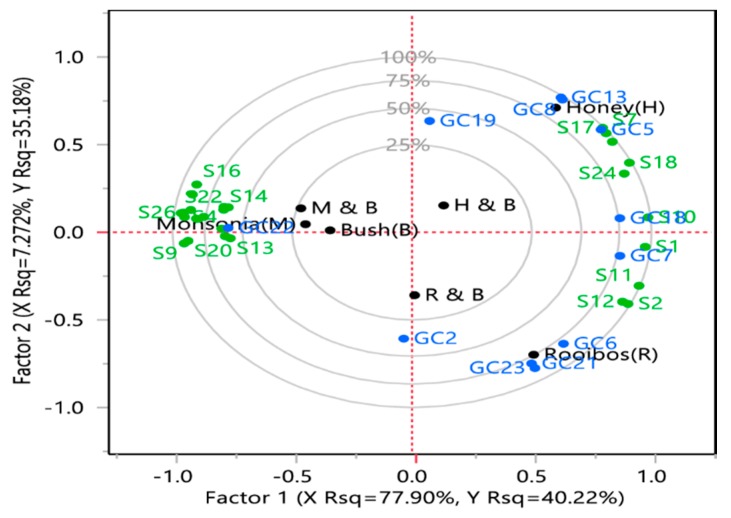
South Africa has a traditional heritage of using indigenous herbal teas, and the demand for herbal teas motivated by the functional health benefits has far exceeded global supply. This has led to worldwide interest in the sensory characteristics and volatile compound characterisation of herbal drink formulations. The objective of this study was to investigate the descriptive sensory analysis and volatile compounds of bush, special, honeybush and rooibos tea and the blend of bush tea with special, honeybush and rooibos, respectively. The trained sensory panel scored each tea sample for aroma, taste, aftertaste and mouthfeel attributes using sensory evaluation practices. Compound identification was performed by gas chromatography connected to a mass spectrometer (GC-MS). The results of the study demonstrated that rooibos and honeybush tea had an overall sweet-caramel, honey-sweet, perfume floral and woody aroma while bush tea and special tea depicted green-cut grass, dry green herbal and astringent/dry mouth feel. The GC-MS analyses depicted the following compounds 2-furanmethanol, 2-methoxy-4-vinylphenol, D-limonene, dihydroactinidolide, linalool, (E,E)-2,4-heptadienal, and phytol. The blending of bush tea with rooibos and honeybush tea toned down its astringent mouth feel. Compounds identified in this study may be useful markers for potential herbal tea sensory characteristics.
南非有使用本土草本茶的传统,受功能性健康益处驱动,对草本茶的需求已远远超过全球供应。这引发了全球对草本饮料配方的感官特性和挥发性化合物表征的兴趣。本研究的目的是分别调查灌木茶、特制茶、蜜树茶和路易波士茶以及灌木茶与特制茶、蜜树茶和路易波士茶的混合物的描述性感官分析和挥发性化合物。经过培训的感官评价小组使用感官评价方法对每个茶样的香气、味道、余味和口感属性进行评分。通过与质谱仪相连的气相色谱法进行化合物鉴定。研究结果表明,路易波士茶和蜜树茶总体上具有甜焦糖、蜂蜜甜、香水花和木质香气,而灌木茶和特制茶则呈现出割下的青草、干燥的绿色草本植物气味以及涩味/口干的感觉。气相色谱 - 质谱分析确定了以下化合物:2 - 呋喃甲醇、2 - 甲氧基 - 4 - 乙烯基苯酚、D - 柠檬烯、二氢猕猴桃内酯、芳樟醇、(E,E) - 2,4 - 庚二烯醛和叶绿醇。灌木茶与路易波士茶和蜜树茶混合后,其涩味口感有所减轻。本研究中鉴定出的化合物可能是潜在草本茶感官特性的有用标记物。