Zhang Kai, Qian Si-Chong, Pan Xu-Dong, Dong Song-Bo, Zheng Jun, Liu Hong, Wang Yue-Li, Sun Li-Zhong
Department of Cardiovascular Surgery, Beijing Anzhen Hospital, Capital Medical University, Beijing Institute of Heart, Lung and Blood Vessel Diseases, 2 Anzhen Rd, Beijing, 100029, China.
Department of Cardiothoracic Surgery, Chinese Academy of Medical Sciences & Peking Union Medical College, Beijing, China.
J Cardiothorac Surg. 2020 Apr 15;15(1):60. doi: 10.1186/s13019-020-01100-7.
Acute type A aortic dissection (ATAAD) is a life-threatening condition that requires surgical intervention. Stroke remains an extremely serious adverse outcome that can occur in ATAAD patients undergoing aortic arch repair, leading to higher rates of patient mortality and decreased postoperative quality of life. In the present study, we sought to determine whether carotid intima-media thickness (cIMT) is a reliable predictor of postoperative stroke risk.
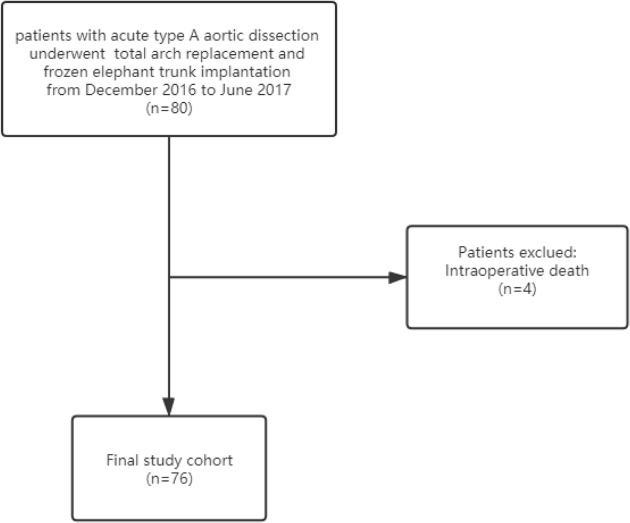
This was a prospective study of 76 patients with ATAAD undergoing aortic arch repair. For all patients, cIMT was determined preoperatively through a Doppler-based method. Incidence of different forms of neurological dysfunction, including temporary neurological dysfunction (TND) and stroke, was monitored in these patients, and the relationship between cIMT and stroke incidence was assessed using a receiver-operating characteristic (ROC) curve. Prognostic variables associated with stroke risk were further identified through univariate and multivariate analyses.
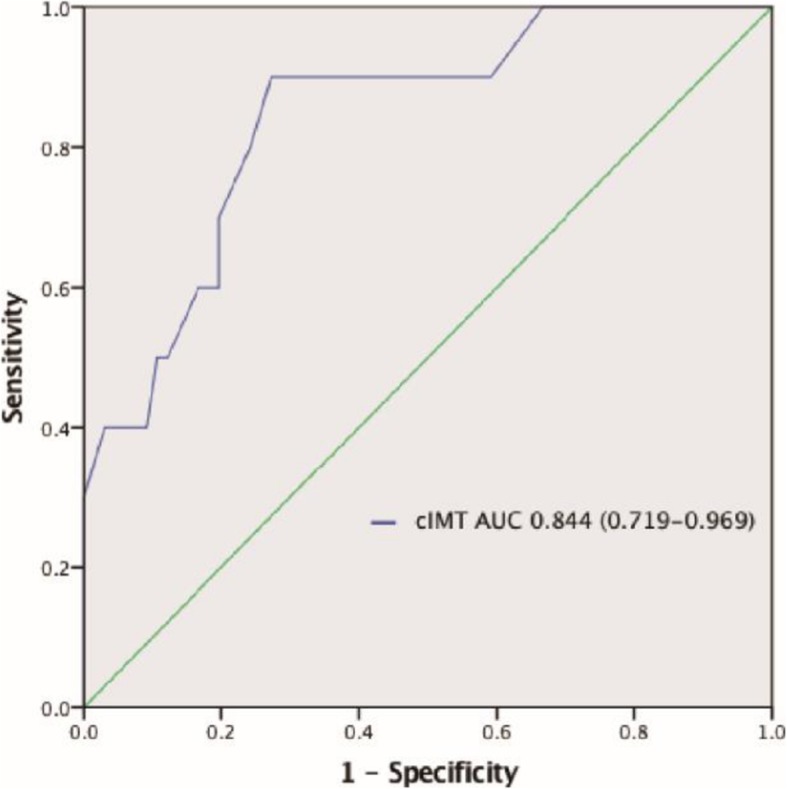
A total of 26/76 (34.2%) patients in the present study suffered from neurological dysfunction, of whom 16 (21.0%) suffered from TND and 10 (13.2%) suffered a stroke. The remaining 50 patients (65.8%) did not suffer from neurological dysfunction. The cIMT values in the stroke, TND, and neurological dysfunction-free patients in this study were 1.12 ± 0.19 (mm), 0.99 ± 0.13 (mm), and 0.87 ± 0.13 (mm), respectively. A total of 4 patients in this cohort died during the study, including 1 in the TND group and 3 in the stroke group. An ROC curve analysis indicated that cIMT could predict stroke with an area under the curve value of 0.844 (95% CI, 0.719-0.969; p < 0.001). A multivariate analysis revealed that cIMT > 0.9 mm was independently associated with stroke risk (p = 0.018).
We found that cIMT can be used to predict postoperative stroke risk in ATAAD patients undergoing aortic arch repair, with a cIMT > 0.9 mm coinciding with increased stroke risk in these patients.
ChiCTR1900022289. Date of registration 4 April 2019 retrospectively registered.
急性A型主动脉夹层(ATAAD)是一种危及生命的疾病,需要手术干预。中风仍然是一种极其严重的不良后果,可发生在接受主动脉弓修复的ATAAD患者中,导致患者死亡率升高和术后生活质量下降。在本研究中,我们试图确定颈动脉内膜中层厚度(cIMT)是否是术后中风风险的可靠预测指标。
这是一项对76例接受主动脉弓修复的ATAAD患者的前瞻性研究。对于所有患者,术前通过基于多普勒的方法测定cIMT。监测这些患者中不同形式神经功能障碍的发生率,包括短暂性神经功能障碍(TND)和中风,并使用受试者操作特征(ROC)曲线评估cIMT与中风发生率之间的关系。通过单因素和多因素分析进一步确定与中风风险相关的预后变量。
本研究中共有26/76(34.2%)例患者出现神经功能障碍,其中16例(21.0%)出现TND,10例(13.2%)发生中风。其余50例患者(65.8%)未出现神经功能障碍。本研究中中风患者、TND患者和无神经功能障碍患者的cIMT值分别为1.12±0.19(mm)、0.99±0.13(mm)和0.87±0.13(mm)。该队列中有4例患者在研究期间死亡,其中TND组1例,中风组3例。ROC曲线分析表明,cIMT能够预测中风,曲线下面积值为0.844(95%CI,0.719 - 0.969;p < 0.001)。多因素分析显示,cIMT > 0.9 mm与中风风险独立相关(p = 0.018)。
我们发现cIMT可用于预测接受主动脉弓修复的ATAAD患者的术后中风风险,cIMT > 0.9 mm与这些患者中风风险增加相符。
ChiCTR1900022289。注册日期2019年4月4日,回顾性注册。