Department of Neurology, Charité - Universitätsmedizin Berlin, Berlin D-13353, Germany.
Department of Psychiatry and Psychotherapy, Charité - Universitätsmedizin Berlin, Berlin D-10117, Germany.
eNeuro. 2020 Jun 19;7(3). doi: 10.1523/ENEURO.0537-19.2020. Print 2020 May/Jun.
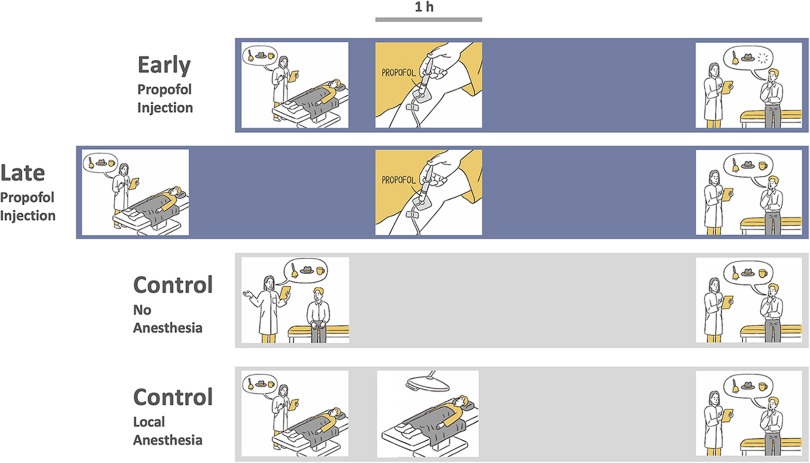
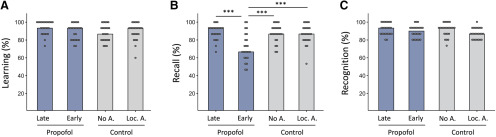
Maintenance of memory across time is crucial for adaptive behavior. Current theories posit that the underlying consolidation process depends on stabilization of synapses and reorganization of interactions between hippocampus and neocortex. However, the temporal properties of hippocampal-neocortical network reconfiguration during consolidation are still a matter of debate. Translational research on this issue is challenged by the paucity of techniques to transiently interfere with memory in the healthy human brain. Here, we report a neuro-pharmacological approach with the GABAergic anesthetic propofol and a memory task sensitive to hippocampal dysfunction. Patients undergoing minor surgery learned word lists before injection of an anesthetic dose of propofol. Results show that administration of the drug shortly after learning (∼13 min) impairs recall after awakening but spares recognition. By contrast, later administration (∼105 min) has no effect. These findings suggest significant changes in memory networks very early after learning that are decisive for later recall. Propofol general anesthesia provides an experimental tool to modulate the first steps of hippocampus-mediated memory consolidation in humans.
跨时间维持记忆对于适应行为至关重要。当前的理论假设,潜在的巩固过程取决于突触的稳定和海马体与新皮层之间相互作用的重组。然而,巩固过程中海马-新皮层网络重新配置的时间特性仍然存在争议。由于缺乏在健康人脑内瞬时干扰记忆的技术,该问题的转化研究受到了挑战。在这里,我们报告了一种神经药理学方法,使用 GABA 能麻醉剂异丙酚和对海马功能障碍敏感的记忆任务。接受小手术的患者在注射麻醉剂量的异丙酚之前学习单词列表。结果表明,药物在学习后不久(约 13 分钟)给药会损害苏醒后的回忆,但不影响识别。相比之下,稍后给药(约 105 分钟)则没有效果。这些发现表明,在学习后非常早期记忆网络发生了显著变化,这对以后的回忆起决定性作用。异丙酚全身麻醉为调节人类海马介导的记忆巩固的最初步骤提供了一种实验工具。