Tang Terence T L, Passmore Lori A
MRC Laboratory of Molecular Biology, Cambridge CB2 0QH, United Kingdom.
Cold Spring Harb Symp Quant Biol. 2019;84:21-30. doi: 10.1101/sqb.2019.84.039818. Epub 2020 Apr 15.
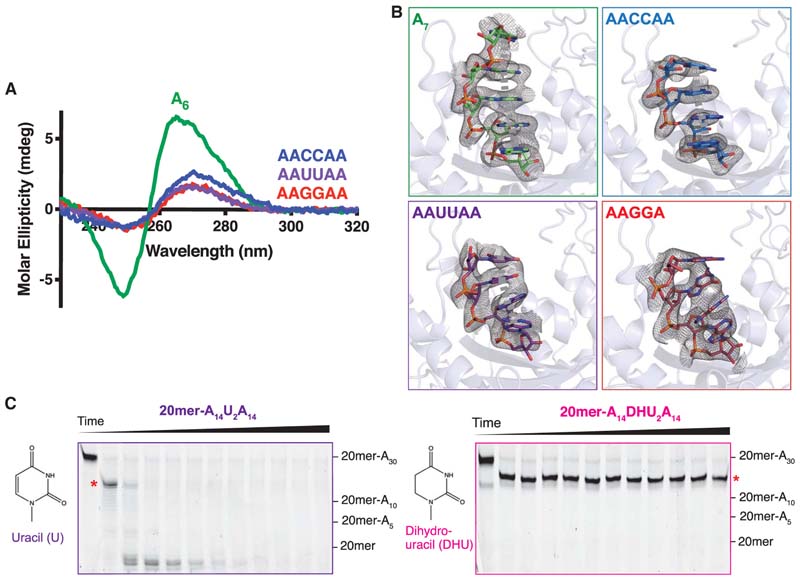
The polyadenosine (poly(A)) tail, which is found on the 3' end of almost all eukaryotic messenger RNAs (mRNAs), plays an important role in the posttranscriptional regulation of gene expression. Shortening of the poly(A) tail, a process known as deadenylation, is thought to be the first and rate-limiting step of mRNA turnover. Deadenylation is performed by the Pan2-Pan3 and Ccr4-Not complexes that contain highly conserved exonuclease enzymes Pan2, and Ccr4 and Caf1, respectively. These complexes have been extensively studied, but the mechanisms of how the deadenylase enzymes recognize the poly(A) tail were poorly understood until recently. Here, we summarize recent work from our laboratory demonstrating that the highly conserved Pan2 exonuclease recognizes the poly(A) tail, not through adenine-specific functional groups, but through the conformation of poly(A) RNA. Our biochemical, biophysical, and structural investigations suggest that poly(A) forms an intrinsic base-stacked, single-stranded helical conformation that is recognized by Pan2, and that disruption of this structure inhibits both Pan2 and Caf1. This intrinsic structure has been shown to be important in poly(A) recognition in other biological processes, further underlining the importance of the unique conformation of poly(A).
多聚腺苷酸(poly(A))尾巴存在于几乎所有真核生物信使核糖核酸(mRNA)的3'末端,在基因表达的转录后调控中发挥着重要作用。poly(A)尾巴的缩短,即去腺苷酸化过程,被认为是mRNA周转的第一步和限速步骤。去腺苷酸化由Pan2-Pan3和Ccr4-Not复合物执行,它们分别包含高度保守的核酸外切酶Pan2以及Ccr4和Caf1。这些复合物已得到广泛研究,但直到最近,去腺苷酸酶如何识别poly(A)尾巴的机制仍知之甚少。在此,我们总结了我们实验室最近的工作,这些工作表明高度保守的Pan2核酸外切酶识别poly(A)尾巴,不是通过腺嘌呤特异性官能团,而是通过poly(A) RNA的构象。我们的生化、生物物理和结构研究表明,poly(A)形成一种内在的碱基堆积单链螺旋构象,该构象被Pan2识别,并且这种结构的破坏会抑制Pan2和Caf1。这种内在结构已被证明在其他生物过程的poly(A)识别中很重要,进一步强调了poly(A)独特构象的重要性。