State Key Laboratory of Medical Genomics, Shanghai Institute of Hematology, Shanghai Rui Jin Hospital, Shanghai Jiao Tong University School of Medicine, 197 Rui Jin Er Road, Shanghai, China.
Pôle de Recherches Sino-Français en Science du Vivant et Génomique, Laboratory of Molecular Pathology, Shanghai, China.
Signal Transduct Target Ther. 2020 Mar 6;5(1):15. doi: 10.1038/s41392-020-0113-2.
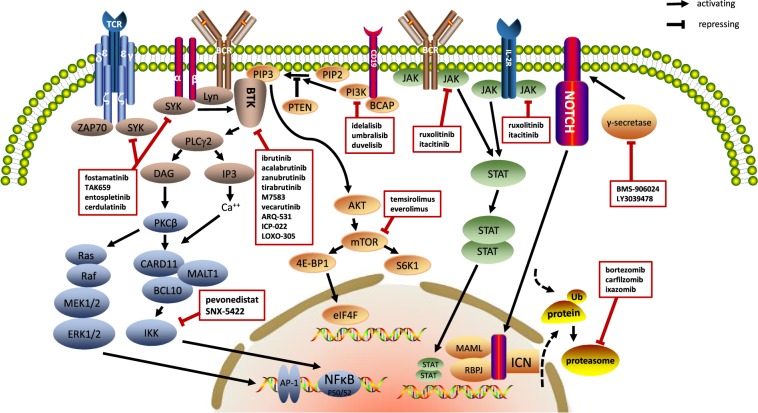
The incidence of lymphoma has gradually increased over previous decades, and it ranks among the ten most prevalent cancers worldwide. With the development of targeted therapeutic strategies, though a subset of lymphoma patients has become curable, the treatment of refractory and relapsed diseases remains challenging. Many efforts have been made to explore new targets and to develop corresponding therapies. In addition to novel antibodies targeting surface antigens and small molecular inhibitors targeting oncogenic signaling pathways and tumor suppressors, immune checkpoint inhibitors and chimeric antigen receptor T-cells have been rapidly developed to target the tumor microenvironment. Although these targeted agents have shown great success in treating lymphoma patients, adverse events should be noted. The selection of the most suitable candidates, optimal dosage, and effective combinations warrant further investigation. In this review, we systematically outlined the advances in targeted therapy for malignant lymphoma, providing a clinical rationale for mechanism-based lymphoma treatment in the era of precision medicine.
过去几十年来,淋巴瘤的发病率逐渐上升,其在全球最常见癌症中排名前十。随着靶向治疗策略的发展,虽然一部分淋巴瘤患者可以被治愈,但难治性和复发性疾病的治疗仍然具有挑战性。许多研究都致力于探索新的靶点并开发相应的治疗方法。除了针对表面抗原的新型抗体和针对致癌信号通路和肿瘤抑制因子的小分子抑制剂外,免疫检查点抑制剂和嵌合抗原受体 T 细胞也迅速被开发以靶向肿瘤微环境。尽管这些靶向药物在治疗淋巴瘤患者方面取得了巨大的成功,但应注意不良反应。最适合的候选者的选择、最佳剂量和有效的联合治疗方案仍需要进一步研究。在这篇综述中,我们系统地概述了恶性淋巴瘤的靶向治疗进展,为精准医学时代基于机制的淋巴瘤治疗提供了临床依据。