Weigert André, Drozdz Maciej, Silva Fatima, Frazão João, Alsuwaida Abdulkareem, Krishnan Mahesh, Kleophas Werner, Brzosko Szymon, Johansson Fredrik K, Jacobson Stefan H
Department of Nephrology, DaVita, Lisbon, Portugal.
Department of Nephrology, DaVita International, Krakow, Poland.
Clin Kidney J. 2019 Jun 17;13(2):217-224. doi: 10.1093/ckj/sfz069. eCollection 2020 Apr.
Women of all ages and elderly patients of both genders comprise an increasing proportion of the haemodialysis population. Worldwide, significant differences in practice patterns and treatment results exist between genders and among younger versus older patients. Although efforts to mitigate sex-based differences have been attempted, significant disparities still exist.
This retrospective cohort study included all 1247 prevalent haemodialysis patients in DaVita units in Portugal (five dialysis centres, = 730) and Poland (seven centres, = 517). Demographic data, dialysis practice patterns, vascular access prevalence and the achievement of a variety of Kidney Disease: Improving Global Outcomes (KDIGO) treatment targets were evaluated in relation to gender and age groups.
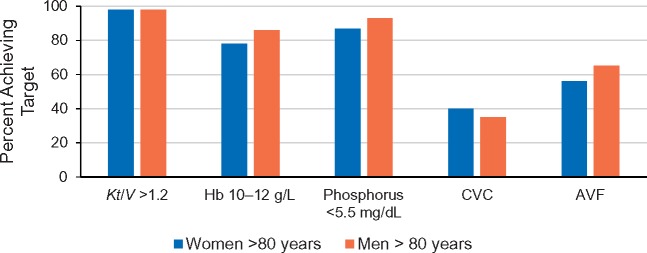
Body weight and the prescribed dialysis blood flow rate were lower in women (P < 0.001), whereas treated blood volume per kilogram per session was higher (P < 0.01), resulting in higher single-pool in women than in men (P < 0.001). Haemoglobin was significantly higher in men (P = 0.01), but the proportion of patients within target range (10-12 g/dL) was similar. Men more often had an arteriovenous fistula than women (80% versus 73%; P < 0.01) with a similar percentage of central venous catheters. There were no gender-specific differences in terms of dialysis adequacy, anaemia parameters or mineral and bone disorder parameters, or in the attainment of KDIGO targets between women and men >80 years of age.
This large, multicentre real-world analysis indicates that haemodialysis practices and treatment targets are similar for women and men, including the most elderly, in DaVita haemodialysis clinics in Europe.
各年龄段女性及老年男女患者在血液透析人群中所占比例日益增加。在全球范围内,不同性别以及年轻与老年患者之间的实践模式和治疗结果存在显著差异。尽管已尝试努力减少基于性别的差异,但显著差距依然存在。
这项回顾性队列研究纳入了葡萄牙(5个透析中心,n = 730)和波兰(7个中心,n = 517)达维塔单位的所有1247例维持性血液透析患者。评估了人口统计学数据、透析实践模式、血管通路患病率以及各种改善全球肾脏病预后(KDIGO)治疗目标的达成情况与性别和年龄组的关系。
女性的体重和规定的透析血流量较低(P < 0.001),而每次治疗每千克体重的治疗血量较高(P < 0.01),导致女性的单池比男性更高(P < 0.001)。男性的血红蛋白显著更高(P = 0.01),但处于目标范围(10 - 12 g/dL)的患者比例相似。男性比女性更常拥有动静脉内瘘(80%对73%;P < 0.01),中心静脉导管的比例相似。在透析充分性、贫血参数或矿物质和骨病参数方面,以及80岁以上女性和男性之间在达成KDIGO目标方面没有性别特异性差异。
这项大型多中心真实世界分析表明,在欧洲达维塔血液透析诊所中,包括最年长的患者在内,女性和男性的血液透析实践和治疗目标相似。