Division of Pulmonary and Critical Care Medicine, Department of Medicine, Samsung Medical Center, Sungkyunkwan University School of Medicine, Seoul, South Korea.
Division of Pulmonary and Critical Care Medicine, Department of Internal Medicine, Yonsei University College of Medicine, Yonsei University Health System, Seoul, South Korea.
Adv Ther. 2020 May;37(5):2303-2316. doi: 10.1007/s12325-020-01328-8. Epub 2020 Apr 15.
The efficacy and safety of pirfenidone have been previously demonstrated in patients with mild-to-moderate idiopathic pulmonary fibrosis (IPF). However, the effect of pirfenidone in patients with advanced IPF remains unclear. Here, we investigated the effects of pirfenidone against advanced IPF in a real-world setting.
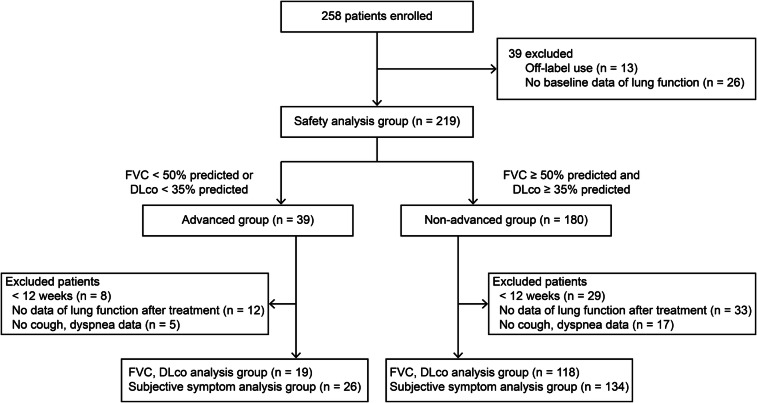
A prospective nationwide post-marketing study was conducted on 258 patients from 10 Korean institutions. Patients with a predicted forced vital capacity (FVC) less than 50% or a diffusing capacity of the lung for carbon monoxide (DLco) less than 35% at baseline were classified as the advanced IPF group.
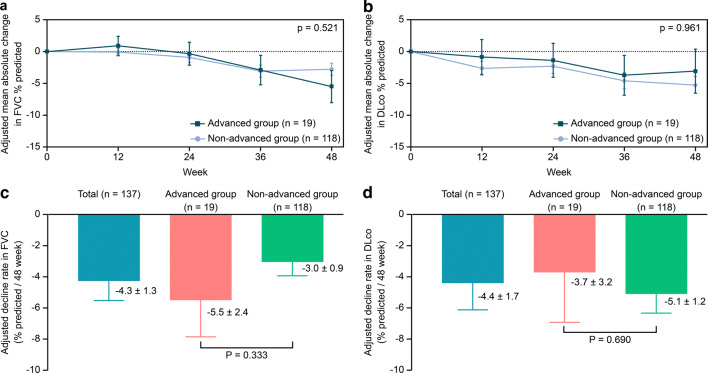
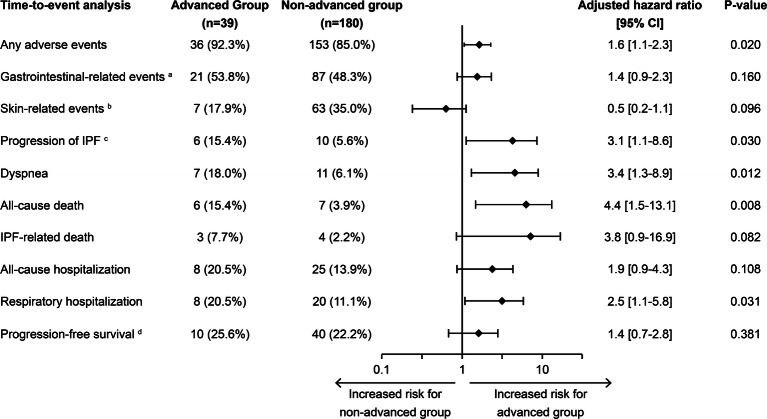
Of 219 patients included in the analysis, the majority were male (76.3%); the mean age was 67.3 years, and the advanced group accounted for 17.8% of the patients. The median treatment duration was 298 days. Among the subjects, 86.3% experienced adverse events (AEs), of which a decreased appetite (32.4%) and a photosensitivity reaction (13.7%) were the most frequent. The incidence of AEs was similar between the advanced and non-advanced groups (92.3% vs. 85.0%, respectively; p = 0.229). Although the overall discontinuation rate was higher in the advanced group than in the non-advanced group (74.4% vs. 50.0%, respectively; p = 0.006), the percentages of the patients who discontinued treatment as a result of AEs were similar in both groups (20.5% vs. 23.3%, respectively; p = 0.704). In all patients, the rates of decline in the predicted FVC and DLco over 48 weeks were - 4.3 ± 1.3% and - 4.4 ± 1.7%, respectively. There was no between-group difference in the rate of lung function decline.
Pirfenidone used for the treatment of patients with IPF in a real-world setting was well tolerated, with an acceptable safety profile and a consistent therapeutic effect, regardless of the disease severity.
ClinicalTrials.gov NCT03761082; the trial was retrospectively registered on December 3, 2018.
吡非尼酮先前已被证明可在轻度至中度特发性肺纤维化(IPF)患者中有效且安全。然而,吡非尼酮在晚期 IPF 患者中的效果尚不清楚。在这里,我们在真实环境中研究了吡非尼酮对晚期 IPF 的影响。
对来自 10 家韩国机构的 258 例患者进行了一项前瞻性全国性上市后研究。基线时预测用力肺活量(FVC)小于 50%或一氧化碳弥散量(DLco)小于 35%的患者被归类为晚期 IPF 组。
在纳入分析的 219 例患者中,大多数为男性(76.3%);平均年龄为 67.3 岁,晚期组占患者的 17.8%。中位治疗持续时间为 298 天。在这些受试者中,86.3%出现不良事件(AE),其中食欲下降(32.4%)和光敏反应(13.7%)最为常见。晚期组和非晚期组的 AE 发生率相似(92.3% vs. 85.0%,分别;p=0.229)。尽管晚期组的总体停药率高于非晚期组(74.4% vs. 50.0%,分别;p=0.006),但两组因 AE 而停药的患者比例相似(20.5% vs. 23.3%,分别;p=0.704)。在所有患者中,48 周时预测 FVC 和 DLco 的下降率分别为-4.3±1.3%和-4.4±1.7%。两组间肺功能下降率无差异。
在真实环境中,吡非尼酮用于治疗 IPF 患者,具有良好的耐受性、可接受的安全性和一致的治疗效果,与疾病严重程度无关。
ClinicalTrials.gov NCT03761082;试验于 2018 年 12 月 3 日进行了回顾性注册。