Demir E, Abdelhai K, Demir I E, Jäger C, Scheufele F, Schorn S, Rothe K, Friess H, Ceyhan G O
Department of Surgery, Munich, Germany.
Hepato-Pancreato-Biliary Unit, Department of General Surgery, Acibadem Mehmet Ali Aydinlar University School of Medicine, Istanbul, Turkey.
BJS Open. 2020 Jun;4(3):432-437. doi: 10.1002/bjs5.50272. Epub 2020 Apr 16.
Pancreatic fistula (PF) is a common complication after pancreatic surgery. It is unclear how microbes in PF fluid affect outcomes and which microbes are present after pancreatoduodenectomy (PD) and distal pancreatectomy (DP). The aim of this study was to compare the microbiological spectrum of PF fluid after PD versus DP, and its association with postoperative complications.
Bacterial strains and antibiotic resistance rates of bacterial swabs obtained from the PF fluid of patients who underwent DP or PD were analysed. Cultured bacteria were classified as Enterobacterales and as 'other intestinal and non-intestinal microorganisms' based on whether they are typically part of the normal human intestinal flora.
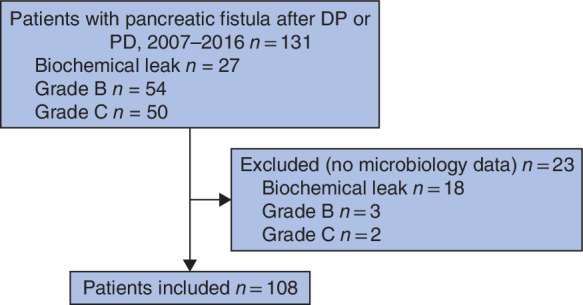
A total of 847 patients had a pancreatic resection (PD 600; DP 247) between July 2007 and December 2016. Clinically relevant PF was detected in 131 patients (15·5 per cent). Bacterial swabs were obtained from 108 patients (DP 47; PD 61), of which 19 (17·6 per cent) were sterile. Enterobacterales were detected in 74 per cent of PF fluid swabs after PD, and in 34 per cent after DP. Infected, polymicrobial or multidrug-resistant PF fluid was more common after PD (rates of 95, 50 and 48 per cent respectively) than after DP (66, 26 and 6 per cent respectively). Patients with higher grade complications (Clavien-Dindo grade IV-V) or grade C PF had more Enterobacterales and multidrug-resistant Enterobacterales in the PF fluid after DP.
Enterobacterales and multidrug-resistant bacteria are detected frequently after PD and DP, and are associated with more severe complications and PF in patients undergoing DP.
胰瘘(PF)是胰腺手术后的常见并发症。目前尚不清楚胰瘘液中的微生物如何影响预后,以及在胰十二指肠切除术(PD)和胰腺远端切除术(DP)后存在哪些微生物。本研究的目的是比较PD与DP后胰瘘液的微生物谱及其与术后并发症的关系。
分析从接受DP或PD的患者胰瘘液中获取的细菌拭子的菌株和抗生素耐药率。根据培养的细菌是否为正常人类肠道菌群的典型组成部分,将其分类为肠杆菌科和“其他肠道及非肠道微生物”。
2007年7月至2016年12月期间,共有847例患者接受了胰腺切除术(PD 600例;DP 247例)。131例患者(15.5%)检测到临床相关胰瘘。从108例患者(DP 47例;PD 61例)获取了细菌拭子,其中19例(17.6%)无菌。PD后74%的胰瘘液拭子检测到肠杆菌科细菌,DP后为34%。感染性、多微生物或多重耐药性胰瘘液在PD后(分别为95%、50%和48%)比DP后(分别为66%、26%和6%)更常见。DP后出现较高等级并发症(Clavien-Dindo分级IV-V级)或C级胰瘘的患者,其胰瘘液中的肠杆菌科细菌和多重耐药性肠杆菌科细菌更多。
PD和DP后经常检测到肠杆菌科细菌和多重耐药菌,且与DP患者更严重的并发症和胰瘘相关。