National Clinical Research Center for Infectious Diseases, The Third People's Hospital of Shenzhen, The Second Affiliated Hospital of Southern University of Science and Technology, Shenzhen, Guangdong, 518100, China.
National Clinical Research Center for Infectious Diseases, The Third People's Hospital of Shenzhen, The Second Affiliated Hospital of Southern University of Science and Technology, Shenzhen, Guangdong, 518100, China.
J Hepatol. 2020 Sep;73(3):566-574. doi: 10.1016/j.jhep.2020.04.006. Epub 2020 Apr 13.
BACKGROUND & AIMS: Recent data on the coronavirus disease 2019 (COVID-19) outbreak caused by the severe acute respiratory syndrome coronavirus 2 (SARS-CoV-2) has begun to shine light on the impact of the disease on the liver. But no studies to date have systematically described liver test abnormalities in patients with COVID-19. We evaluated the clinical characteristics of COVID-19 in patients with abnormal liver test results.
Clinical records and laboratory results were obtained from 417 patients with laboratory-confirmed COVID-19 who were admitted to the only referral hospital in Shenzhen, China from January 11 to February 21, 2020 and followed up to March 7, 2020. Information on clinical features of patients with abnormal liver tests were collected for analysis.
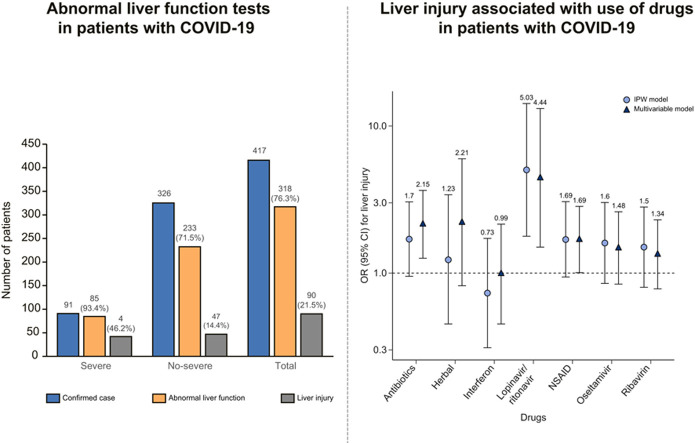
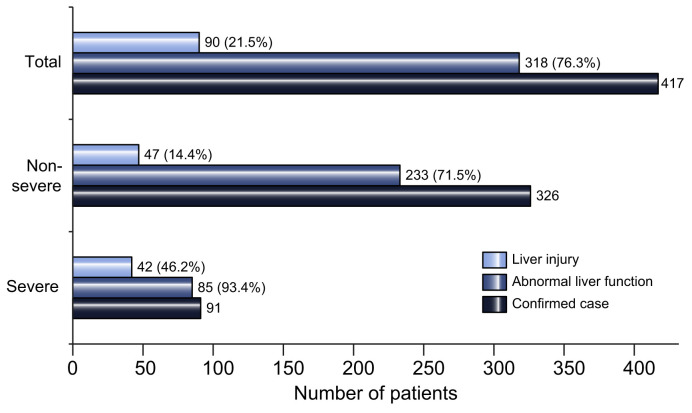
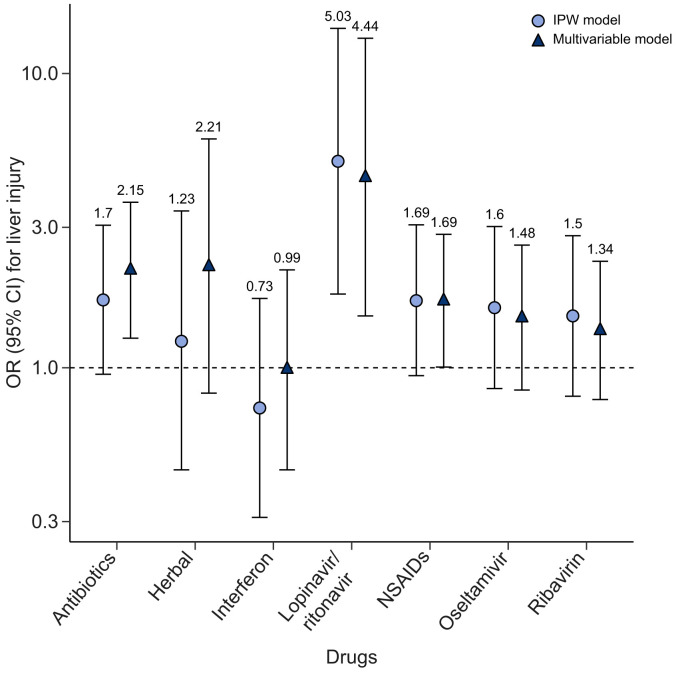
Of 417 patients with COVID-19, 318 (76.3%) had abnormal liver test results and 90 (21.5%) had liver injury during hospitalization. The presence of abnormal liver tests became more pronounced during hospitalization within 2 weeks, with 49 (23.4%), 31 (14.8%), 24 (11.5%) and 51 (24.4%) patients having alanine aminotransferase, aspartate aminotransferase, total bilirubin and gamma-glutamyl transferase levels elevated to more than 3× the upper limit of normal, respectively. Patients with abnormal liver tests of hepatocellular type or mixed type at admission had higher odds of progressing to severe disease (odds ratios [ORs] 2.73; 95% CI 1.19-6.3, and 4.44, 95% CI 1.93-10.23, respectively). The use of lopinavir/ritonavir was also found to lead to increased odds of liver injury (OR from 4.44 to 5.03, both p <0.01).
Patients with abnormal liver tests were at higher risk of progressing to severe disease. The detrimental effects on liver injury mainly related to certain medications used during hospitalization, which should be monitored and evaluated frequently.
Data on liver tests in patients with COVID-19 are scarce. We observed a high prevalence of liver test abnormalities and liver injury in 417 patients with COVID-19 admitted to our referral center, and the prevalence increased substantially during hospitalization. The presence of abnormal liver tests and liver injury were associated with the progression to severe pneumonia. The detrimental effects on liver injury were related to certain medications used during hospitalization, which warrants frequent monitoring and evaluation for these patients.
由严重急性呼吸综合征冠状病毒 2 (SARS-CoV-2) 引起的 2019 年冠状病毒病 (COVID-19) 爆发的最新数据开始揭示该疾病对肝脏的影响。但迄今为止,尚无研究系统描述 COVID-19 患者的肝试验异常。我们评估了有异常肝试验结果的 COVID-19 患者的临床特征。
从 2020 年 1 月 11 日至 2 月 21 日期间入住中国深圳唯一转诊医院的 417 例经实验室确诊的 COVID-19 患者中获取临床记录和实验室结果,并随访至 2020 年 3 月 7 日。收集有异常肝试验患者的临床特征信息进行分析。
417 例 COVID-19 患者中,318 例(76.3%)有异常肝试验结果,90 例(21.5%)住院期间有肝损伤。住院后 2 周内,异常肝试验更为明显,分别有 49(23.4%)、31(14.8%)、24(11.5%)和 51(24.4%)例患者丙氨酸氨基转移酶、天冬氨酸氨基转移酶、总胆红素和γ-谷氨酰转移酶水平升高至正常值的 3 倍以上。入院时肝酶异常为肝细胞型或混合型的患者进展为重症疾病的可能性更高(比值比 [OR] 2.73;95%CI 1.19-6.3,4.44,95%CI 1.93-10.23)。还发现使用洛匹那韦/利托那韦会增加肝损伤的几率(OR 从 4.44 增加至 5.03,均 p <0.01)。
有异常肝试验的患者进展为重症疾病的风险更高。肝损伤的不良影响主要与住院期间使用的某些药物有关,应经常监测和评估这些药物。
COVID-19 患者的肝试验数据很少。我们观察到我们转诊中心的 417 例 COVID-19 患者中有很高的肝试验异常和肝损伤发生率,并且在住院期间该发生率显著增加。异常肝试验和肝损伤的存在与发展为严重肺炎有关。肝损伤的不良影响与住院期间使用的某些药物有关,需要对这些患者进行频繁的监测和评估。