Department of Human and Medical Genetics, Institute of Biomedical Sciences, Faculty of Medicine, Vilnius University, Santariškių st. 2, 08661, Vilnius, LT, Lithuania.
Faculty of Medicine, Vilnius University, Vilnius, Lithuania.
BMC Med Genomics. 2020 Apr 16;13(1):63. doi: 10.1186/s12920-020-0711-4.
Interstitial 4q deletions are rare chromosomal alterations. Most of the previously reported deletions involving the 4q13.3 region are large chromosomal alterations with a common loss of band 4q21 resulting in marked growth restriction, severe intellectual disability, and absent or severely delayed speech. A microdeletion of 4q13.3 hasn't been previously reported. We discuss the involvement of genes and the observed phenotype, comparing it with that of previously reported patients.
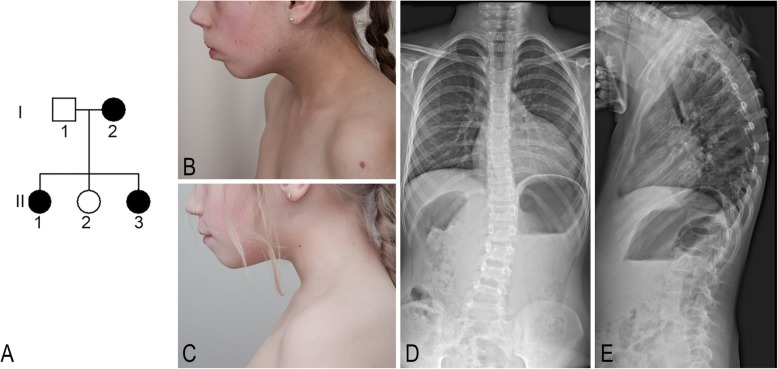
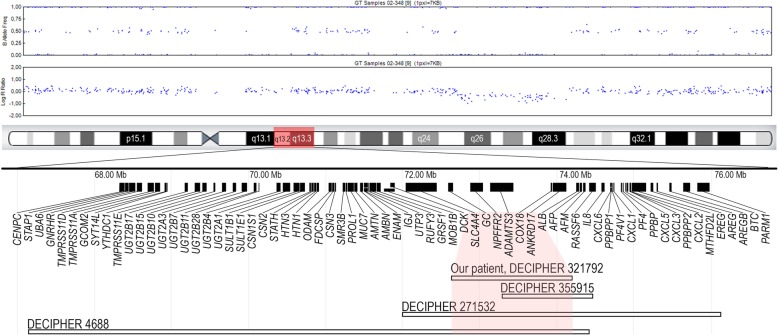
We report on a 4q13.3 microdeletion detected in three affected individuals of a Lithuanian family. The clinical features of two affected children and their affected mother are very similar and include short stature, congenital heart defect, skeletal anomalies, minor facial anomalies, delayed puberty, and intellectual disability. Whole genome SNP microarray analysis of one child revealed an interstitial 4q13.3 microdeletion, 1.56 Mb in size. FISH analysis confirmed the deletion in the proband and identified the same deletion in her affected sib and mother, while it was not detected in a healthy sib. Deletion includes ADAMTS3, ANKRD17, COX18, GC, and NPFFR2 protein-coding genes.
Our findings suggest that 4q13.3 microdeletion is a cause of a recognizable phenotype of three affected individuals. The detected microdeletion is the smallest interstitial deletion in 4q13. We highlight ADAMTS3, ANKRD17 and RNU4ATAC9P as candidate genes for intellectual disability, growth retardation and congenital heart defect.
间期 4q 缺失是罕见的染色体改变。以前报道的涉及 4q13.3 区域的大多数缺失都是大的染色体改变,共同缺失带 4q21 导致明显的生长受限、严重的智力障碍以及言语缺失或严重延迟。4q13.3 的微缺失以前没有报道过。我们讨论了基因的参与和观察到的表型,并将其与以前报道的患者进行了比较。
我们报告了一个立陶宛家庭的三个受影响个体中检测到的 4q13.3 微缺失。两个受影响的孩子及其受影响的母亲的临床特征非常相似,包括身材矮小、先天性心脏缺陷、骨骼异常、轻微的面部异常、青春期延迟和智力障碍。对一个孩子的全基因组 SNP 微阵列分析显示存在 1.56Mb 大小的 4q13.3 微缺失。FISH 分析证实先证者存在缺失,并在其受影响的同胞和母亲中发现了相同的缺失,而在健康的同胞中未检测到缺失。缺失包括 ADAMTS3、ANKRD17、COX18、GC 和 NPFFR2 蛋白编码基因。
我们的研究结果表明,4q13.3 微缺失是三个受影响个体可识别表型的原因。检测到的微缺失是 4q13 中最小的间质缺失。我们强调 ADAMTS3、ANKRD17 和 RNU4ATAC9P 作为智力障碍、生长迟缓和先天性心脏缺陷的候选基因。