Department of Physiology, Xiangya School of Medicine, Central South University, Changsha, Hunan 410078, China.
State Key Laboratory for Infectious Disease Prevention and Control, Collaborative Innovation Center for Diagnosis and Treatment of Infectious Diseases, National Institute for Communicable Disease Control and Prevention, Chinese Center for Disease Control and Prevention, Beijing 102206, People's Republic of China.
Infect Dis Poverty. 2020 Apr 16;9(1):38. doi: 10.1186/s40249-020-00652-z.
Drug resistant tuberculosis poses a great challenge for tuberculosis control worldwide. Timely determination of drug resistance and effective individual treatment are essential for blocking the transmission of drug resistant Mycobacterium tuberculosis. We aimed to establish and evaluate the accuracy of a reverse dot blot hybridization (RDBH) assay to simultaneously detect the resistance of four anti-tuberculosis drugs in M. tuberculosis isolated in China.
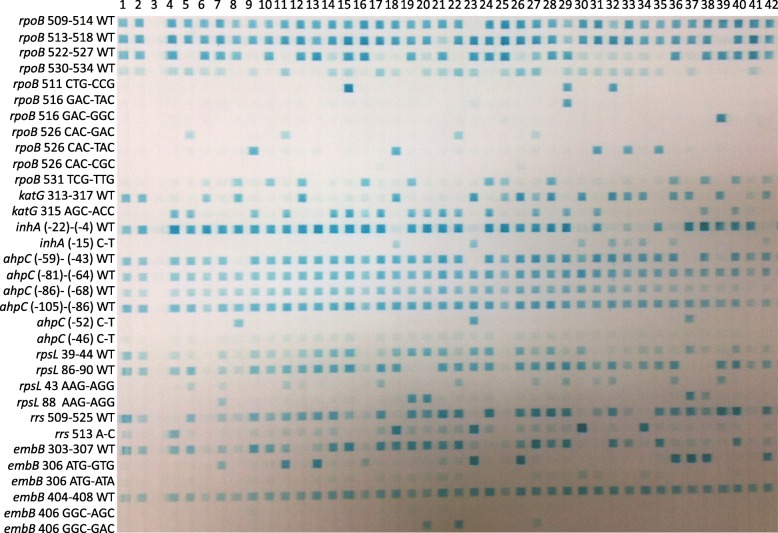
In this study, we applied a RDBH assay to simultaneously detect the resistance of rifampicin (RIF), isoniazid (INH), streptomycin (SM) and ethambutol (EMB) in 320 clinical M. tuberculosis isolates and compared the results to that from phenotypic drug susceptibility testing (DST) and sequencing. The RDBH assay was designed to test up to 42 samples at a time. Pearson's chi-square test was used to compute the statistical measures of the RDBH assay using the phenotypic DST or sequencing as the gold standard method, and Kappa identity test was used to determine the consistency between the RDBH assay and the phenotypic DST or sequencing.
The results showed that the concordances between phenotypic DST and RDBH assay were 95% for RIF, 92.8% for INH, 84.7% for SM, 77.2% for EMB and the concordances between sequencing and RDBH assay were 97.8% for RIF, 98.8% for INH, 99.1% for SM, 93.4% for EMB. Compared to the phenotypic DST results, the sensitivity and specificity of the RDBH assay for resistance detection were 92.4 and 98.5% for RIF, 90.3 and 97.3% for INH, 77.4 and 91.5% for SM, 61.4 and 85.7% for EMB, respectively; compared to sequencing, the sensitivity and specificity of the RDBH assay were 97.7 and 97.9% for RIF, 97.9 and 100.0% for INH, 97.8 and 100.0% for SM, 82.6 and 99.1% for EMB, respectively. The turnaround time of the RDBH assay was 7 h for testing 42 samples.
Our data suggested that the RDBH assay could serve as a rapid and efficient method for testing the resistance of M. tuberculosis against RIF, INH, SM and EMB, enabling early administration of appropriate treatment regimens to the affected drug resistant tuberculosis patients.
耐药结核病对全球结核病控制构成了巨大挑战。及时确定耐药性并进行有效的个体化治疗对于阻断耐药结核分枝杆菌的传播至关重要。我们旨在建立并评估一种反向斑点杂交(RDBH)检测法同时检测中国分离的结核分枝杆菌对四种抗结核药物的耐药性的准确性。
本研究应用 RDBH 检测法同时检测 320 例临床结核分枝杆菌分离株中利福平(RIF)、异烟肼(INH)、链霉素(SM)和乙胺丁醇(EMB)的耐药性,并与表型药敏试验(DST)和测序结果进行比较。RDBH 检测法的设计可同时检测多达 42 个样本。采用 Pearson χ²检验计算 RDBH 检测法与表型 DST 或测序作为金标准方法的统计指标,并采用 Kappa 一致性检验确定 RDBH 检测法与表型 DST 或测序的一致性。
结果显示,表型 DST 与 RDBH 检测法的一致性分别为 RIF 为 95%、INH 为 92.8%、SM 为 84.7%、EMB 为 77.2%,测序与 RDBH 检测法的一致性分别为 RIF 为 97.8%、INH 为 98.8%、SM 为 99.1%、EMB 为 93.4%。与表型 DST 结果相比,RDBH 检测法对耐药性检测的敏感性和特异性分别为 RIF 为 92.4%和 98.5%、INH 为 90.3%和 97.3%、SM 为 77.4%和 91.5%、EMB 为 61.4%和 85.7%;与测序相比,RDBH 检测法的敏感性和特异性分别为 RIF 为 97.7%和 97.9%、INH 为 97.9%和 100.0%、SM 为 97.8%和 100.0%、EMB 为 82.6%和 99.1%。RDBH 检测法检测 42 个样本的周转时间为 7 小时。
我们的数据表明,RDBH 检测法可作为一种快速有效的方法,用于检测结核分枝杆菌对 RIF、INH、SM 和 EMB 的耐药性,从而能够早期为受耐药结核病影响的患者提供适当的治疗方案。