Mathison Centre for Mental Health Research & Education, Hotchkiss Brain Institute, University of Calgary, Calgary, Alberta, Canada.
Epidemiol Psychiatr Sci. 2020 Apr 17;29:e115. doi: 10.1017/S2045796020000281.
The mental health of youth is continually changing and requires reliable monitoring to ensure that adequate social and economic resources are allocated. This study assessed trends in mental health among Canadian youth, 12-24 years old. Specifically, we examined the prevalence of poor/fair perceived mental health, diagnosis of mood and anxiety disorders, suicidality, perceived stress and sleep problems, substance use, and mental health consultations.
Data were collected from eight cycles of the annual Canadian Community Health Survey (2011-2018). Prevalence of mental health outcomes was calculated from each survey, and meta-regression was used to assess trends over time. In the absence of a significant trend over time, the eight cycles were pooled together using meta-analysis techniques to gain precision. Trends in prevalence were assessed for the overall sample of youth (12-24 years) and separately for male and female adolescents (12-18 years) and young adults (19-24 years).
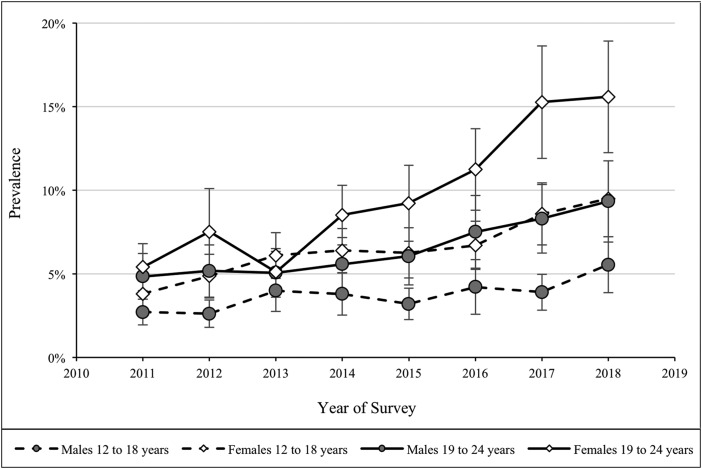
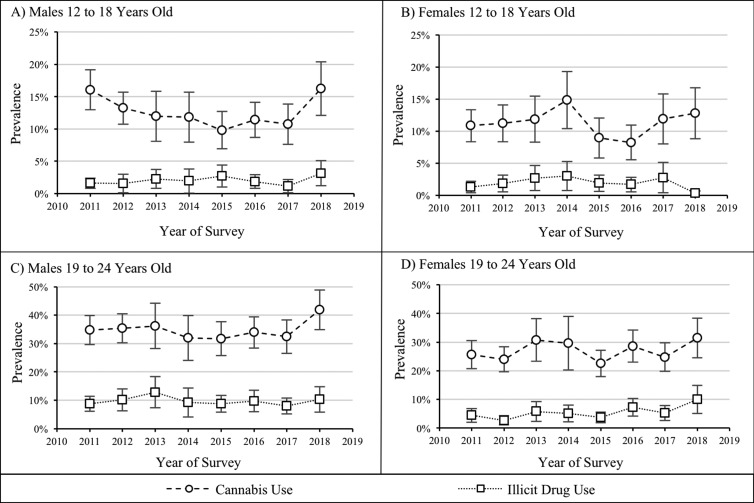
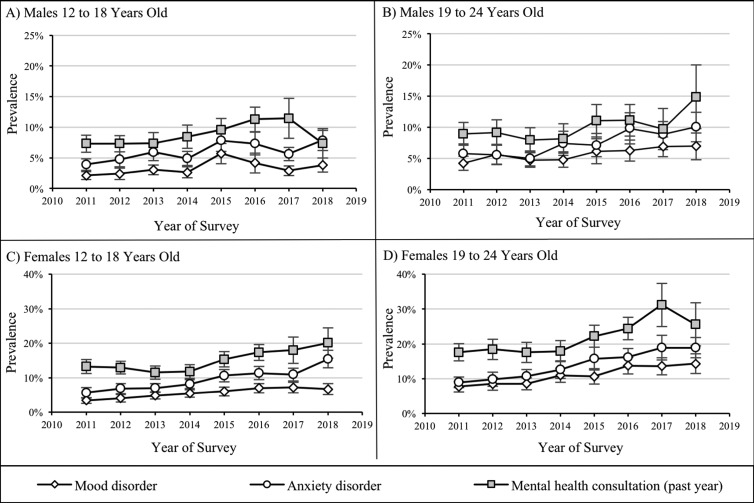
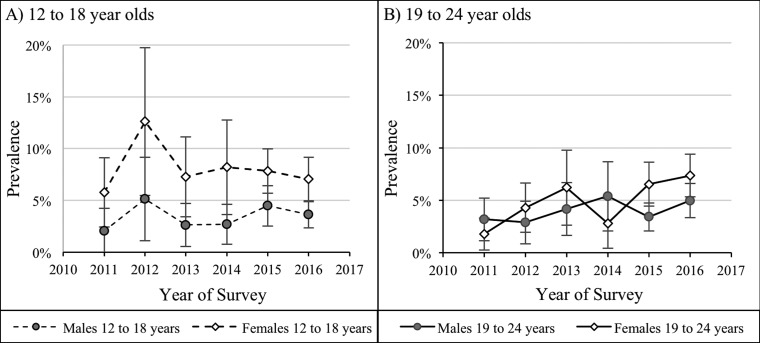
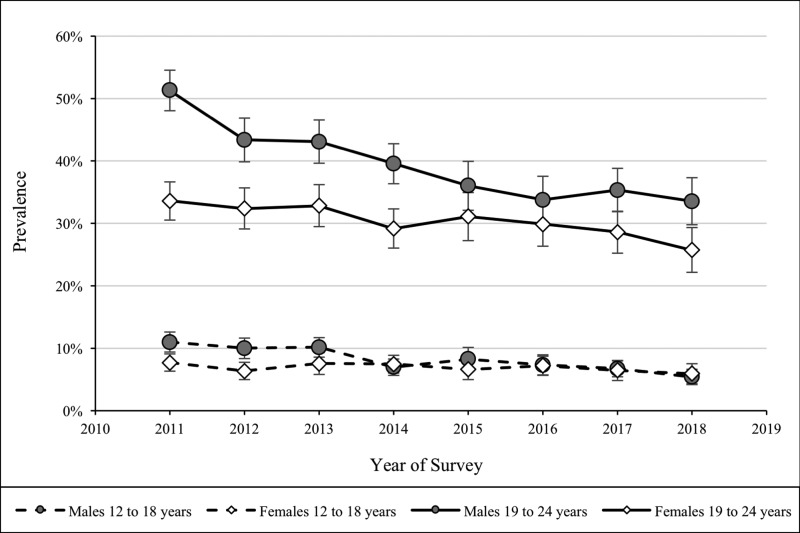
The prevalence of poor/fair perceived mental health, diagnosed mood and anxiety disorders, and past-year mental health consultations increased from 2011 to 2018, most strongly among young adult females. Past-year suicidality increased among young adult females but did not change for other age and sex groups. Notably, the prevalence of binge drinking decreased by 2.4% per year for young adult males, 1.0% for young adult females and 0.7% per year for adolescent males, while staying relatively stable for adolescent females. Prevalence of cannabis use declined among adolescents before legalisation (2011-2017); however, this trend did not persist in 2018. Instead, the 2018 prevalence was 5.6% higher than the 2017 prevalence (16.3 v. 10.7%). The combined prevalence of other illicit drug use was stable at 4.6%; however, cocaine use and hallucinogens increased by approximately 0.2% per year.
Our findings highlight a growing need for youth mental health services, as indicated by a rise in the prevalence of diagnosed mood and anxiety disorders and past-year mental health consultations. The reason for these observed increases is less apparent - it may represent a true rise in the prevalence of mental illness, or be an artefact of change in diagnostic practices, mental health literacy or diminishing stigma. Nonetheless, the findings indicate a need for the health care system to respond to the rising demand for mental health services among youth.
青年的心理健康状况在不断变化,需要进行可靠的监测,以确保分配足够的社会和经济资源。本研究评估了加拿大 12-24 岁青年的心理健康趋势。具体而言,我们研究了心理健康状况不佳/一般的感知率、情绪和焦虑障碍的诊断、自杀意念、感知压力和睡眠问题、物质使用以及心理健康咨询的情况。
数据来自于年度加拿大社区健康调查的 8 个周期(2011-2018 年)。从每个调查中计算心理健康结果的流行率,并使用元回归评估随时间的趋势。在没有随时间显著变化的情况下,使用荟萃分析技术将 8 个周期合并在一起以提高精度。评估了青年(12-24 岁)整体样本以及男青少年(12-18 岁)和青年(19-24 岁)的男女青少年的流行率趋势。
从 2011 年到 2018 年,心理健康状况不佳/一般的感知率、诊断出的情绪和焦虑障碍以及过去一年的心理健康咨询率有所增加,在年轻女性中最为明显。过去一年的自杀意念在年轻女性中有所增加,但在其他年龄和性别群体中没有变化。值得注意的是,青年男性的狂欢饮酒率每年下降 2.4%,青年女性下降 1.0%,青少年男性每年下降 0.7%,而青少年女性则相对稳定。在合法化之前(2011-2017 年),青少年的大麻使用率下降;然而,这一趋势在 2018 年并没有持续。相反,2018 年的流行率比 2017 年高出 5.6%(16.3 比 10.7%)。其他非法药物使用率保持稳定,为 4.6%;然而,可卡因和致幻剂的使用率每年增加约 0.2%。
我们的研究结果强调了青年心理健康服务的需求不断增加,这表明情绪和焦虑障碍以及过去一年心理健康咨询的诊断率不断上升。观察到这些增加的原因不太清楚——它可能代表着精神疾病的实际流行率上升,也可能是诊断实践、心理健康知识或耻辱感减少变化的人为产物。尽管如此,这些发现表明需要医疗保健系统应对青年对心理健康服务需求的增加。