Gadoth Adva, Heymann Jody
WORLD Policy Analysis Center, Fielding School of Public Health, University of California, Los Angeles, 621 Charles E Young Drive South, Los Angeles, CA 90095.
EClinicalMedicine. 2020 Mar 5;20:100299. doi: 10.1016/j.eclinm.2020.100299. eCollection 2020 Mar.
Past research has demonstrated the relationship between women's educational levels and other measures of social development with maternal and child health outcomes. This study examines the relationship between gender parity in education and work, achieved through greater female participation in both spheres, with survival in both women and men.
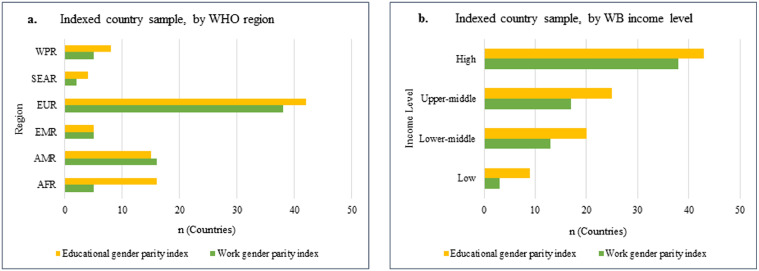
Utilizing cross-sectional indicators from United Nations agencies, we constructed global indices of gender parity in education and work for international comparison. Multivariable regression was performed to assess relationships between gender parity index scores and national mortality rates or life expectancy indicators.
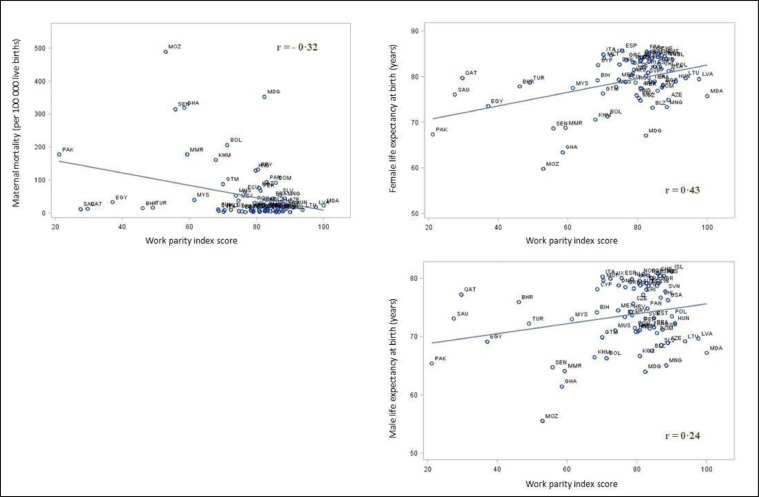
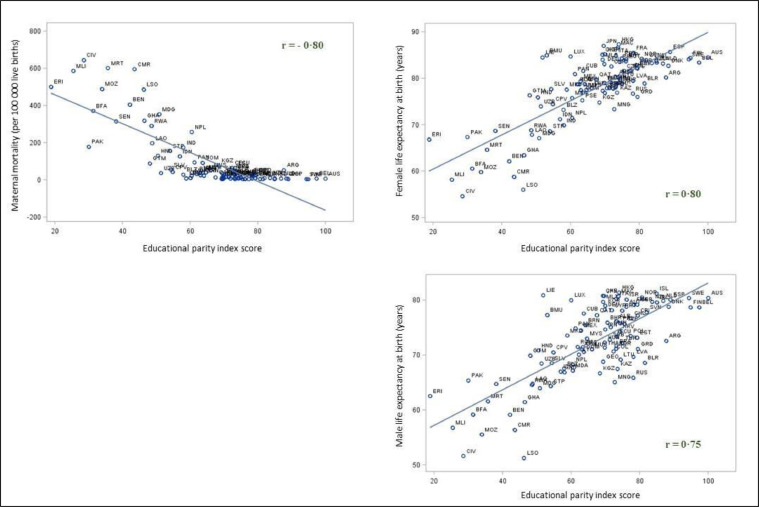
Gender parity in both arenas was significantly associated with improved health outcomes after controlling for country health expenditures and other characteristics. A 10% higher country educational parity index score was associated with 59·5 fewer maternal deaths per 100 000 live births, a 2·1-year increase in female life expectancy, and almost a 1-year increase in male life expectancy at birth. Similarly, a 10% higher work parity index score was significantly associated with 14·6 fewer maternal deaths per 100 000 live births and a 0·9-year increase in female life expectancy at birth, with no deleterious relationship to male life expectancy.
This study extends past research by examining actionable areas of gender equality and their impact on both male and female survival. While longitudinal research is needed to examine both causality and mechanisms, our findings suggest longevity gains for both women and men, and for all children through reduced maternal mortality, where greater parity in school and work is exhibited.
No funding source directly supported the work in this manuscript. We are deeply indebted to the Conrad N Hilton Foundation for its support of Adva Gadoth as a Hilton Scholar.
过去的研究已经证明了女性教育水平以及社会发展的其他指标与母婴健康结果之间的关系。本研究考察通过提高女性在教育和工作领域的参与度所实现的教育和工作中的性别平等与男性和女性生存情况之间的关系。
利用联合国机构的横断面指标,我们构建了用于国际比较的教育和工作领域性别平等全球指数。进行多变量回归以评估性别平等指数得分与国家死亡率或预期寿命指标之间的关系。
在控制了国家卫生支出和其他特征后,两个领域的性别平等均与改善的健康结果显著相关。国家教育平等指数得分每提高10%,每10万例活产中的孕产妇死亡数减少59.5例,女性预期寿命增加2.1岁,男性出生时预期寿命增加近1岁。同样,工作平等指数得分每提高10%,每10万例活产中的孕产妇死亡数显著减少14.6例,女性出生时预期寿命增加0.9岁,且与男性预期寿命无有害关系。
本研究通过考察性别平等的可行动领域及其对男性和女性生存的影响,扩展了以往的研究。虽然需要纵向研究来考察因果关系和机制,但我们的研究结果表明,在学校和工作中表现出更大平等的情况下,女性和男性以及所有儿童都能因孕产妇死亡率降低而延长寿命。
没有资金来源直接支持本稿件中的工作。我们深切感谢康拉德·N·希尔顿基金会对阿德瓦·加多思作为希尔顿学者的支持。