School of Pharmacy, Queen's University Belfast, Belfast, BT9 7BL, Northern Ireland.
Department of Biocatalysis & Isotope Chemistry, Almac, 20 Seagoe Industrial Estate, Craigavon, UK.
Appl Microbiol Biotechnol. 2020 Jun;104(11):4781-4794. doi: 10.1007/s00253-020-10585-0. Epub 2020 Apr 16.
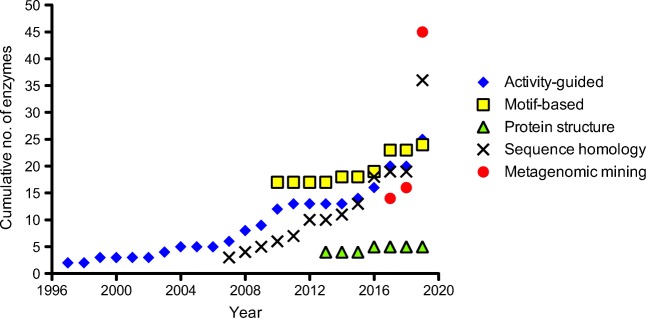
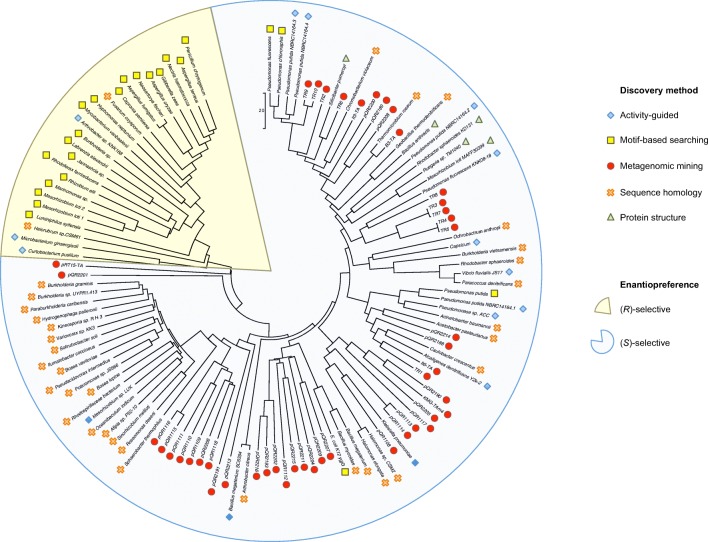
Transaminases (TAms) are important enzymes for the production of chiral amines for the pharmaceutical and fine chemical industries. Novel TAms for use in these industries have been discovered using a range of approaches, including activity-guided methods and homologous sequence searches from cultured microorganisms to searches using key motifs and metagenomic mining of environmental DNA libraries. This mini-review focuses on the methods used for TAm discovery over the past two decades, analyzing the changing trends in the field and highlighting the advantages and drawbacks of the respective approaches used. This review will also discuss the role of protein engineering in the development of novel TAms and explore possible directions for future TAm discovery for application in industrial biocatalysis. KEY POINTS: • The past two decades of TAm enzyme discovery approaches are explored. • TAm sequences are phylogenetically analyzed and compared to other discovery methods. • Benefits and drawbacks of discovery approaches for novel biocatalysts are discussed. • The role of protein engineering and future discovery directions is highlighted.
转氨酶(TAms)是制药和精细化工行业手性胺生产的重要酶。已经使用多种方法发现了用于这些行业的新型 TAm,包括活性导向方法和从培养的微生物中同源序列搜索,以及使用关键基序和环境 DNA 文库的宏基因组挖掘的搜索。这篇综述主要关注过去二十年中 TAm 发现的方法,分析该领域的变化趋势,并强调所使用的各种方法的优缺点。这篇综述还将讨论蛋白质工程在手性胺酶的开发中的作用,并探讨未来用于工业生物催化的新型 TAm 发现的可能方向。
探索了过去二十年 TAm 酶发现方法。
对 TAm 序列进行了系统发育分析,并与其他发现方法进行了比较。
讨论了新型生物催化剂发现方法的优缺点。
强调了蛋白质工程的作用和未来的发现方向。