Sathianathen Niranjan Jude, Lane Iii Robert, Murphy Declan G, Loeb Stacy, Bakker Caitlin, Lamb Alastair D, Weight Christopher J
Department of Urology, University of Minnesota, Minneapolis, MN, United States.
Department of Surgical Oncology, Peter MacCallum Cancer Centre, Melbourne, Australia.
J Med Internet Res. 2020 Apr 17;22(4):e12288. doi: 10.2196/12288.
Social media coverage is increasingly used to spread the message of scientific publications. Traditionally, the scientific impact of an article is measured by the number of citations. At a journal level, this conventionally matures over a 2-year period, and it is challenging to gauge impact around the time of publication.
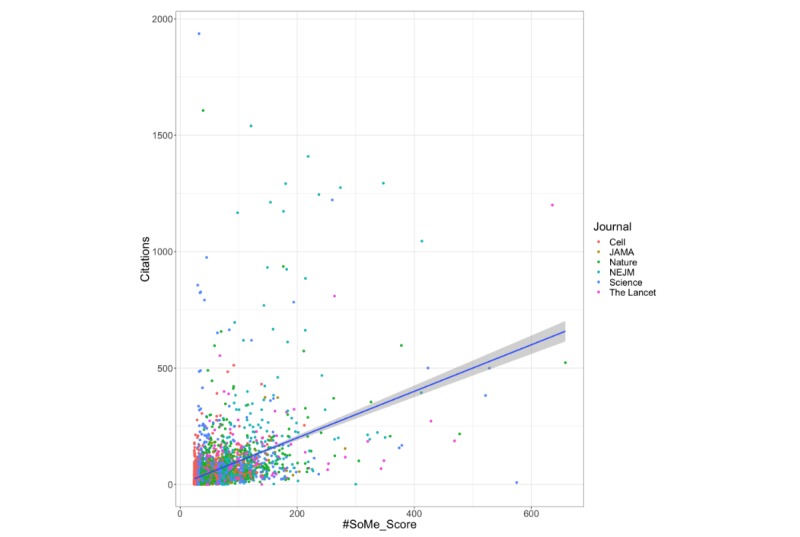
We, therefore, aimed to assess whether Web-based attention is associated with citations and to develop a predictive model that assigns relative importance to different elements of social media coverage: the #SoME_Impact score.
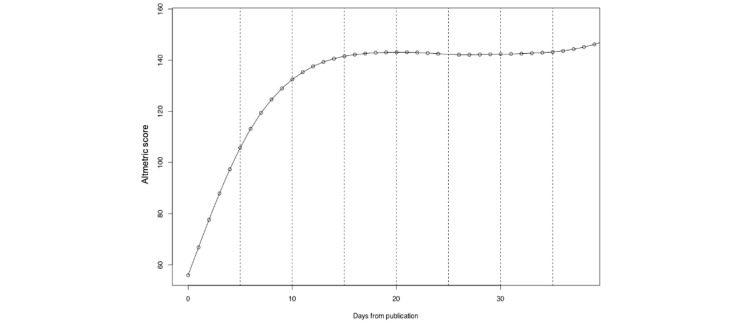
We included all original articles published in 2015 in a selection of the highest impact journals: The New England Journal of Medicine, The Lancet, the Journal of the American Medical Association, Nature, Cell, and Science. We first characterized the change in Altmetric score over time by taking a single month's sample of recently published articles from the same journals and gathered Altmetric data daily from the time of publication to create a mixed effects spline model. We then obtained the overall weighted Altmetric score for all articles from 2015, the unweighted data for each Altmetric component, and the 2-year citation count from Scopus for each of these articles from 2016 to 2017. We created a stepwise multivariable linear regression model to develop a #SoME_Score that was predictive of 2-year citations. The score was validated using a dataset of articles from the same journals published in 2016.
In our unselected sample of 145 recently published articles, social media coverage appeared to plateau approximately 14 days after publication. A total of 3150 articles with a median citation count of 16 (IQR 5-33) and Altmetric score of 72 (IQR 28-169) were included for analysis. On multivariable regression, compared with articles in the lowest quantile of #SoME_Score, articles in the second, third, and upper quantiles had 0.81, 15.20, and 87.67 more citations, respectively. On the validation dataset, #SoME_Score model outperformed the Altmetric score (adjusted R 0.19 vs 0.09; P<.001). Articles in the upper quantile of #SoME_Score were more than 5 times more likely to be among the upper quantile of those cites (odds ratio 5.61, 95% CI 4.70-6.73).
Social media attention predicts citations and could be used as an early surrogate measure of scientific impact. Owing to the cross-sectional study design, we cannot determine whether correlation relates to causation.
社交媒体报道越来越多地被用于传播科学出版物的信息。传统上,一篇文章的科学影响力是通过被引用次数来衡量的。在期刊层面,这通常在两年的时间里逐渐成熟,并且在出版时衡量影响力具有挑战性。
因此,我们旨在评估基于网络的关注度是否与引用次数相关,并开发一种预测模型,该模型为社交媒体报道的不同元素赋予相对重要性:#SoME_Impact评分。
我们纳入了2015年发表在一些高影响力期刊上的所有原创文章:《新英格兰医学杂志》《柳叶刀》《美国医学会杂志》《自然》《细胞》和《科学》。我们首先通过从同一期刊中抽取一个月的近期发表文章样本,来描述Altmetric评分随时间的变化,并从发表之时起每天收集Altmetric数据,以创建一个混合效应样条模型。然后,我们获取了2015年所有文章的总体加权Altmetric评分、每个Altmetric组件的未加权数据,以及这些文章在2016年至2017年期间来自Scopus的两年引用次数。我们创建了一个逐步多变量线性回归模型来开发一个能够预测两年引用次数的#SoME评分。该评分使用2016年发表在同一期刊上的文章数据集进行验证。
在我们未筛选的145篇近期发表文章的样本中,社交媒体报道在发表后约14天似乎趋于平稳。总共纳入3150篇文章进行分析,这些文章的引用次数中位数为16(四分位间距5 - 33),Altmetric评分为72(四分位间距28 - 169)。在多变量回归中,与#SoME评分最低四分位数的文章相比,第二、第三和最高四分位数的文章分别多0.81、15.20和87.67次引用。在验证数据集中,#SoME评分模型的表现优于Altmetric评分(调整后的R值为0.19对0.09;P <.001)。#SoME评分最高四分位数的文章在那些被引用文章的最高四分位数中的可能性高出5倍多(优势比5.61,95%置信区间4.70 - 6.73)。
社交媒体关注度可预测引用次数,并可作为科学影响力的早期替代指标。由于采用横断面研究设计,我们无法确定相关性是否意味着因果关系。