Pardo Michal, Qiu Xinghua, Zimmermann Ralf, Rudich Yinon
Department of Earth and Planetary Sciences, Weizmann Institute of Science, Rehovot 76100, Israel.
State Key Joint Laboratory for Environmental Simulation and Pollution Control, College of Environmental Sciences and Engineering, and Center for Environment and Health, Peking University, Beijing 100871, P.R. China.
Chem Res Toxicol. 2020 May 18;33(5):1110-1120. doi: 10.1021/acs.chemrestox.0c00007. Epub 2020 Apr 30.
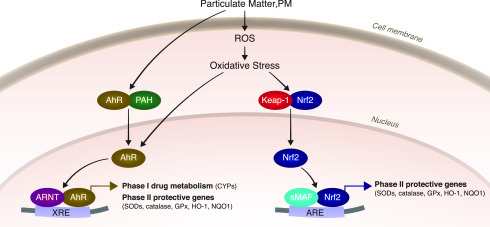
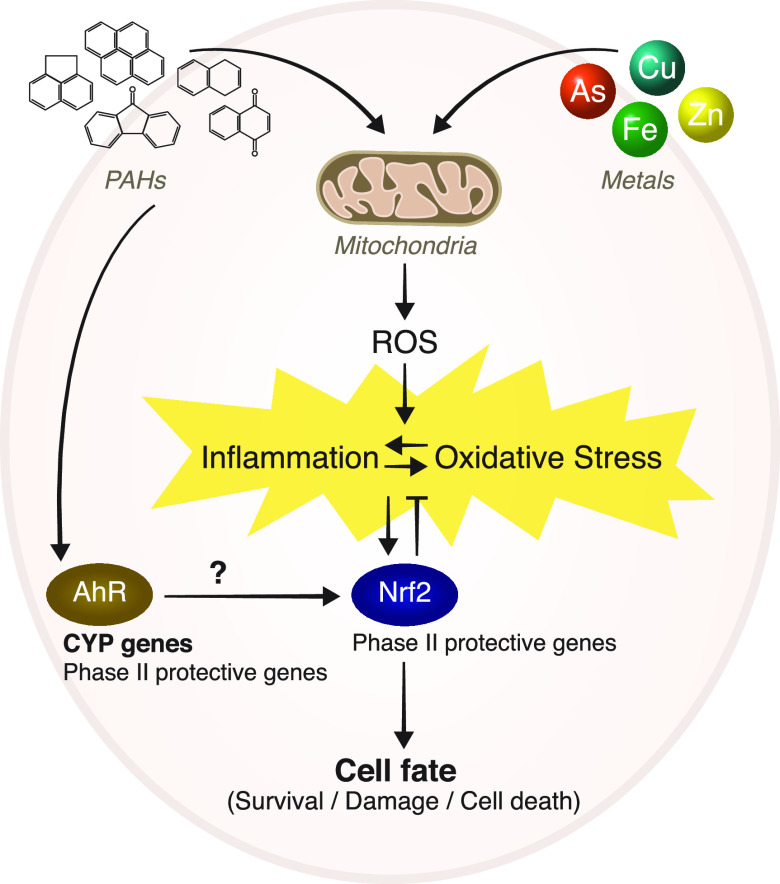
Particulate matter (PM), an important component of air pollution, induces significant adverse health effects. Many of the observed health effects caused by inhaled PM are associated with oxidative stress and inflammation. This association has been linked in particular to the particles' chemical components, especially the inorganic/metal and the organic/polycyclic aromatic hydrocarbon (PAH) fractions, and their ability to generate reactive oxygen species in biological systems. The transcription factor NF-E2 nuclear factor erythroid-related factor 2 (Nrf2) is activated by redox imbalance and regulates the expression of phase II detoxifying enzymes. Nrf2 plays a key role in preventing PM-induced toxicity by protecting against oxidative damage and inflammation. This review focuses on specific PM fractions, particularly the dissolved metals and PAH fractions, and their roles in inducing oxidative stress and inflammation in cell and animal models with respect to Nrf2 and mitochondria.
颗粒物(PM)是空气污染的一个重要组成部分,会对健康造成重大不利影响。吸入PM所导致的许多已观察到的健康影响都与氧化应激和炎症有关。这种关联尤其与颗粒物的化学成分有关,特别是无机/金属和有机/多环芳烃(PAH)部分,以及它们在生物系统中产生活性氧的能力。转录因子NF-E2核因子红系相关因子2(Nrf2)通过氧化还原失衡被激活,并调节II期解毒酶的表达。Nrf2通过防止氧化损伤和炎症,在预防PM诱导的毒性中起关键作用。本综述重点关注特定的PM部分,特别是溶解金属和PAH部分,以及它们在细胞和动物模型中相对于Nrf2和线粒体在诱导氧化应激和炎症方面的作用。