Institute of Social and Preventive Medicine (ISPM), University of Bern, Bern, Switzerland.
Epidemiology and Biostatistics Department, School of Public Health, Imperial College London, London, UK.
Int J Health Geogr. 2020 Apr 17;19(1):15. doi: 10.1186/s12942-020-00211-7.
The aetiology of most childhood cancers is largely unknown. Spatially varying environmental factors such as traffic-related air pollution, background radiation and agricultural pesticides might contribute to the development of childhood cancer. This study is the first investigation of the spatial disease mapping of childhood cancers using exact geocodes of place of residence.
We included 5947 children diagnosed with cancer in Switzerland during 1985-2015 at 0-15 years of age from the Swiss Childhood Cancer Registry. We modelled cancer risk using log-Gaussian Cox processes and indirect standardisation to adjust for age and year of diagnosis. We examined whether the spatial variation of risk can be explained by modelled ambient air concentration of NO, modelled exposure to background ionising radiation, area-based socio-economic position (SEP), linguistic region, duration in years of general cancer registration in the canton or degree of urbanisation.
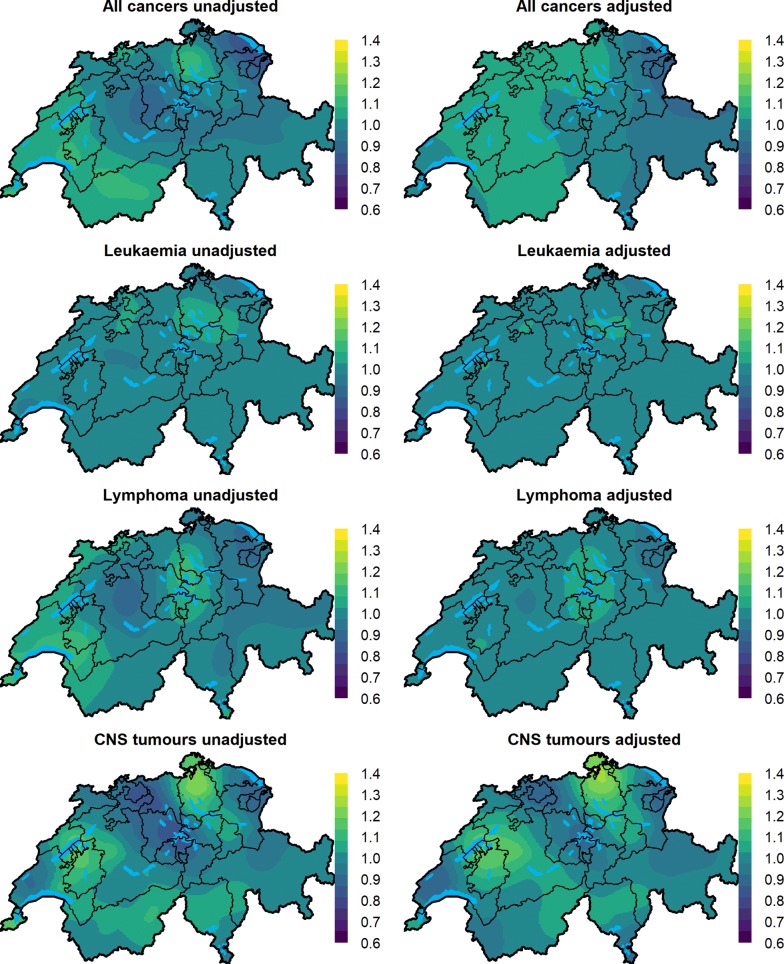
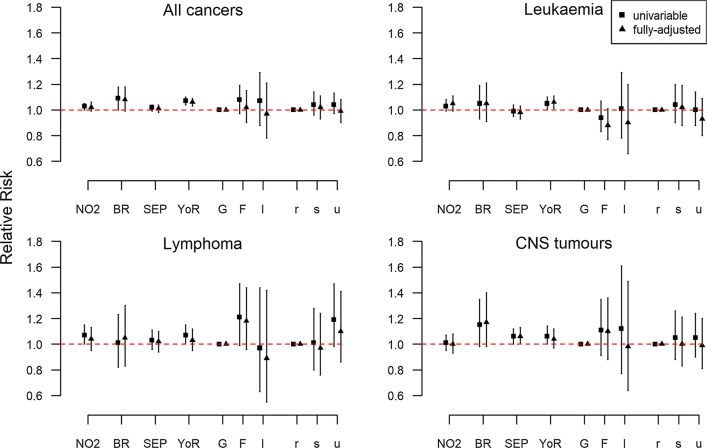
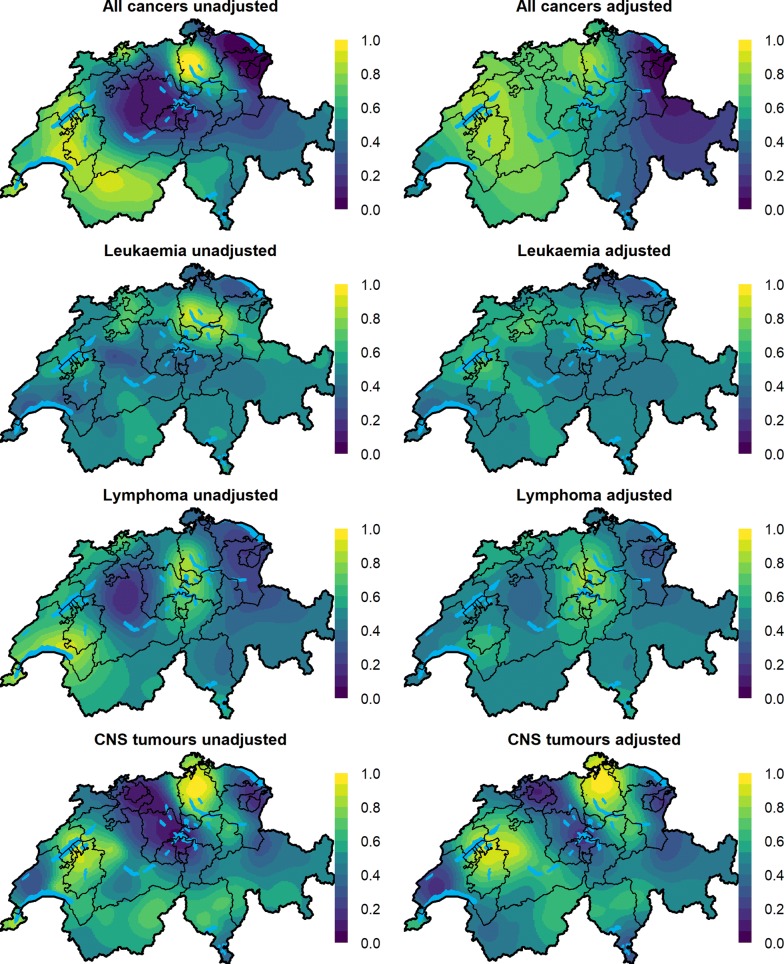
For all childhood cancers combined, the posterior median relative risk (RR), compared to the national level, varied by location from 0.83 to 1.13 (min to max). Corresponding ranges were 0.96 to 1.09 for leukaemia, 0.90 to 1.13 for lymphoma, and 0.82 to 1.23 for central nervous system (CNS) tumours. The covariates considered explained 72% of the observed spatial variation for all cancers, 81% for leukaemia, 82% for lymphoma and 64% for CNS tumours. There was weak evidence of an association of CNS tumour incidence with modelled exposure to background ionising radiation (RR per SD difference 1.17; 0.98-1.40) and with SEP (1.6; 1.00-1.13).
Of the investigated diagnostic groups, childhood CNS tumours showed the largest spatial variation. The selected covariates only partially explained the observed variation of CNS tumours suggesting that other environmental factors also play a role.
大多数儿童癌症的病因在很大程度上尚不清楚。交通相关的空气污染、本底辐射和农业杀虫剂等空间变化的环境因素可能促成儿童癌症的发生。本研究首次利用居住地点的精确地理编码对儿童癌症进行空间疾病绘图。
我们纳入了瑞士儿童癌症登记处 1985 年至 2015 年间诊断为 0-15 岁的 5947 名癌症患儿。我们使用对数高斯 Cox 过程模型和间接标准化来调整年龄和诊断年份,对癌症风险进行建模。我们检验了风险的空间变化是否可以通过模型化的环境空气中的 NO 浓度、模型化的本底电离辐射暴露、基于区域的社会经济地位(SEP)、语言区域、在州登记的癌症总年限或城市化程度来解释。
对于所有合并的儿童癌症,与全国水平相比,位置的后验中位数相对风险(RR)从 0.83 到 1.13(最小值到最大值)不等。白血病的对应范围为 0.96 至 1.09,淋巴瘤为 0.90 至 1.13,中枢神经系统(CNS)肿瘤为 0.82 至 1.23。所考虑的协变量解释了所有癌症观察到的空间变异的 72%,白血病为 81%,淋巴瘤为 82%,CNS 肿瘤为 64%。有弱证据表明 CNS 肿瘤发病率与模型化的本底电离辐射暴露(每标准差差异的 RR 为 1.17;0.98-1.40)和 SEP(1.6;1.00-1.13)有关。
在所研究的诊断组中,儿童中枢神经系统肿瘤的空间变异最大。所选协变量仅部分解释了 CNS 肿瘤的观察到的变异,表明其他环境因素也起作用。