Taylor Sara C, Ferri Sarah L, Grewal Mahip, Smernoff Zoe, Bucan Maja, Weiner Joshua A, Abel Ted, Brodkin Edward S
Department of Psychiatry, Perelman School of Medicine, University of Pennsylvania, Philadelphia, Pennsylvania; Department of Genetics, Perelman School of Medicine, University of Pennsylvania, Philadelphia, Pennsylvania.
Iowa Neuroscience Institute, Roy J. and Lucille A. Carver College of Medicine, University of Iowa, Iowa City, Iowa.
Biol Psychiatry. 2020 Sep 15;88(6):442-451. doi: 10.1016/j.biopsych.2020.02.012. Epub 2020 Feb 22.
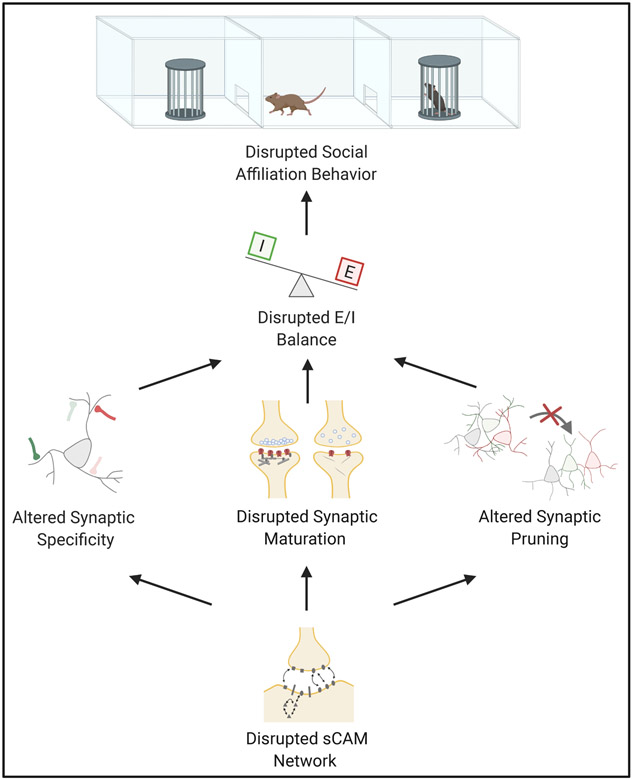
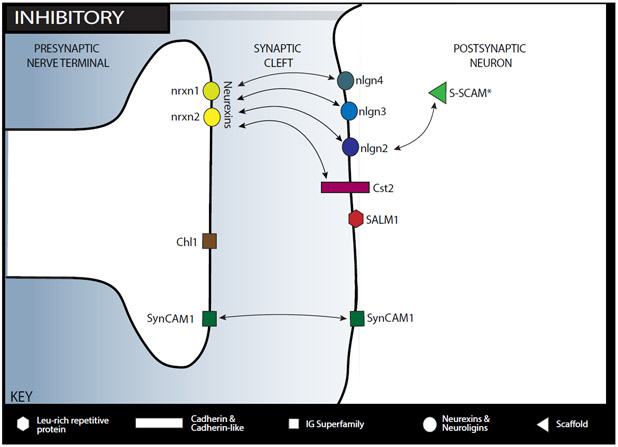
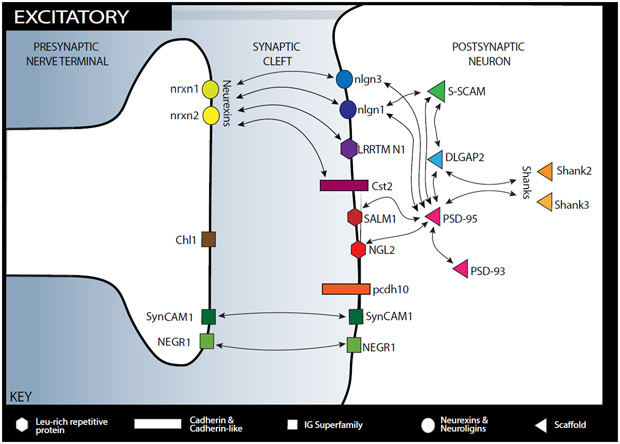
Social affiliative behaviors-engagement in positive (i.e., nonaggressive) social approach and reciprocal social interactions with a conspecific-comprise a construct within the National Institute of Mental Health Research Domain Criteria Social Processes Domain. These behaviors are disrupted in multiple human neurodevelopmental and neuropsychiatric disorders, such as autism, schizophrenia, social phobia, and others. Human genetic studies have strongly implicated synaptic cell adhesion molecules (sCAMs) in several such disorders that involve marked reductions, or other dysregulations, of social affiliative behaviors. Here, we review the literature on the role of sCAMs in social affiliative behaviors. We integrate findings pertaining to synapse structure and morphology, neurotransmission, postsynaptic signaling pathways, and neural circuitry to propose a multilevel model that addresses the impact of a diverse group of sCAMs, including neurexins, neuroligins, protocadherins, immunoglobulin superfamily proteins, and leucine-rich repeat proteins, as well as their associated scaffolding proteins, including SHANKs and others, on social affiliative behaviors. This review finds that the disruption of sCAMs often manifests in changes in social affiliative behaviors, likely through alterations in synaptic maturity, pruning, and specificity, leading to excitation/inhibition imbalance in several key regions, namely the medial prefrontal cortex, basolateral amygdala, hippocampus, anterior cingulate cortex, and ventral tegmental area. Unraveling the complex network of interacting sCAMs in glutamatergic synapses will be an important strategy for elucidating the mechanisms of social affiliative behaviors and the alteration of these behaviors in many neuropsychiatric and neurodevelopmental disorders.
社会亲和行为——参与积极(即非攻击性)的社会接近以及与同种个体的相互社会互动——是美国国立精神卫生研究所研究领域标准社会过程领域中的一个概念。这些行为在多种人类神经发育和神经精神疾病中受到干扰,如自闭症、精神分裂症、社交恐惧症等。人类遗传学研究强烈表明,突触细胞粘附分子(sCAMs)与几种此类涉及社会亲和行为显著减少或其他失调的疾病有关。在此,我们综述了关于sCAMs在社会亲和行为中作用的文献。我们整合了与突触结构和形态、神经传递、突触后信号通路以及神经回路相关的研究结果,以提出一个多层次模型,该模型阐述了包括神经连接蛋白、神经配体、原钙粘蛋白、免疫球蛋白超家族蛋白和富含亮氨酸重复蛋白在内的多种sCAMs及其相关支架蛋白(包括SHANKs等)对社会亲和行为的影响。本综述发现,sCAMs的破坏通常表现为社会亲和行为的改变,可能是通过突触成熟、修剪和特异性的改变,导致几个关键区域(即内侧前额叶皮质、基底外侧杏仁核、海马体、前扣带回皮质和腹侧被盖区)的兴奋/抑制失衡。阐明谷氨酸能突触中相互作用的sCAMs复杂网络将是阐明社会亲和行为机制以及这些行为在许多神经精神和神经发育疾病中改变的重要策略。