Department of Cardiology, People's Liberation Army General Hospital, Beijing, China; The George Institute for Global Health, Faculty of Medicine, University of New South Wales, NSW, Australia; Department of Cardiology, Xinqiao Hospital, Army Military Medical University, Chongqing, China.
Department of Cardiology, People's Liberation Army General Hospital, Beijing, China.
Prog Cardiovasc Dis. 2020 Jul-Aug;63(4):518-524. doi: 10.1016/j.pcad.2020.04.008. Epub 2020 Apr 16.
Evidence about COVID-19 on cardiac injury is inconsistent.
We aimed to summarize available data on severity differences in acute cardiac injury and acute cardiac injury with mortality during the COVID-19 outbreak.
We performed a systematic literature search across Pubmed, Embase and pre-print from December 1, 2019 to March 27, 2020, to identify all observational studies that reported cardiac specific biomarkers (troponin, creatine kinase-MB fraction, myoglobin, or NT-proBNP) during COVID-19 infection. We extracted data on patient demographics, infection severity, comorbidity history, and biomarkers during COVID-19 infection. Where possible, data were pooled for meta-analysis with standard (SMD) or weighted (WMD) mean difference and corresponding 95% confidence intervals (CI).
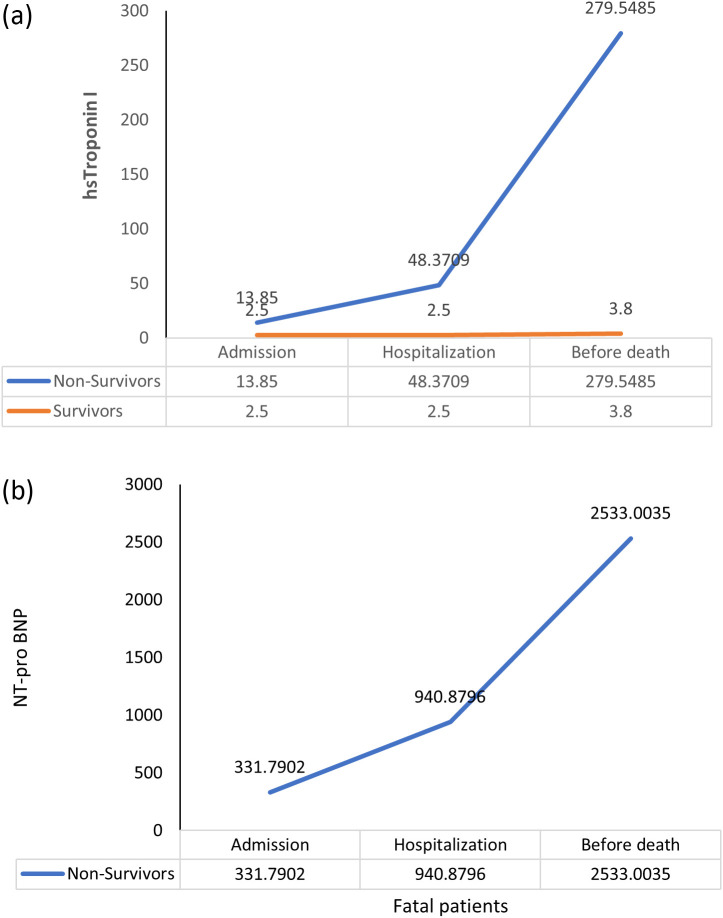
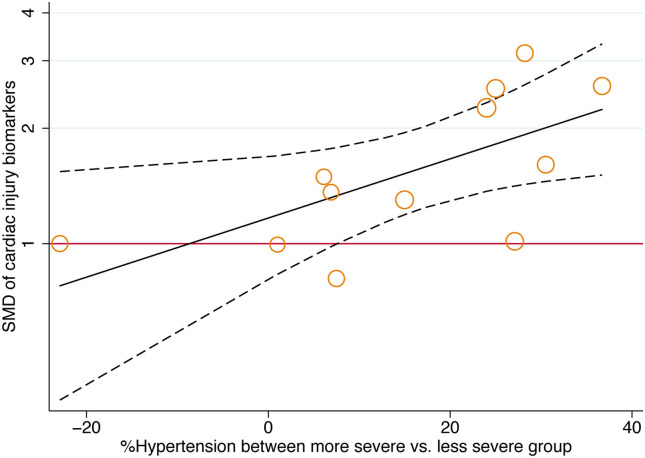
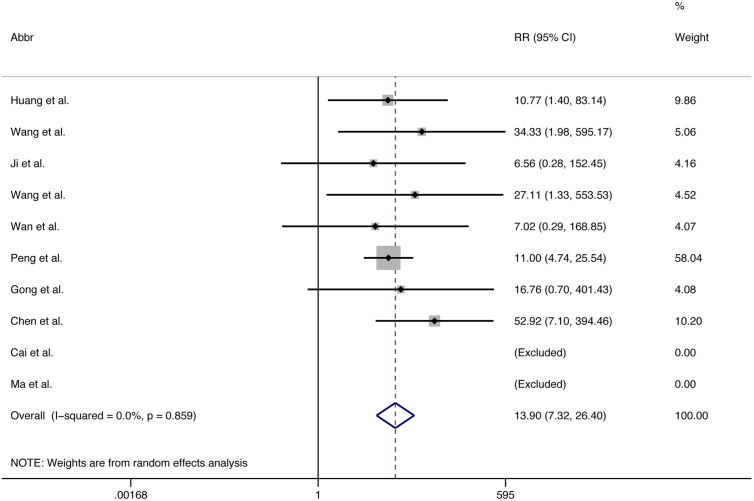
We included 4189 confirmed COVID-19 infected patients from 28 studies. More severe COVID-19 infection is associated with higher mean troponin (SMD 0.53, 95% CI 0.30 to 0.75, p < 0.001), with a similar trend for creatine kinase-MB, myoglobin, and NT-proBNP. Acute cardiac injury was more frequent in those with severe, compared to milder, disease (risk ratio 5.99, 3.04 to 11.80; p < 0.001). Meta regression suggested that cardiac injury biomarker differences of severity are related to history of hypertension (p = 0.030). Also COVID19-related cardiac injury is associated with higher mortality (summary risk ratio 3.85, 2.13 to 6.96; p < 0.001). hsTnI and NT-proBNP levels increased during the course of hospitalization only in non-survivors.
The severity of COVID-19 is associated with acute cardiac injury, and acute cardiac injury is associated with death. Cardiac injury biomarkers mainly increase in non-survivors. This highlights the need to effectively monitor heart health to prevent myocarditis in patients infected with COVID-19.
关于 COVID-19 导致心脏损伤的证据并不一致。
我们旨在总结 COVID-19 爆发期间急性心脏损伤严重程度差异以及与死亡率相关的急性心脏损伤的现有数据。
我们对 Pubmed、Embase 和预印本进行了系统文献检索,检索时间为 2019 年 12 月 1 日至 2020 年 3 月 27 日,以确定所有报告 COVID-19 感染期间心脏特异性生物标志物(肌钙蛋白、肌酸激酶-MB 片段、肌红蛋白或 NT-proBNP)的观察性研究。我们提取了患者人口统计学、感染严重程度、合并症病史和 COVID-19 感染期间生物标志物的数据。如有可能,使用标准(SMD)或加权(WMD)均数差值和相应的 95%置信区间(CI)进行荟萃分析。
我们纳入了 28 项研究的 4189 例确诊 COVID-19 感染患者。更严重的 COVID-19 感染与更高的肌钙蛋白平均值相关(SMD 0.53,95%CI 0.30 至 0.75,p<0.001),肌酸激酶-MB、肌红蛋白和 NT-proBNP 也有类似的趋势。与轻度疾病相比,严重疾病患者更常发生急性心脏损伤(风险比 5.99,3.04 至 11.80;p<0.001)。元回归表明,心脏损伤生物标志物严重程度的差异与高血压病史有关(p=0.030)。此外,COVID19 相关的心脏损伤与更高的死亡率相关(综合风险比 3.85,2.13 至 6.96;p<0.001)。仅在非幸存者中,hsTnI 和 NT-proBNP 水平在住院期间升高。
COVID-19 的严重程度与急性心脏损伤相关,而急性心脏损伤与死亡相关。心脏损伤生物标志物主要在非幸存者中增加。这突显了需要有效监测心脏健康以预防 COVID-19 感染患者的心肌炎。