Departamento de Biología, Herbario UAA, Centro de Ciencias Básicas, Edificio 132, Universidad Autónoma de Aguascalientes, Av, Universidad No. 940, Ciudad Universitaria, 20131, Aguascalientes, Aguascalientes, México.
Departamento de Botánica y Zoología, Centro Universitario de Ciencias Biológicas y Agropecuarias, Universidad de Guadalajara, Camino Ing. Ramón Padilla Sánchez 2100, Nextipac, 45200, Nextipac, Zapopan, Jalisco, México.
BMC Evol Biol. 2020 Apr 19;20(1):44. doi: 10.1186/s12862-020-01605-8.
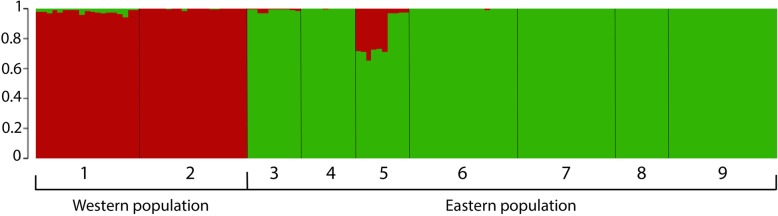
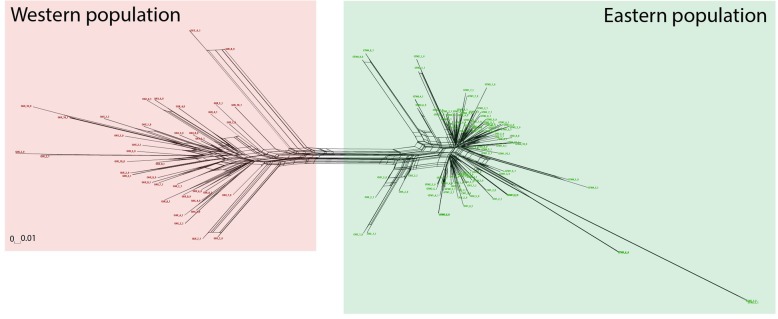
The Mexican hand tree or Canac (Chiranthodendron pentadactylon) is a temperate tree species of cloud and pine-oak forests of southern Mexico and Guatemala. Its characteristic hand-shaped flower is used in folk medicine and has constituted the iconic symbol of the Sociedad Botánica de México since 1940. Here, the evolutionary history of this species was estimated through phylogeographic analyses of nuclear DNA sequences obtained through restriction site associated DNA sequencing and ecological niche modeling. Total genomic DNA was extracted from leaf samples obtained from a representative number (5 to 10 per sampling site) of individuals distributed along the species geographic range. In Mexico, population is comprised by spatially isolated individuals which may follow the trends of cloud forest fragmentation. By contrast, in Guatemala Chiranthodendron may constitute a canopy dominant species near the Acatenango volcano. The distributional range of this species encompasses geographic provinces separated by the Isthmus of Tehuantepec. The objectives of the study were to: (i) estimate its genetic structure to define whether the observed range disjunction exerted by the Isthmus of Tehuantepec translates into separate populations, (ii) link population divergence timing and demographic trends to historical climate change, and (iii) test hypotheses related to Pleistocene refugia.
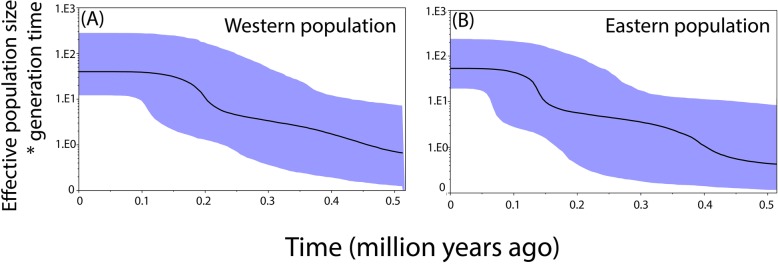
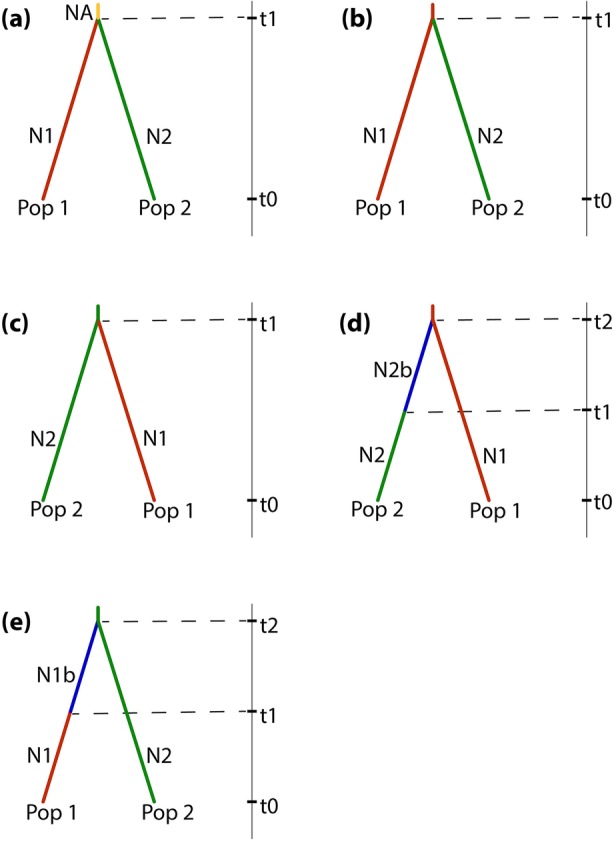
Patterns of genetic diversity indicated high levels of genetic differentiation between populations separated by the Isthmus. The western and eastern population diverged approximately 0.873 Million years ago (Ma). Demographic analyses supported a simultaneous split from an ancestral population and rapid expansion from a small stock approximately 0.2 Ma corresponding to a glacial period. The populations have remained stable since the LIG (130 Kilo years ago (Ka)). Species distribution modelling (SDM) predicted a decrease in potential distribution in the Last Interglacial (LIG) and an increase during the Last Glacial Maximum (LGM) (22 Ka), Mid-Holocene (6 Ka) and present times.
Divergence time estimations support the hypothesis that populations represent Quaternary relict elements of a species with broader and northernmost distribution. Pleistocene climatic shifts exerted major influence on the distribution of populations allowing dispersion during episodes of suitable climatic conditions and structuring during the first interglacial with a time period length of 100 Kilo years (Kyr) and the vicariant influence of the Isthmus. Limited demographic expansion and population connectivity during the LGM supports the moist forest hypothesis model.
墨西哥手树或 Canac(Chiranthodendron pentadactylon)是一种中温树种,生长在墨西哥南部和危地马拉的云杉和松栎森林中。它特有的手状花朵在民间医学中被使用,并自 1940 年以来一直构成墨西哥植物学会的标志性象征。在这里,通过核 DNA 序列的系统地理分析来估计该物种的进化历史,这些序列是通过限制性位点相关 DNA 测序和生态位建模获得的。从分布在物种地理范围内的个体中,提取了具有代表性数量的叶片样本(每个采样点 5 到 10 个)的总基因组 DNA。在墨西哥,种群由空间隔离的个体组成,这些个体可能遵循云林破碎化的趋势。相比之下,在危地马拉,Chiranthodendron 可能是阿卡特南戈火山附近的树冠优势物种。该物种的分布范围包括由特万特佩克地峡隔开的地理省份。该研究的目的是:(i)估计其遗传结构,以确定由特万特佩克地峡施加的观察到的范围分离是否转化为单独的种群,(ii)将种群分歧时间和人口趋势与历史气候变化联系起来,以及(iii)检验与更新世避难所有关的假设。
遗传多样性模式表明,被地峡隔开的种群之间存在高水平的遗传分化。西部和东部种群大约在 0.873 万年前(Ma)分化。人口分析支持从一个祖先种群的同时分裂和大约 0.2 Ma 的小种群的快速扩张,对应于一个冰川时期。自 LIG(130 千年前(Ka))以来,种群一直保持稳定。物种分布模型(SDM)预测,在上一个间冰期(LIG)和末次冰盛期(LGM)(22 Ka)、中全新世(6 Ka)和现在,潜在分布会减少。
分歧时间估计支持这样的假设,即种群代表具有更广泛和最北分布的第四纪残余元素。更新世气候变化对种群分布产生了重大影响,允许在适宜气候条件下扩散,并在第一个间冰期形成结构,时间长度为 100 千年(Kyr),并受到地峡的隔离影响。在 LGM 期间,有限的人口扩张和人口连通性支持潮湿森林假说模型。