Department of Otolaryngology Head and Neck Surgery, Ann and Robert H. Lurie Children's Hospital of Chicago, Northwestern Feinberg School of Medicine, 225 E Chicago Ave, Chicago, IL, 60610, USA.
Department of Otolaryngology - Head and Neck Surgery, Northwestern University, 676 N St Clair, Suite 1325, Chicago, IL, 60611, USA.
J Otolaryngol Head Neck Surg. 2020 Apr 19;49(1):19. doi: 10.1186/s40463-020-00415-8.
Previous literature has reported on the incidence of short-term complications following resection of cervical lymphatic malformations (LMs) in children, however no research has yet investigated the long-term symptomatic course in these patients. This study aims to provide families and providers with an understanding of expectations for long-term symptom control, specifically in association with subsequent upper respiratory infections (URIs).
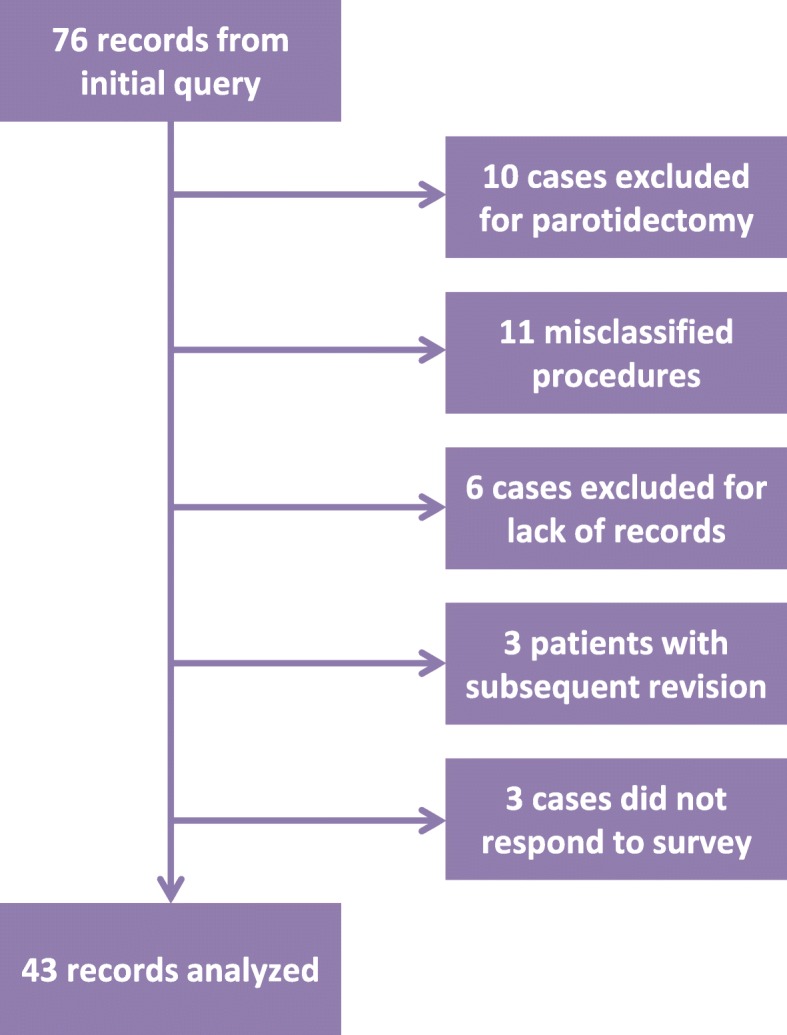
A retrospective chart review produced a case series of patients who underwent resection of cervical LM at a pediatric tertiary care center between 2007 and 2016. Demographic data, disease characteristics, operative details, and postoperative care were evaluated. Telephone surveys were conducted to ascertain the course of postoperative symptoms at the surgical site.
Forty-three patients responded to the telephone survey. Thirty-seven (86.0%) had at least one postoperative surgical site symptom during subsequent URIs, with 28 (65.1%) reporting redness, 34 (79.1%) reporting swelling, and 18 (41.9%) reporting pain. Patients who experienced any of these symptoms universally indicated that they developed soon after the surgical resection, and over half reported that they improved over time. Postoperative seroma was associated with swelling during subsequent URIs (p = 0.04). Patients age 7 or were greater were more likely than those under 7 to report pain with URIs (p = 0.006). All 8 patients with drain placement for at least 2 days reported swelling during subsequent URIs. The incidence of the queried symptoms did not vary significantly based on sex, stage, histology, surgical subsite, or presence of residual disease.
While preoperative symptoms associated with cervical LMs are also frequently encountered postoperatively, particularly in some patient subgroups, improvement over time should be expected.
先前的文献报道了儿童颈部淋巴管瘤(LM)切除术后短期并发症的发生率,但尚无研究调查这些患者的长期症状病程。本研究旨在为患者家属和医务人员提供对长期症状控制的预期,特别是与随后的上呼吸道感染(URI)相关的预期。
对 2007 年至 2016 年期间在一家儿科三级护理中心接受颈部 LM 切除术的患者进行了回顾性图表审查,以生成病例系列。评估了人口统计学数据、疾病特征、手术细节和术后护理。进行电话调查以确定术后手术部位的症状病程。
43 名患者对电话调查做出了回应。37 名(86.0%)在随后的 URI 中至少有一次术后手术部位症状,其中 28 名(65.1%)报告发红,34 名(79.1%)报告肿胀,18 名(41.9%)报告疼痛。出现这些症状的患者普遍表示这些症状是在手术切除后不久出现的,并且超过一半的患者表示这些症状随时间的推移而改善。术后血清肿与随后的 URI 中的肿胀有关(p=0.04)。年龄为 7 岁或 7 岁以上的患者比 7 岁以下的患者更有可能报告 URI 时疼痛(p=0.006)。所有放置引流管至少 2 天的 8 名患者在随后的 URI 中均报告肿胀。询问的症状发生率与性别、分期、组织学、手术部位或残留疾病的存在无关。
尽管与颈部 LM 相关的术前症状在手术后也经常出现,特别是在某些患者亚组中,但应预计会随时间的推移而改善。
4 级