Department of Gastroenterology and Hepatology, Cancer Centre Amsterdam, Amsterdam Gastroenterology and Metabolism, Amsterdam UMC, University of Amsterdam, Meibergdreef 9, Amsterdam, Netherlands.
Foundation of Population Screening Mid-West, Amsterdam, Netherlands.
Br J Cancer. 2020 Jun;122(12):1865-1871. doi: 10.1038/s41416-020-0832-8. Epub 2020 Apr 20.
Faecal immunochemical testing (FIT) is suboptimal in detecting advanced neoplasia (AN). To increase the sensitivity and yield of a FIT-based screening programme, FIT could be combined with risk factors for AN. We evaluated the incremental yield of adding a family history questionnaire (FHQ) on colorectal cancer (CRC) and Lynch syndrome-associated tumours to the Dutch FIT-based screening programme.
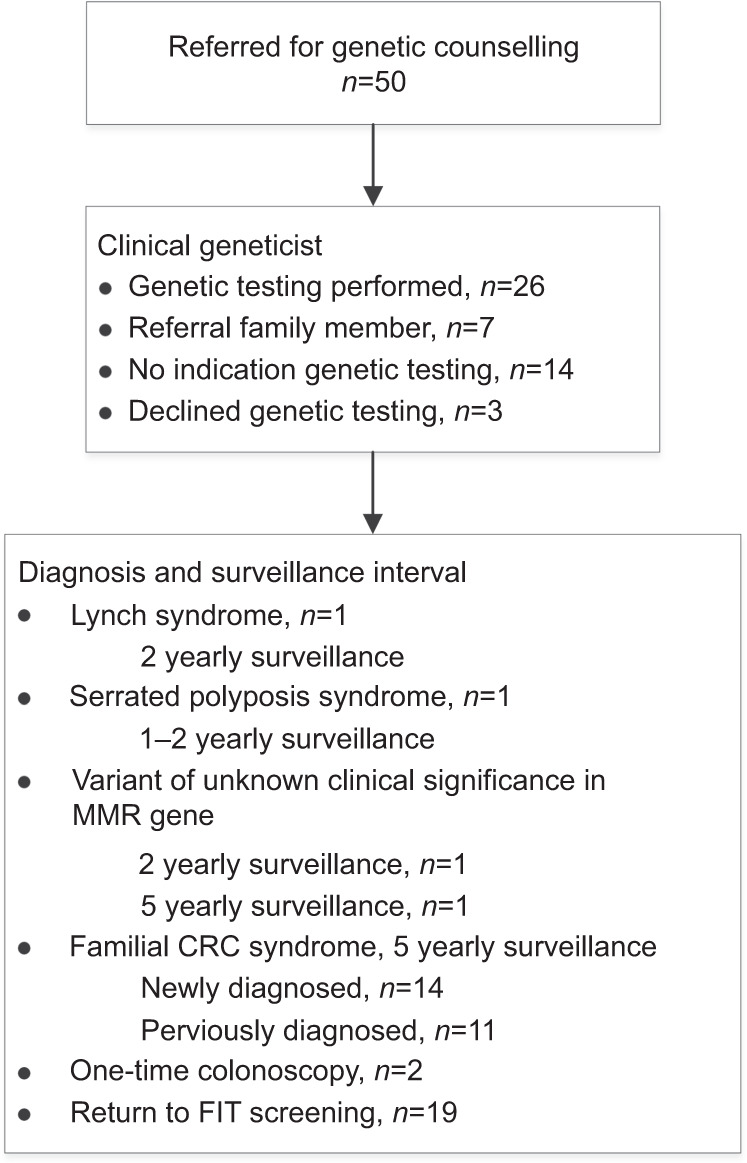
Six thousand screen-naive individuals, aged 59-75 years, were invited to complete a FIT (FOB-Gold, cut-off 47 µg Hb/g faeces) and a validated online FHQ. Participants with a positive FIT and/or positive FHQ, confirmed after genetic counselling, were referred for colonoscopy. Yield of detecting AN per 1000 invitees for the combined strategy was compared with the FIT-only strategy.
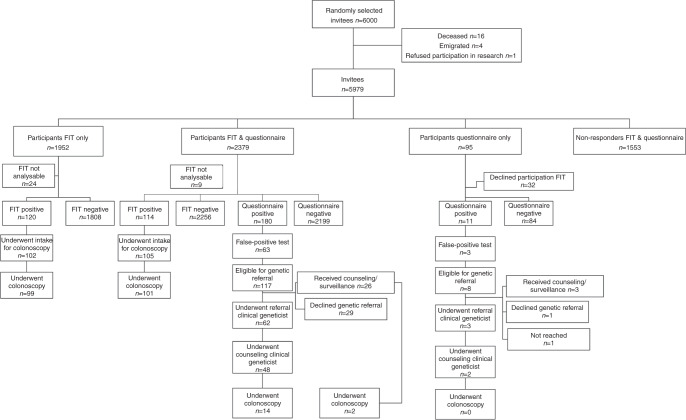
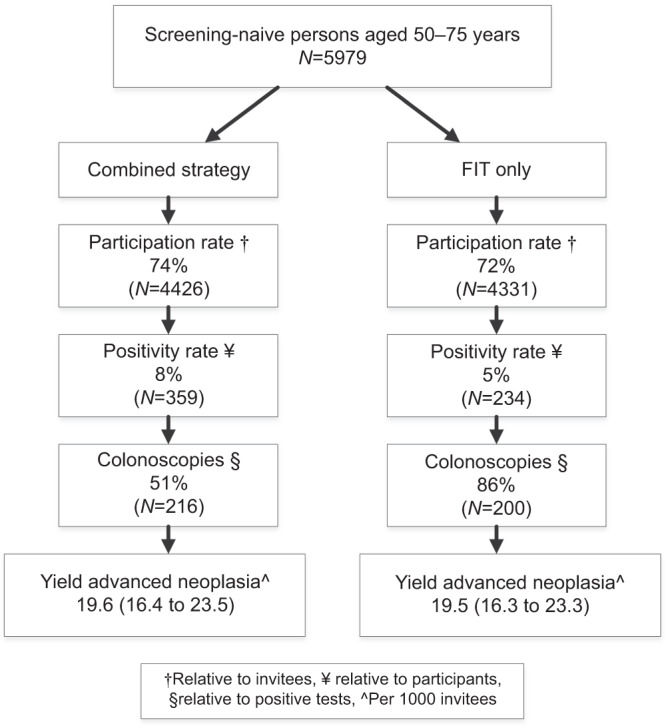
Of the 5979 invitees, 1952 (32.6%) completed the FIT only, 2379 (39.8%) completed both the FIT and FHQ and 95 (1.6%) completed the FHQ only. Addition of the FHQ to FIT-based screening resulted in one extra case of AN detected after 16 additional colonoscopies, resulting in a yield of 19.6 (95% CI, 16.4-23.5) for the combined strategy versus 19.5 (95% CI, 16.3-23.3) for the FIT-only strategy (p = 1.0).
The addition of an FHQ to one round of FIT screening did not increase the detection of AN compared with FIT only (ClinicalTrials.gov NCT02698462).
粪便免疫化学检测(FIT)在检测高级别肿瘤(AN)方面效果不佳。为了提高基于 FIT 的筛查方案的敏感性和收益,FIT 可与 AN 的风险因素相结合。我们评估了在荷兰基于 FIT 的筛查计划中,增加了结直肠癌(CRC)和林奇综合征相关肿瘤家族史问卷(FHQ)对 FIT 的附加收益。
我们邀请了 6000 名无筛查史、年龄在 59-75 岁的个体完成 FIT(FOB-Gold,截止值 47μg Hb/g 粪便)和经过验证的在线 FHQ。对 FIT 和/或经遗传咨询后确认的阳性 FHQ 的参与者进行结肠镜检查。每 1000 名受邀者中,比较了联合策略检测 AN 的收益与仅 FIT 策略。
在 5979 名受邀者中,1952 名(32.6%)仅完成了 FIT,2379 名(39.8%)同时完成了 FIT 和 FHQ,95 名(1.6%)仅完成了 FHQ。将 FHQ 添加到基于 FIT 的筛查中,额外进行 16 次结肠镜检查后,可多检出 1 例 AN,联合策略的收益为 19.6(95%CI,16.4-23.5),而仅 FIT 策略的收益为 19.5(95%CI,16.3-23.3)(p=1.0)。
与仅 FIT 相比,将 FHQ 添加到一轮 FIT 筛查中并不能增加 AN 的检出率(ClinicalTrials.gov NCT02698462)。