Tabassum Sadia, Hameed Muhammad Hasan, Khan Farhan Raza
Department of Operative Dentistry, Jinnah Medical and Dental College, Karachi, Pakistan.
Department of Operative Dentistry, Aga Khan University Hospital, Karachi, Pakistan.
Contemp Clin Dent. 2019 Apr-Jun;10(2):220-225. doi: 10.4103/ccd.ccd_635_18.
The aim of this study is to compare the depth of cure of two composite materials (SDR and Filtek bulk-fill) cured at variable increment depths (2, 4, and 6 mm) and voltages (180 and 220 volts).
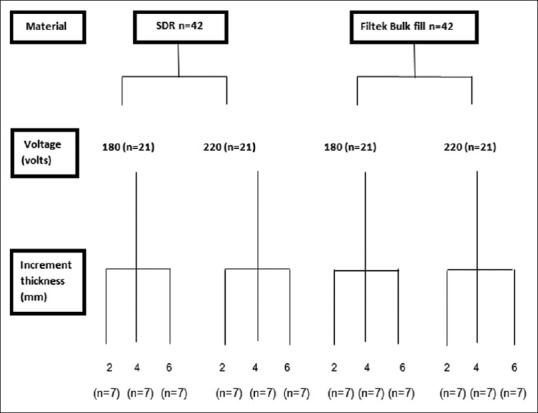
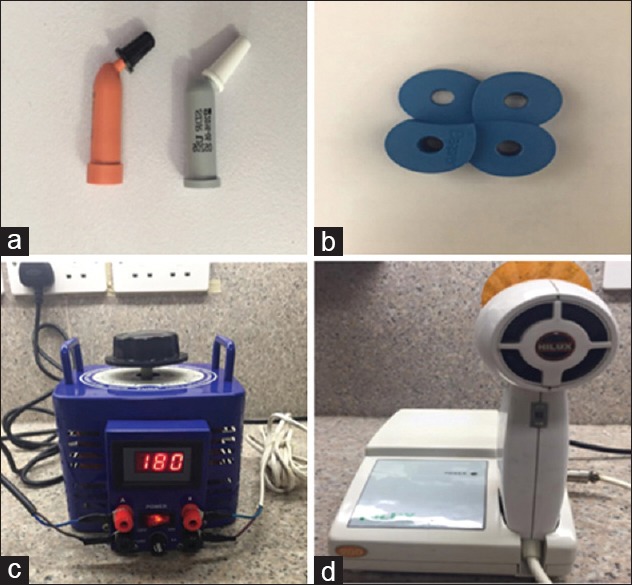
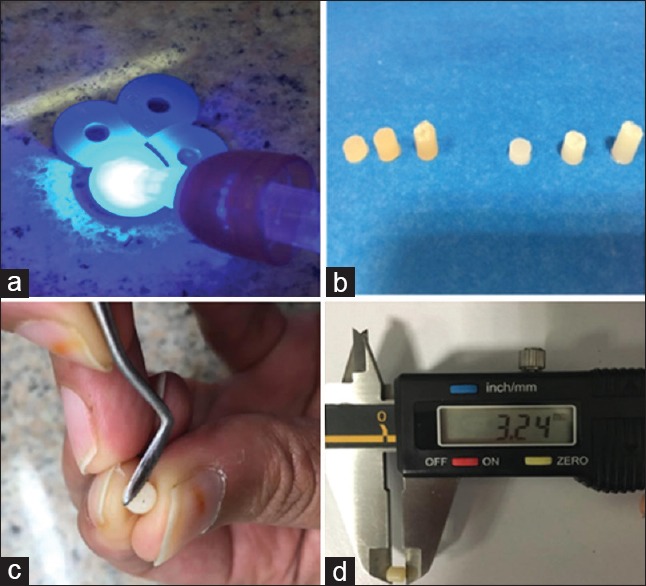
Each sample of the composite material was packed in a mold of 2 mm, 4 mm, and 6 mm and curing light (quartz tungsten halogen) of optimal intensity was exposed for 20 s at 2 different voltages on each specimen. After curing, the specimens were removed and the composite on the nonexposed end was scraped with a plastic instrument. The remaining composite thickness was measured using a digital Vernier caliper. The reading was divided by half to follow the ISO 4049 method. Independent sample -test, one-way ANOVA, and linear regression analysis were applied. Level of significance was kept at 0.01.
The mean DOC of SDR and Filtek were 1.93 ± 0.82 and 1.77 ± 0.65 mm. Lowering the voltage from 220 to 180 volts reduced the depth of Filtek from 1.87 ± 0.74 to 1.67 ± 0.54 mm, whereas the DOC of SDR remained unchanged at 1.93 mm at the two voltages. The adjusted for the depth of cure was 0.93 when the increment thickness, voltage, and restorative material were taken together in the regression model.
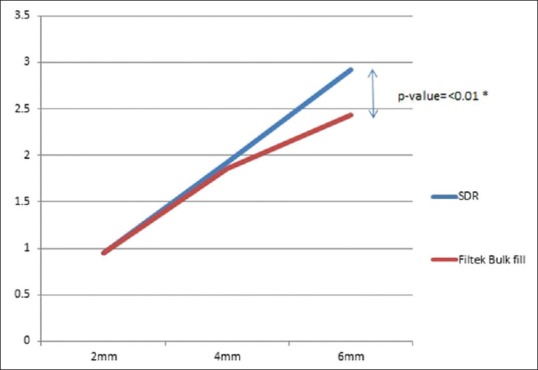
There was no statistically significant difference between SDR and Filtek for the depth of cure at 2 and 4 mm increments. However, at 6 mm increment, the SDR cured significantly deeper than the Filtek. Around 91% variation in the depth of cure of these composites materials is explained by increment thickness alone.
本研究旨在比较两种复合材料(SDR和Filtek大容量充填材料)在不同增量深度(2、4和6毫米)以及不同电压(180和220伏)下固化后的固化深度。
将每种复合材料样本分别填充到2毫米、4毫米和6毫米的模具中,然后在每个样本上以两种不同电压用最佳强度的固化灯(石英钨卤素灯)照射20秒。固化后,取出样本,用塑料器械刮去未照射端的复合材料。使用数字游标卡尺测量剩余复合材料的厚度。读数除以二以遵循ISO 4049方法。应用独立样本t检验、单因素方差分析和线性回归分析。显著性水平设定为0.01。
SDR和Filtek的平均固化深度分别为1.93±0.82毫米和1.77±0.65毫米。将电压从220伏降至180伏时,Filtek的固化深度从1.87±0.74毫米降至1.67±0.54毫米,而SDR在两种电压下的固化深度均保持在1.93毫米不变。在回归模型中,当将增量厚度、电压和修复材料一起考虑时,固化深度的调整R²为0.93。
在增量为2毫米和4毫米时,SDR和Filtek的固化深度在统计学上无显著差异。然而,在增量为6毫米时,SDR的固化深度明显比Filtek深。这些复合材料固化深度约91%的变化仅由增量厚度解释。