Huang Xing-Bing, Huang Xiong, He Hong-Bo, Mei Fang, Sun Bin, Zhou Su-Miao, Yan Su, Zheng Wei, Ning Yuping
The Affiliated Brain Hospital of Guangzhou Medical University (Guangzhou Huiai Hospital), Guangzhou, People's Republic of China.
Neuropsychiatr Dis Treat. 2020 Apr 5;16:901-908. doi: 10.2147/NDT.S248190. eCollection 2020.
Ketamine and propofol have become increasingly popular in electroconvulsive therapy (ECT) anaesthesia. This study was conducted to examine whether changes in serum levels of brain-derived neurotrophic factor (BDNF) are associated with the antidepressant effects of ketofol, a combination of ketamine and propofol, in ECT for patients with treatment-resistant depression (TRD).
Thirty patients with TRD (18-65 years) were enrolled and underwent eight ECT sessions with ketamine (0.5 mg/kg) plus propofol (0.5 mg/kg) (ketofol). Symptom severity was monitored using the 17-item Hamilton Depression Rating Scale (HAMD-17) and the Brief Psychiatric Rating Scale (BPRS), and serum levels of BDNF were examined by enzyme-linked immunosorbent assay (ELISA) at baseline and after 2, 4, and 8 ECT treatments. Serum levels of BDNF were also collected from thirty healthy controls.
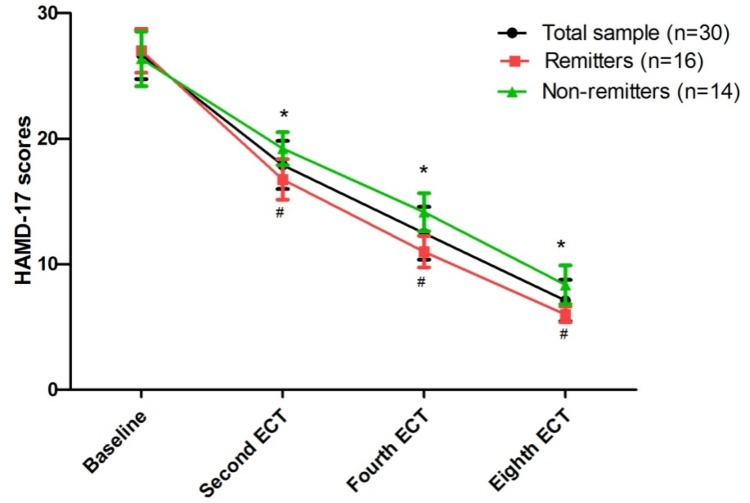
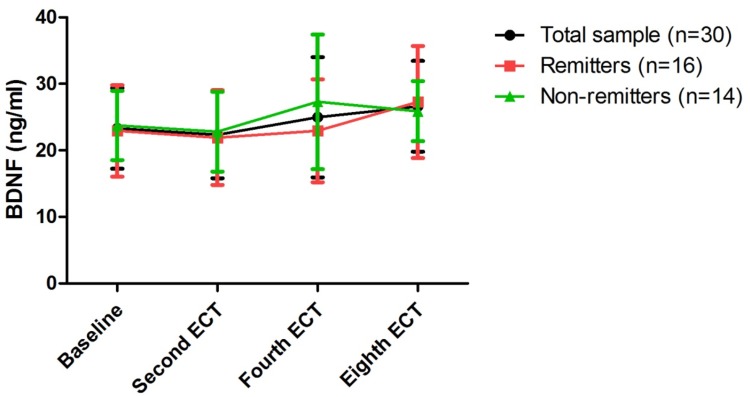
At baseline, there were no significant differences in serum levels of BDNF between patients with TRD and healthy controls. The response and remission rates in patients with TRD were 100% (30/30) and 53.3% (16/30) after ECT treatment, respectively. Despite a significant reduction in HAMD-17 and BPRS scores after ECT, no changes in serum levels of BDNF were observed after ECT treatment when compared to baseline. No association was found between serum levels of BDNF and changes in illness severity.
Serum levels of BDNF did not represent a suitable candidate biomarker for determining the antidepressant effects of ketofol during ECT for patients with TRD.
氯胺酮和丙泊酚在电休克治疗(ECT)麻醉中越来越常用。本研究旨在探讨血清脑源性神经营养因子(BDNF)水平的变化是否与氯胺酚(氯胺酮与丙泊酚的合剂)对难治性抑郁症(TRD)患者进行ECT治疗时的抗抑郁效果相关。
招募30例年龄在18 - 65岁的TRD患者,接受8次ECT治疗,每次使用氯胺酮(0.5mg/kg)加丙泊酚(0.5mg/kg)(氯胺酚)。使用17项汉密尔顿抑郁量表(HAMD - 17)和简明精神病评定量表(BPRS)监测症状严重程度,并在基线时以及ECT治疗2次、4次和8次后通过酶联免疫吸附测定(ELISA)检测血清BDNF水平。还从30名健康对照者中采集血清BDNF水平。
在基线时,TRD患者与健康对照者的血清BDNF水平无显著差异。ECT治疗后,TRD患者的有效率和缓解率分别为100%(30/30)和53.3%(16/30)。尽管ECT治疗后HAMD - 17和BPRS评分显著降低,但与基线相比,ECT治疗后血清BDNF水平未观察到变化。未发现血清BDNF水平与疾病严重程度变化之间存在关联。
血清BDNF水平并非确定氯胺酚对TRD患者进行ECT治疗时抗抑郁效果的合适候选生物标志物。