Lee Maosheng, Li Huilin, Zhao Hengxia, Suo Miao, Liu Deliang
The Fourth Clinical Medical College, Guangzhou University of Chinese Medicine, Guangzhou 510006, People's Republic of China.
Department of Endocrinology, Shenzhen Traditional Chinese Medicine Hospital, Shenzhen 518033, People's Republic of China.
Diabetes Metab Syndr Obes. 2020 Apr 9;13:1097-1107. doi: 10.2147/DMSO.S246381. eCollection 2020.
Type 2 diabetes mellitus (T2DM), a complex metabolic disease, has become a major public health issue around the world. Hydroxysafflor yellow A (HSYA) is the major active chemical ingredient of . (safflower), which is widely used in patients with cardiovascular and cerebrovascular diseases in China. The aim of this study was to investigate the anti-diabetic effect and potential mechanism of HSYA on the high-fat diet (HFD) and streptozotocin (STZ-)-induced T2DM rats.
T2DM rats were induced by feeding HFD (60% fat) for four weeks followed by intraperitoneal injection of a low dose of streptozocin (35mg/kg). The T2DM rats were treated with HSYA (120mg/kg) or metformin (90mg/kg) for eight weeks. Biochemical analysis, histological analysis and Western blot analysis were conducted after 8 weeks of intervention.
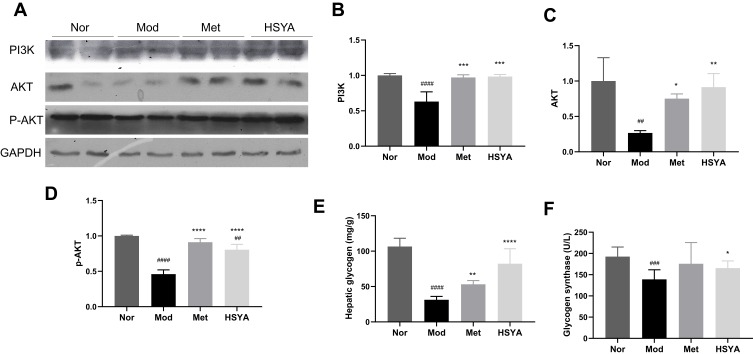
The treatment with HSYA evidently reduced fasting-blood glucose and insulin resistance in T2DM rats, indicated by results from fasting-blood glucose, oral glucose tolerance test, fasting insulin levels and histology of pancreas islets. The Western blot results revealed that HSYA reversed the down-regulation of PI3K and AKT in liver. The TUNEL assay analysis of pancreatic tissue showed that HSYA could inhibit the apoptosis of pancreatic β-cells to a certain extent. Moreover, HSYA-treatment increased the levels of glycogen synthase and hepatic glycogen and improved lipid metabolism by reducing the triglyceride, total and low-density lipoprotein cholesterol levels, even though it did not change the rats' body weights.
The results of this study suggested that HSYA could promote PI3K/Akt activation and inhibit the apoptosis of pancreatic β-cells directly or indirectly, which might be the underlying mechanisms in HSYA to improve insulin resistance and regulate glycolipid metabolism in T2DM rats.
2型糖尿病(T2DM)是一种复杂的代谢性疾病,已成为全球主要的公共卫生问题。羟基红花黄色素A(HSYA)是(红花)的主要活性化学成分,在中国广泛应用于心血管和脑血管疾病患者。本研究旨在探讨HSYA对高脂饮食(HFD)和链脲佐菌素(STZ)诱导的T2DM大鼠的抗糖尿病作用及潜在机制。
通过喂食高脂饮食(60%脂肪)四周,随后腹腔注射低剂量链脲佐菌素(35mg/kg)诱导T2DM大鼠。将T2DM大鼠用HSYA(120mg/kg)或二甲双胍(90mg/kg)治疗八周。干预8周后进行生化分析、组织学分析和蛋白质印迹分析。
HSYA治疗明显降低了T2DM大鼠的空腹血糖和胰岛素抵抗,空腹血糖、口服葡萄糖耐量试验、空腹胰岛素水平和胰岛组织学结果表明了这一点。蛋白质印迹结果显示,HSYA逆转了肝脏中PI3K和AKT的下调。胰腺组织的TUNEL分析表明,HSYA可在一定程度上抑制胰腺β细胞的凋亡。此外,HSYA治疗增加了糖原合酶和肝糖原水平,并通过降低甘油三酯、总胆固醇和低密度脂蛋白胆固醇水平改善了脂质代谢,尽管它没有改变大鼠的体重。
本研究结果表明,HSYA可促进PI3K/Akt激活,直接或间接抑制胰腺β细胞凋亡,这可能是HSYA改善T2DM大鼠胰岛素抵抗和调节糖脂代谢的潜在机制。