
2 型糖尿病二甲双胍治疗大鼠肝组织中潜在治疗靶点基因的转录组学和蛋白质组学分析。
Transcriptomic and proteomic analysis of potential therapeutic target genes in the liver of metformin‑treated Sprague‑Dawley rats with type 2 diabetes mellitus.
机构信息
College of Life Science, Zhejiang Chinese Medical University, Hangzhou, Zhejiang 310053, P.R. China.
College of Pharmacy, Zhejiang Chinese Medical University, Hangzhou, Zhejiang 310053, P.R. China.
出版信息
Int J Mol Med. 2018 Jun;41(6):3327-3341. doi: 10.3892/ijmm.2018.3535. Epub 2018 Mar 6.
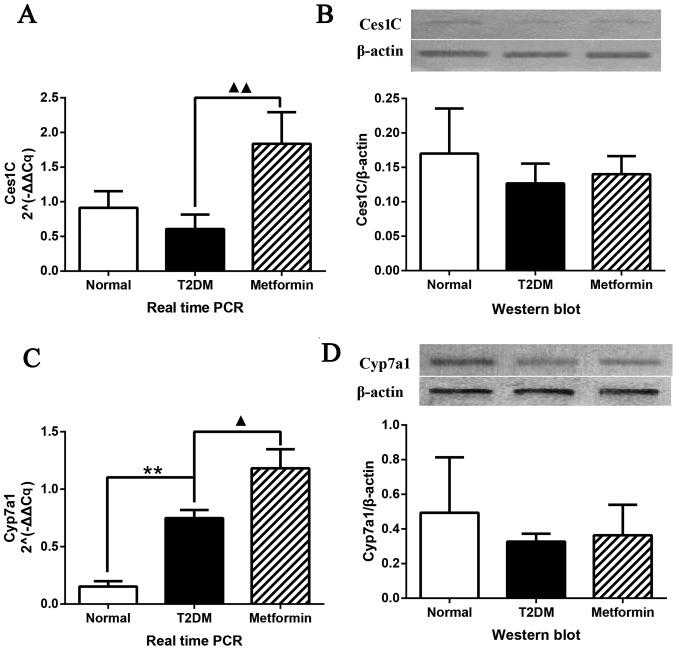
The main actions of metformin are as follows: To reduce hyperglycemia via the suppression of gluconeogenesis, improve glucose uptake and insulin sensitivity, and stimulate activation of adenosine monophosphate‑activated protein kinase during the treatment of diabetes mellitus. It is well known that metformin acts via complex mechanisms, including multitarget and multipathway mechanisms; however, the multitargeted antidiabetic genes of metformin remain obscure. The present study aimed to perform transcriptomic and proteomic analysis of potential therapeutic target genes in the liver of metformin‑treated Sprague‑Dawley rats with type 2 diabetes mellitus. The type 2 diabetes rat model was established using streptozotocin. Fasting blood glucose, hemoglobin A1c, serum insulin and biological parameters were subsequently measured. Differentially expressed genes (DEGs) and proteins were identified in the rat livers by expression profile analysis and isobaric tags for relative and absolute quantitation (iTRAQ). A 1.5‑fold alteration in gene expression, as determined using chip‑based expression profile analysis, and a 1.2‑fold alteration in protein expression, as determined using iTRAQ, were considered physiologically significant benchmarks, which were used to identify DEGS in metformin‑treated rats with type 2 diabetes mellitus. The DEGs were verified using quantitative polymerase chain reaction (qPCR) and western blot analysis. Numerous hepatic genes involved in various metabolic pathways were affected by metformin; in particular, genes associated with lipid metabolism were markedly affected. Expression profile analysis and iTRAQ analysis suggested that carboxylesterase 1C subunit (Ces1C) and cholesterol 7α‑hydroxylyase (Cyp7a1) may serve as important DEGs, which were validated by qPCR and western blot analysis. Ces1C and Cyp7a1 are the main enzymes in cholesterol metabolism, yet the result of western blotting was not consistent with qPCR. The present study demonstrated that metformin may affect the expression of numerous hepatic genes involved in metabolic pathways, particularly the lipid and cholesterol metabolic pathways. Ces1C and Cyp7a1 may be considered novel therapeutic target genes in the liver, which are involved in the antidiabetic effects of metformin.
二甲双胍的主要作用如下
在治疗糖尿病时,通过抑制糖异生、提高葡萄糖摄取和胰岛素敏感性以及刺激腺苷单磷酸激活蛋白激酶的激活来降低高血糖。众所周知,二甲双胍通过复杂的机制发挥作用,包括多靶点和多途径机制;然而,二甲双胍的多靶向抗糖尿病基因仍然不清楚。本研究旨在对 2 型糖尿病斯普拉格-道利大鼠肝脏中潜在治疗靶点基因进行转录组和蛋白质组分析。使用链脲佐菌素建立 2 型糖尿病大鼠模型。随后测量空腹血糖、糖化血红蛋白 A1c、血清胰岛素和生物学参数。通过表达谱分析和等重标记相对和绝对定量(iTRAQ)鉴定大鼠肝脏中的差异表达基因(DEGs)和蛋白质。芯片表达谱分析确定基因表达变化 1.5 倍,iTRAQ 确定蛋白表达变化 1.2 倍,被认为是生理显著的基准,用于鉴定 2 型糖尿病中用二甲双胍治疗的大鼠的 DEGs。使用定量聚合酶链反应(qPCR)和 Western blot 分析验证 DEGs。许多参与各种代谢途径的肝基因受到二甲双胍的影响;特别是与脂质代谢相关的基因受到显著影响。表达谱分析和 iTRAQ 分析表明,羧基酯酶 1C 亚基(Ces1C)和胆固醇 7α-羟化酶(Cyp7a1)可能是重要的 DEGs,qPCR 和 Western blot 分析验证了这一点。Ces1C 和 Cyp7a1 是胆固醇代谢的主要酶,但 Western blot 的结果与 qPCR 不一致。本研究表明,二甲双胍可能影响参与代谢途径的许多肝基因的表达,特别是脂质和胆固醇代谢途径。Ces1C 和 Cyp7a1 可被认为是肝脏中涉及二甲双胍抗糖尿病作用的新的治疗靶点基因。




 Zotero 插件