Berny Mier Y Teran Jorge Carlos, Konzen Enéas R, Palkovic Antonia, Tsai Siu M, Gepts Paul
Department of Plant Sciences, University of California, Davis, Davis, CA, United States.
Cell and Molecular Biology Laboratory, Centro de Energia Nuclear na Agricultura, Universidade de São Paulo, Piracicaba, Brazil.
Front Plant Sci. 2020 Apr 3;11:346. doi: 10.3389/fpls.2020.00346. eCollection 2020.
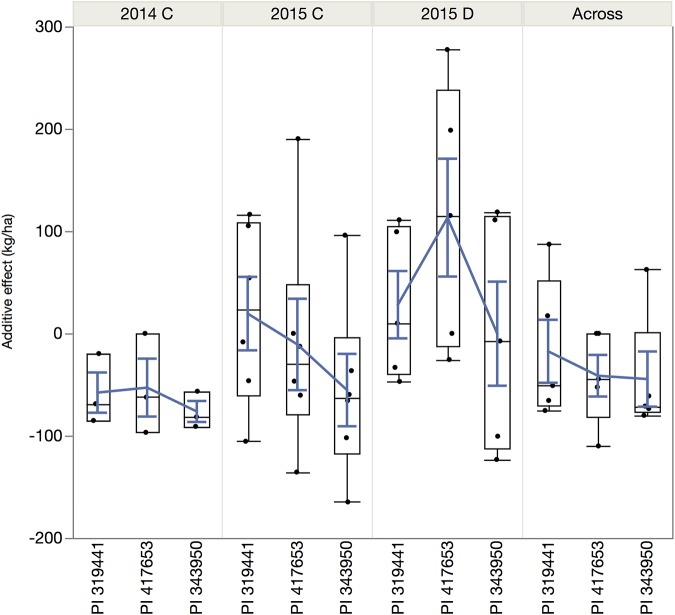
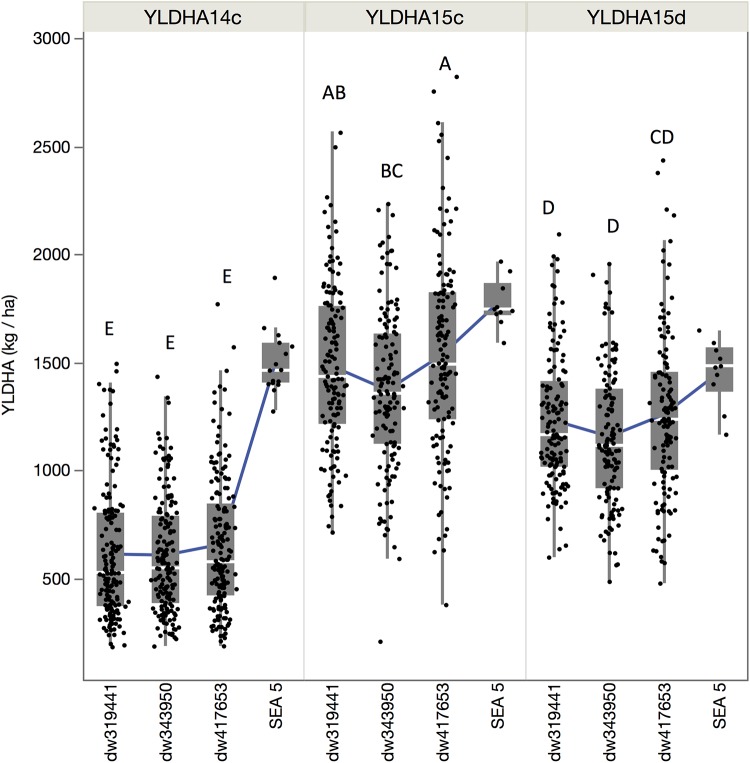
Genetic analyses and utilization of wild genetic variation for crop improvement in common bean ( L.) have been hampered by yield evaluation difficulties, identification of advantageous variation, and linkage drag. The lack of adaptation to cultivation conditions and the existence of highly structured populations make association mapping of diversity panels not optimal. Joint linkage mapping of nested populations avoids the later constraint, while populations crossed with a common domesticated parent allow the evaluation of wild variation within a more adapted background. Three domesticated by wild backcrossed-inbred-line populations (BCS) were developed using three wild accessions representing the full range of rainfall of the Mesoamerican wild bean distribution crossed to the elite drought tolerant domesticated parent SEA 5. These populations were evaluated under field conditions in three environments, two fully irrigated trials in two seasons and a simulated terminal drought in the second season. The goal was to test if these populations responded differently to drought stress and contained progenies with higher yield than SEA 5, not only under drought but also under water-watered conditions. Results revealed that the two populations derived from wild parents of the lower rainfall regions produced lines with higher yield compared to the domesticated parent in the three environments, i.e., both in the drought-stressed environment and in the well-watered treatments. Several progeny lines produced yields, which on average over the three environments were 20% higher than the SEA 5 yield. Twenty QTLs for yield were identified in 13 unique regions on eight of the 11 chromosomes of common bean. Five of these regions showed at least one wild allele that increased yield over the domesticated parent. The variation explained by these QTLs ranged from 0.6 to 5.4% of the total variation and the additive effects ranged from -164 to 277 kg ha, with evidence suggesting allelic series for some QTLs. Our results underscore the potential of wild variation, especially from drought-stressed regions, for bean crop improvement as well the identification of regions for efficient marker-assisted introgression.
普通菜豆(Phaseolus vulgaris L.)野生遗传变异在作物改良中的遗传分析和利用一直受到产量评估困难、有利变异鉴定以及连锁累赘的阻碍。缺乏对栽培条件的适应性以及高度结构化群体的存在使得多样性群体的关联作图并不理想。嵌套群体的联合连锁作图避免了后一个限制,而与一个常见驯化亲本杂交的群体则允许在更适应的背景下评估野生变异。利用代表中美洲野生菜豆分布区全部降雨范围的三个野生种质与耐旱优良驯化亲本SEA 5杂交,培育了三个野生回交自交系群体(BCS)。这些群体在三种环境的田间条件下进行了评估,包括两个季节的两次充分灌溉试验以及第二季的模拟终期干旱试验。目的是测试这些群体对干旱胁迫的反应是否不同,以及是否包含不仅在干旱条件下而且在水分充足条件下产量高于SEA 5的后代。结果表明,来自降雨较少地区野生亲本的两个群体在三种环境中,即在干旱胁迫环境和水分充足处理中,都产生了产量高于驯化亲本的品系。几个后代品系的产量在三种环境中的平均值比SEA 5的产量高20%。在普通菜豆11条染色体中的8条染色体上的13个独特区域鉴定出了20个产量相关的QTL。其中5个区域显示至少有一个野生等位基因,其产量高于驯化亲本。这些QTL解释的变异占总变异 的0.6%至5.4%,加性效应范围为-164至277 kg/ha,有证据表明一些QTL存在等位基因系列。我们的结果强调了野生变异,特别是来自干旱胁迫地区的野生变异在菜豆作物改良中的潜力,以及鉴定有效标记辅助导入区域的重要性。