Cho A Jin, Lee Hong-Seock, Lee Young-Ki, Jeon Hee Jung, Park Hayne Cho, Jeong Da-Wun, Kim Yang-Gyun, Lee Sang-Ho, Lee Chang-Hee, Yoo Kyung Don, Wong Ae Kyeong
1Department of Internal Medicine, Kangnam Sacred Heart Hospital, Hallym University College of Medicine, 1, Singil-ro, Yeongdeungpo-gu, Seoul, 07441 South Korea.
2Hallym University College of Medicine, Psychiatry, Seoul, Republic of Korea.
Biopsychosoc Med. 2020 Apr 15;14:9. doi: 10.1186/s13030-020-00181-z. eCollection 2020.
Post-traumatic stress symptoms can occur in patients with medical illness. During the Middle East Respiratory Syndrome (MERS) outbreak in South Korea in 2015, some dialysis patients in three centers who were incidentally exposed to patients or medical staff with confirmed MERS-CoV infection were isolated to interrupt the spread of the infection. We aimed to investigate post-traumatic stress symptoms and risk factors among these patients.
In total, 116 hemodialysis (HD) patients in contact with MERS-CoV-confirmed subjects were isolated using three strategies, namely, single room isolation, cohort isolation, and self-quarantine. We used the Impact of Event Scale-Revised-Korean (IES-R-K) to examine post-traumatic stress symptoms at 12 months after the isolation period.
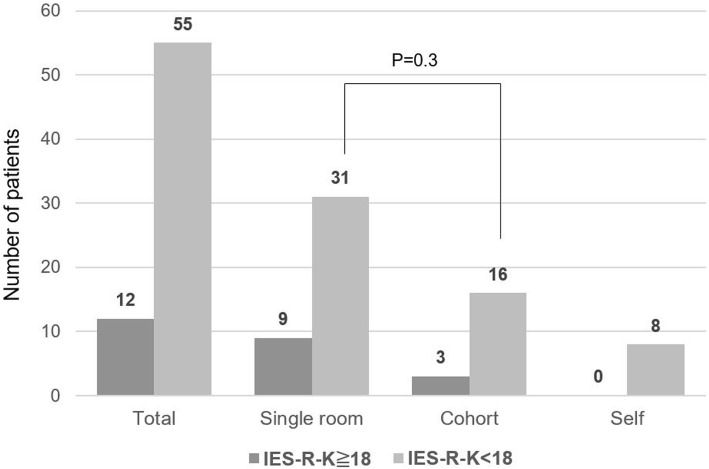
Of the 116 HD patients, 27 were lost to follow-up. Of the 89 patients, 67 (75.3%) completed the questionnaires. Single room isolation was used on 40 (58.8%) of the patients, cohort isolation on 20 (29.4%), and self-imposed quarantine on 8 (11.8%). In total, 17.9% of participants ( = 12) reported post-traumatic stress symptoms exceeding the IES-R-K's cutoff point (≧18). Prevalence rates of IES-R-K ≧18 did not differ significantly according to isolation method. However, isolation duration was linearly associated with the IES-R-K score (standardized β coefficient - 0.272, = 0.026). Scores in subscale were higher in patients with longer isolation period.
MERS was a traumatic experience for quarantined HD patients. IES-R-K scores were not significantly different by isolation methods. However, short isolation was associated with post-traumatic stress symptoms.
创伤后应激症状可发生于患有内科疾病的患者中。在2015年韩国中东呼吸综合征(MERS)疫情爆发期间,三个中心的一些偶然接触确诊中东呼吸综合征冠状病毒(MERS-CoV)感染患者或医护人员的透析患者被隔离,以阻断感染传播。我们旨在调查这些患者的创伤后应激症状及危险因素。
总共116名接触确诊MERS-CoV患者的血液透析(HD)患者采用三种策略进行隔离,即单人房间隔离、群组隔离和自我隔离。我们使用事件影响量表修订版-韩语版(IES-R-K)在隔离期后12个月检查创伤后应激症状。
116名HD患者中,27名失访。89名患者中,67名(75.3%)完成了问卷调查。40名(58.8%)患者采用单人房间隔离,20名(29.4%)采用群组隔离,8名(11.8%)采用自我隔离。总计17.9%的参与者(n = 12)报告创伤后应激症状超过IES-R-K的临界值(≧18)。IES-R-K≧18的患病率根据隔离方法无显著差异。然而,隔离持续时间与IES-R-K评分呈线性相关(标准化β系数 - 0.272,P = 0.026)。隔离期较长的患者在该分量表中的得分较高。
MERS疫情对于被隔离的HD患者而言是一次创伤经历。IES-R-K评分根据隔离方法无显著差异。然而,短时间隔离与创伤后应激症状相关。