Ni Weiqiong, Qi Weixiang, Xu Fei, Cao Weiguo, Xu Cheng, Chen Jiayi, Gao Yunsheng
Department of Radiation Oncology, Ruijin Hospital, Shanghai Jiao Tong University, School of Medicine, Shanghai 200025, China.
Ann Transl Med. 2020 Mar;8(5):223. doi: 10.21037/atm.2020.01.03.
To investigate the prognostic value of pretreatment primary gross tumor with (GTVp) and without retropharyngeal lymph nodes (GTVnx) for predicting survival outcomes in patients with local-regional advanced nasopharyngeal carcinoma (NPC) after intensity-modulated radiation therapy (IMRT).
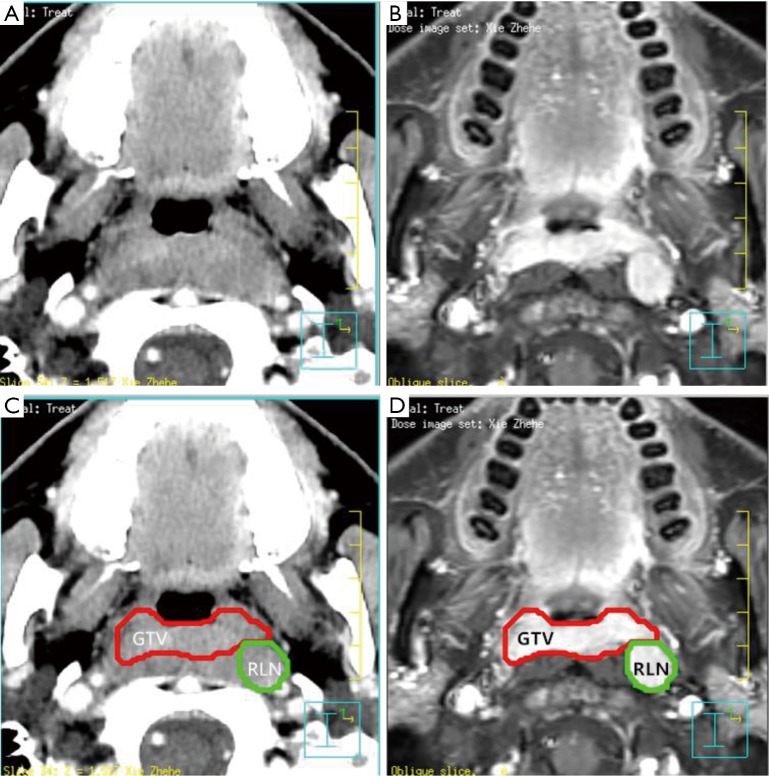
From Jan 2012 to Dec 2017, 148 patients with local-regional advanced NPC who had undergone definitive radiotherapy were identified. GTVnx volume and retropharyngeal lymph nodes (GTVrLNs) volume were measured based on registration of MRI with contrast-enhanced CT images. The Kaplan-Meier method was used for survival analysis. Univariate and multivariate prognostic analyses was performed by using the Cox proportional hazard model. Receiver operating characteristic (ROC) curves were used to identify the cut-off point and assess the prognostic value for GTVnx, GTVp and GTVrLNs.
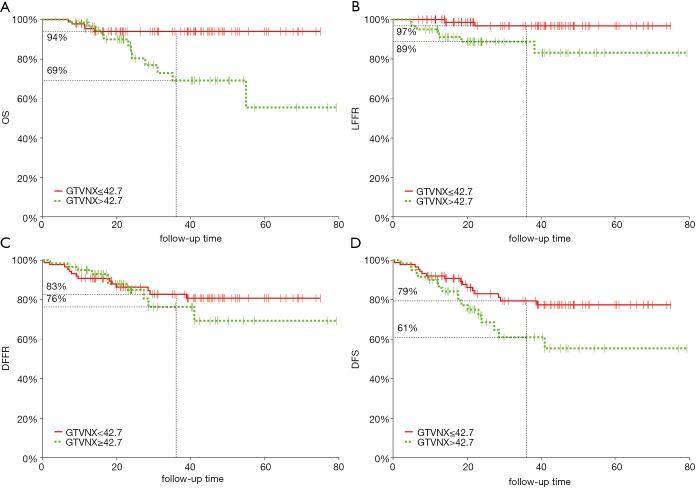
The median follow-up time for the entire group was 27 months (ranging 7 to 80 months). The 3-year overall survival (OS) rate was 85%, and the 3-year local failure-free rate (LFFR), distant failure-free rate (DFFR) and disease-free survival (DFS) rates were 93%, 81%, and 73%, respectively. A positive correlation between GTVnx or GTVp volume and T stage was observed (both P<0.001). The 3-year LFFR, OS, and DFS rate, but not for DMFS, in NPC patients with GTVnx ≤42.7 cm was significantly better than those with >42.7 cm (all P<0.05). Multivariate analysis indicated that GTVnx volume (P=0.041) was the only independent prognostic factor for LFFR, while age and AJCC stage were two independent prognostic factors for OS.
The GTVnx is an independent prognostic factor for local control, while the prognostic value of GTVrLNs is limited. Physicians are recommended to distinguish between GTVnx and retropharyngeal lymph nodes (RLN) involvement when assessing the risk for local recurrence in advanced NPC.
探讨调强放疗(IMRT)后,治疗前有(GTVp)和无咽后淋巴结(GTVnx)的原发性大体肿瘤对局部区域晚期鼻咽癌(NPC)患者生存结局的预后价值。
2012年1月至2017年12月,确定148例接受根治性放疗的局部区域晚期NPC患者。基于MRI与增强CT图像的配准测量GTVnx体积和咽后淋巴结(GTVrLNs)体积。采用Kaplan-Meier法进行生存分析。使用Cox比例风险模型进行单因素和多因素预后分析。采用受试者工作特征(ROC)曲线确定切点并评估GTVnx、GTVp和GTVrLNs的预后价值。
全组患者的中位随访时间为27个月(范围7至80个月)。3年总生存率(OS)为85%,3年局部无复发生存率(LFFR)、远处无复发生存率(DFFR)和无病生存率(DFS)分别为93%、81%和73%。观察到GTVnx或GTVp体积与T分期呈正相关(均P<0.001)。GTVnx≤42.7 cm的NPC患者3年LFFR、OS和DFS率显著优于>42.7 cm的患者,但DMFS率无差异(均P<0.05)。多因素分析表明,GTVnx体积(P=0.041)是LFFR的唯一独立预后因素,而年龄和AJCC分期是OS的两个独立预后因素。
GTVnx是局部控制的独立预后因素,而GTVrLNs的预后价值有限。建议医生在评估晚期NPC局部复发风险时区分GTVnx和咽后淋巴结(RLN)受累情况。