Heard Andrew W, Goldup Stephen M
School of Chemistry, University of Southampton, Highfield, Southampton SO17 1BJ, UK.
Chem. 2020 Apr 9;6(4):994-1006. doi: 10.1016/j.chempr.2020.02.006.
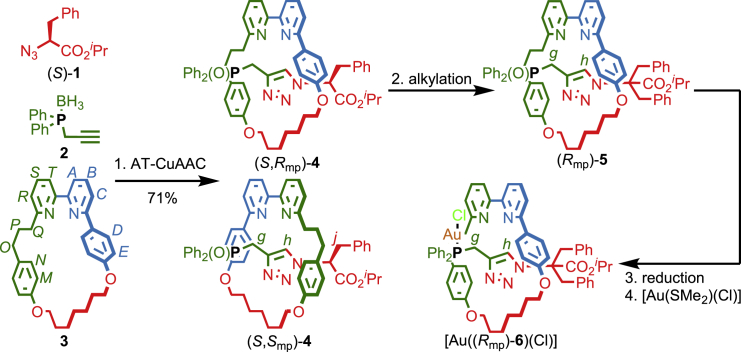
Rotaxanes are interlocked molecules in which a molecular ring is trapped on a dumbbell-shaped axle because of its inability to escape over the bulky end groups, resulting in a so-called mechanical bond. Interlocked molecules have mainly been studied as components of molecular machines, but the crowded, flexible environment created by threading one molecule through another has also been explored in catalysis and sensing. However, so far, the applications of one of the most intriguing properties of interlocked molecules, their ability to display stereogenic units that do not rely on the stereochemistry of their covalent subunits, termed "mechanical chirality," have yet to be properly explored, and prototypical demonstration of the applications of mechanically chiral rotaxanes remain scarce. Here, we describe a mechanically planar chiral rotaxane-based Au complex that mediates a cyclopropanation reaction with stereoselectivities that are comparable with the best conventional covalent catalyst reported for this reaction.
轮烷是一种互锁分子,其中分子环被困在哑铃形轴上,因为它无法越过庞大的端基,从而形成所谓的机械键。互锁分子主要作为分子机器的组件进行研究,但通过将一个分子穿过另一个分子所创造的拥挤、灵活的环境也已在催化和传感领域得到探索。然而,到目前为止,互锁分子最引人入胜的特性之一,即它们能够展示不依赖于其共价亚基立体化学的手性单元(称为“机械手性”)的应用尚未得到充分探索,机械手性轮烷应用的典型示例仍然很少。在这里,我们描述了一种基于机械平面手性轮烷的金配合物,它介导环丙烷化反应,其立体选择性与报道的该反应最佳传统共价催化剂相当。