Drandi Daniela, Alcantara Marion, Benmaad Ichrafe, Söhlbrandt Arian, Lhermitte Ludovic, Zaccaria GianMaria, Ferrante Martina, Genuardi Elisa, Mantoan Barbara, Villarese Patrick, Cheminant Morgane, Starza Irene Della, Ciabatti Elena, Bomben Riccardo, Jimenez Cristina, Callanan Mary, Abdo Chrystelle, Eckert Cornelia, Ribrag Vincent, Cortelazzo Sergio, Dreyling Martin, Hermine Olivier, Delfau-Larue Marie-Hélène, Pott Christiane, Ladetto Marco, Ferrero Simone, Macintyre Elizabeth
Department of Molecular Biotechnologies and Health Sciences, University of Torino, Torino, Italy.
Biological Hematology, Université de Paris (Descartes), Assistance Publique - Hôpitaux de Paris and Institut Necker Enfants Malades (INEM), Paris, France.
Hemasphere. 2020 Apr 3;4(2):e347. doi: 10.1097/HS9.0000000000000347. eCollection 2020 Apr.
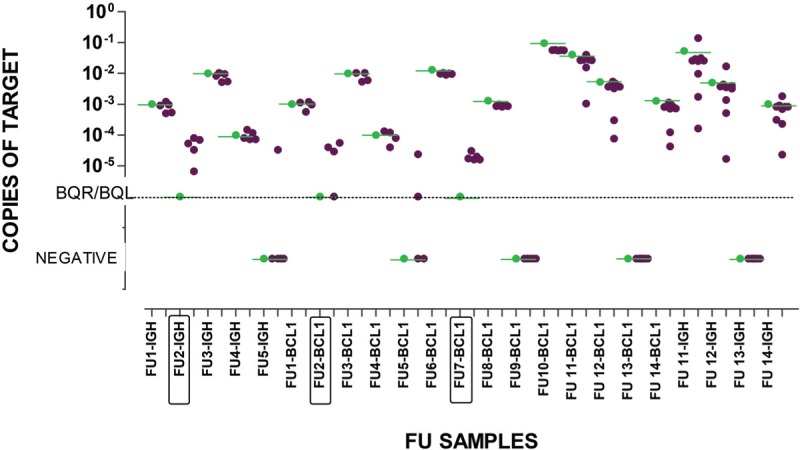
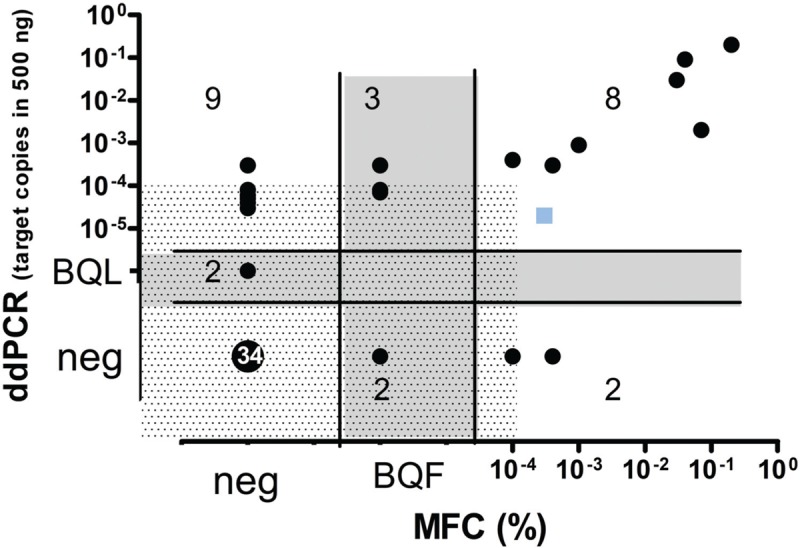
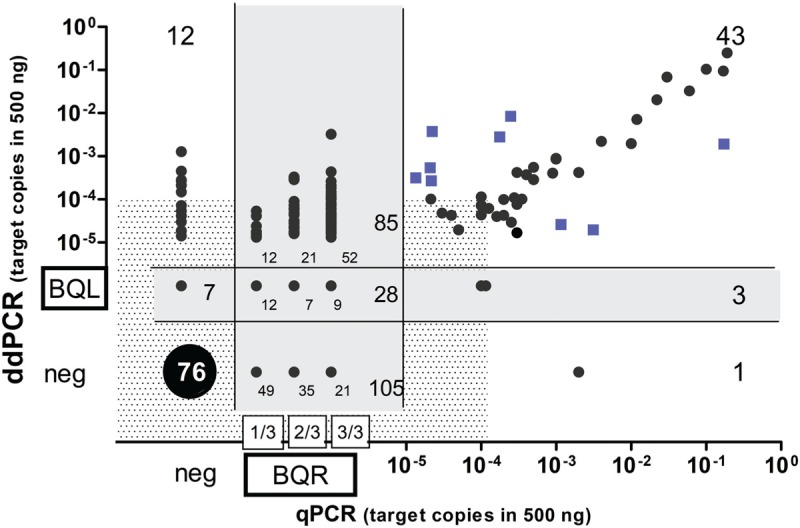
Minimal residual disease (MRD) has been increasingly investigated in mantle cell lymphoma (MCL), including for individual therapeutic stratification and pre-emptive treatment in clinical trials. Although patient/allele specific real-time quantitative polymerase chain reaction (qPCR) of IGH or BCL1-IGH clonal markers is the gold-standard method, its reliance on a standard curve for relative quantification limits quantification of low-level positivity within the 1E-4 to 1E-5 range; over half of positive MRD samples after treatment fall below the quantitative range (BQR) of the standard curve. Droplet digital PCR (ddPCR), in contrast, allows absolute quantification, including for samples with no baseline determination of tumor infiltration by multicolor flow cytometry (MFC), avoiding the need for a reference standard curve. Using updated, optimized, ddPCR criteria we compared it with qPCR in 416 MRD samples (and with MFC in 63), with over-representation (61%) of BQR results by qPCR, from a total of 166 patients from four prospective MCL clinical trials. ddPCR, qPCR and MFC gave comparable results in MRD samples with at least 0.01% (1E-4) positivity. ddPCR was preferable to qPCR since it provided more robust quantification at positivity between 1E-4 and 1E-5. Amongst 240 BQR samples with duplicate or triplicate analysis, 39% were positive by ddPCR, 49% negative and only 12% remained positive below quantifiable ddPCR limits. The prognostic relevance of ddPCR is currently under assessment in the context of prospective trials within the European MCL Network.
微小残留病(MRD)在套细胞淋巴瘤(MCL)中的研究越来越多,包括用于临床试验中的个体治疗分层和抢先治疗。尽管针对IGH或BCL1-IGH克隆标志物的患者/等位基因特异性实时定量聚合酶链反应(qPCR)是金标准方法,但其对相对定量标准曲线的依赖限制了1E-4至1E-5范围内低水平阳性的定量;超过一半的治疗后MRD阳性样本低于标准曲线的定量范围(BQR)。相比之下,液滴数字PCR(ddPCR)可进行绝对定量,包括对未通过多色流式细胞术(MFC)进行肿瘤浸润基线测定的样本,无需参考标准曲线。我们使用更新、优化的ddPCR标准,将其与416份MRD样本中的qPCR(以及63份样本中的MFC)进行比较,这些样本来自四项MCL前瞻性临床试验的166名患者,qPCR的BQR结果占比过高(61%)。在阳性率至少为0.01%(1E-4)的MRD样本中,ddPCR、qPCR和MFC的结果相当。ddPCR优于qPCR,因为它在1E-4至1E-5的阳性率下提供了更可靠的定量。在240份进行了重复或三次分析的BQR样本中,39%通过ddPCR呈阳性,49%呈阴性,只有12%在可量化的ddPCR限值以下仍呈阳性。目前正在欧洲MCL网络的前瞻性试验背景下评估ddPCR的预后相关性。