Institute of Animal Hygiene and Veterinary Public Health, Faculty of Veterinary Medicine, University of Leipzig, An den Tierkliniken 1, 04103, Leipzig, Germany.
Institute of Anatomy, Histology and Embryology, Faculty of Veterinary Medicine, University of Leipzig, An den Tierkliniken 43, 04103, Leipzig, Germany.
Parasit Vectors. 2020 Apr 21;13(1):189. doi: 10.1186/s13071-020-04061-x.
Ixodes spp. are vectors of zoonotic pathogens. All three active life stages (larvae, nymphs, adults) need to feed on a host in order to develop. Usually ticks parasitize attached to the external surface of their hosts' skin. Interestingly, in some cases ticks can also be found in the subcutaneous tissue in a variety of hosts, such as red foxes (Vulpes vulpes), raccoon dogs (Nyctereutes procyonoides) and dogs.
The visceral side of 126 red fox-furs from Germany was examined visually searching for ticks. The localization of ticks was recorded and assigned to ten specific body parts. Morphological identification of ticks was performed according to standardized taxonomic protocols. Ticks which could not be further identified were examined genetically via conventional PCR targeting the 16S rRNA and cox1 gene. Hematoxylin and eosin (H&E) staining was used for histopathological examination.
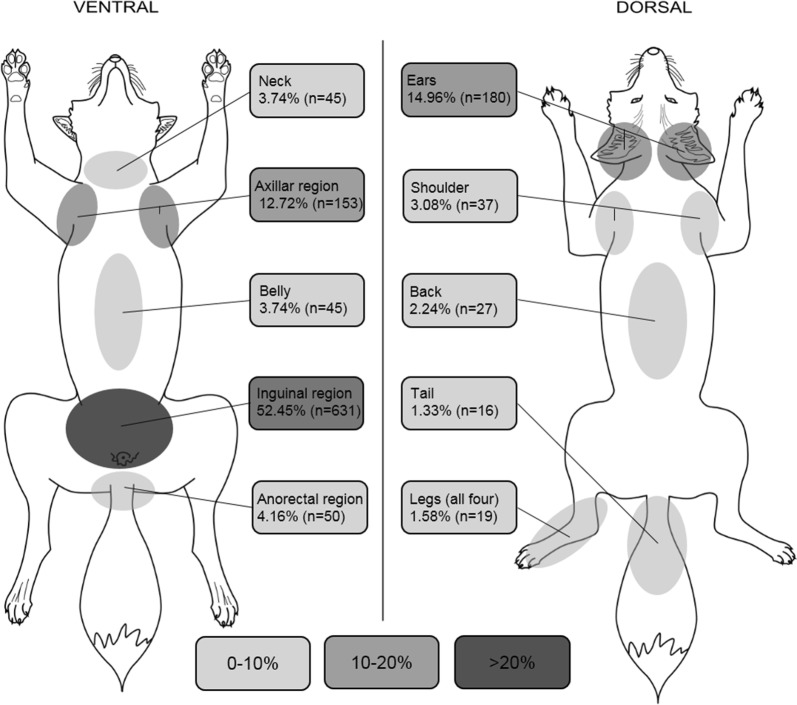
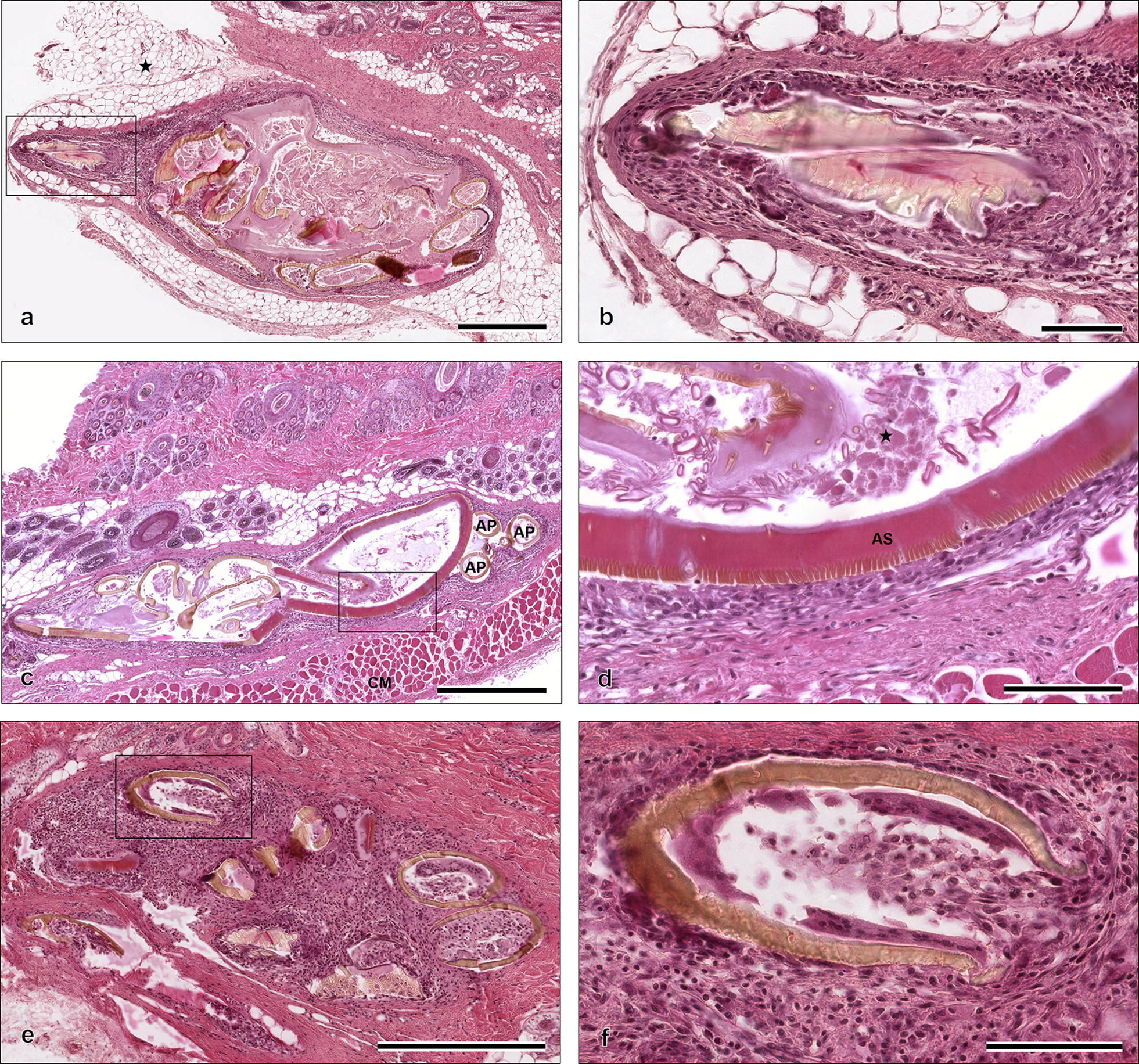
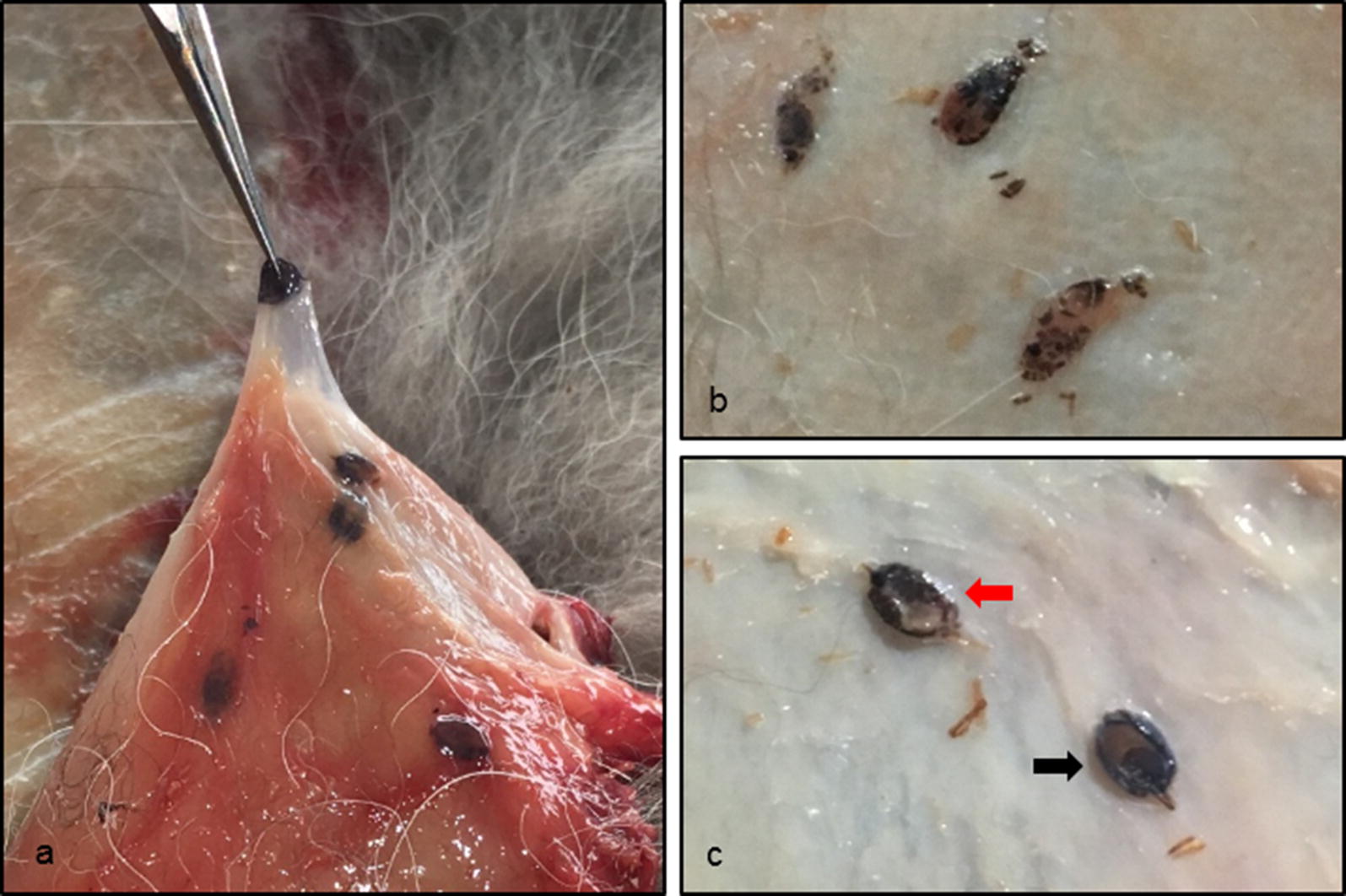
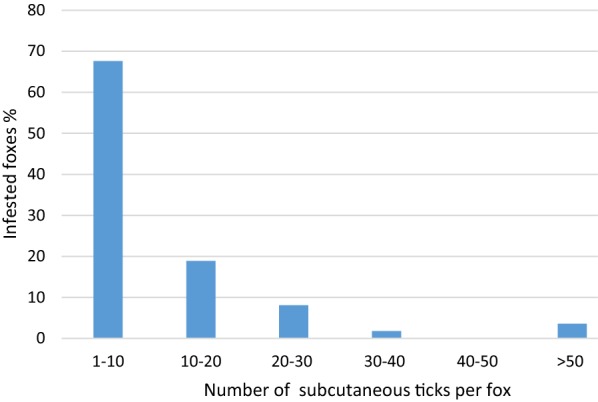
In 111 out of 126 (88.1%) examined coats, at least one tick was found in the subcutaneous tissue. A total of 1203 ticks were removed from the subcutaneous tissue. Well-preserved ticks could be identified based on morphological criteria, but most ticks were in a progressed state of decomposition. Here, morphological species identification was not successful. Also, PCR methods did not lead to a successful species identification. The following species and development stages were found by morphological identification: Ixodes ricinus (female, n = 289; male, n = 8; nymph, n = 1), I. hexagonus (female, n = 2), I. canisuga (female, n = 1). Male I. ricinus were found individually or copulating in pairs with females. Subcutaneous ticks were localized at three predominant affected body parts: ears, axillar and inguinal region. Histological examination of subcutaneous ticks revealed a granulomatous panniculitis.
To the authors' knowledge, this is the first finding of highly prevalent subcutaneous ticks in red foxes from Germany. Subcutaneous location of ticks seems to be very common in red foxes and the rule rather than the exception. Deep embedment of longirostra and long feeding times of females seem to put the subcutaneous location in favor. Most foxes were infested in the inguinal area, where the skin is thin and less hairy.
硬蜱属是多种动物传染病原体的传播媒介。所有三个活动阶段(幼虫、若虫、成虫)都需要以宿主为食才能发育。通常蜱虫寄生在宿主皮肤的外表面。有趣的是,在某些情况下,在各种宿主(如赤狐、貉、狗)的皮下组织中也可以发现蜱虫。
对来自德国的 126 张赤狐皮的内脏侧进行了目视检查,以寻找蜱虫。记录蜱虫的定位,并将其分配到十个特定的身体部位。根据标准化分类学方案对蜱虫进行形态学鉴定。无法进一步鉴定的蜱虫通过针对 16S rRNA 和 cox1 基因的常规 PCR 进行基因检测。对苏木精和伊红(H&E)染色进行组织病理学检查。
在 126 件检查过的外套中,有 111 件(88.1%)至少在皮下组织中发现了一只蜱虫。从皮下组织中取出了 1203 只蜱虫。根据形态学标准,可以识别保存完好的蜱虫,但大多数蜱虫处于分解的后期阶段。在这里,形态学物种鉴定没有成功。此外,PCR 方法也没有导致成功的物种鉴定。通过形态学鉴定发现了以下物种和发育阶段:硬蜱(雌蜱 289 只,雄蜱 8 只,若虫 1 只)、硬蜱六角形亚种(雌蜱 2 只)、硬蜱犬形亚种(雌蜱 1 只)。雄蜱虫单独发现或成对与雌蜱虫交配。皮下蜱虫定位在三个主要受影响的身体部位:耳朵、腋窝和腹股沟区域。皮下蜱虫的组织学检查显示出化脓性脂膜炎。
据作者所知,这是德国赤狐中普遍存在皮下蜱虫的首次发现。蜱虫的皮下位置在赤狐中似乎非常常见,是一种普遍现象而非例外。长喙的深嵌入和雌性的长喂养时间似乎有利于皮下位置。大多数狐狸在腹股沟区域受到感染,腹股沟区域皮肤薄且毛发较少。