
肠易激综合征潜在的神经免疫治疗靶点
Potential neuro-immune therapeutic targets in irritable bowel syndrome.
作者信息
Casado-Bedmar Maite, Keita Åsa V
机构信息
Department of Biomedical and Clinical Sciences, Linköping University, Linköping, Sweden.
Department of Biomedical and Clinical Sciences, Medical Faculty, Linköping University, Campus US, Linköping, 581 85, Sweden.
出版信息
Therap Adv Gastroenterol. 2020 Apr 9;13:1756284820910630. doi: 10.1177/1756284820910630. eCollection 2020.
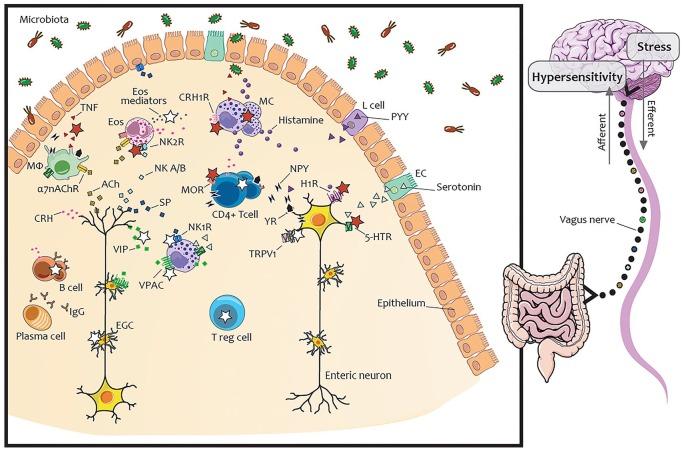
Irritable bowel syndrome (IBS) is a functional gastrointestinal (GI) disorder characterized by recurring abdominal pain and disturbed bowel habits. The aetiology of IBS is unknown but there is evidence that genetic, environmental and immunological factors together contribute to the development of the disease. Current treatment of IBS includes lifestyle and dietary interventions, laxatives or antimotility drugs, probiotics, antispasmodics and antidepressant medication. The gut-brain axis comprises the central nervous system, the hypothalamic pituitary axis, the autonomic nervous system and the enteric nervous system. Within the intestinal mucosa there are close connections between immune cells and nerve fibres of the enteric nervous system, and signalling between, for example, mast cells and nerves has shown to be of great importance during GI disorders such as IBS. Communication between the gut and the brain is most importantly routed the vagus nerve, where signals are transmitted by neuropeptides. It is evident that IBS is a disease of a gut-brain axis dysregulation, involving altered signalling between immune cells and neurotransmitters. In this review, we analyse the most novel and distinct neuro-immune interactions within the IBS mucosa in association with already existing and potential therapeutic targets.
肠易激综合征(IBS)是一种功能性胃肠(GI)疾病,其特征为反复出现腹痛和排便习惯紊乱。IBS的病因尚不清楚,但有证据表明,遗传、环境和免疫因素共同促成了该疾病的发展。IBS的当前治疗方法包括生活方式和饮食干预、泻药或抗动力药物、益生菌、抗痉挛药和抗抑郁药物。肠-脑轴由中枢神经系统、下丘脑-垂体轴、自主神经系统和肠神经系统组成。在肠黏膜内,免疫细胞与肠神经系统的神经纤维之间存在紧密联系,例如,肥大细胞与神经之间的信号传导在诸如IBS等胃肠疾病期间已显示出至关重要的作用。肠道与大脑之间的通信最重要的是通过迷走神经进行,信号通过神经肽传递。很明显,IBS是一种肠-脑轴失调的疾病,涉及免疫细胞与神经递质之间信号传导的改变。在本综述中,我们结合已有的和潜在的治疗靶点,分析了IBS黏膜内最新颖和独特的神经-免疫相互作用。
 Zotero 插件