Department of Cardiovascular and Thoracic Surgery, Faculty of Medicine and Graduate School of Medicine, Hokkaido University, Sapporo, Japan.
Department of Cardiovascular Medicine, Faculty of Medicine and Graduate School of Medicine, Hokkaido University, Sapporo, Japan.
PLoS One. 2020 Apr 21;15(4):e0224713. doi: 10.1371/journal.pone.0224713. eCollection 2020.
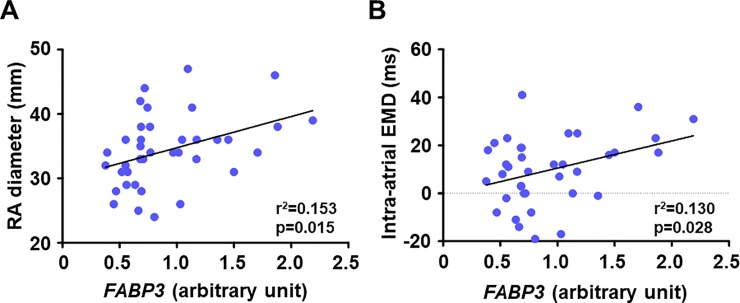
Atrial metabolic disturbance contributes to the onset and development of atrial fibrillation (AF). Autophagy plays a role in maintaining the cellular energy balance. We examined whether atrial gene expressions related to fatty acid metabolism and autophagy are altered in chronic AF and whether they are related to each other. Right atrial tissue was obtained during heart surgery from 51 patients with sinus rhythm (SR, n = 38) or chronic AF (n = 13). Preoperative fasting serum free-fatty-acid levels were significantly higher in the AF patients. The atrial gene expression of fatty acid binding protein 3 (FABP3), which is involved in the cells' fatty acid uptake and intracellular fatty acid transport, was significantly increased in AF patients compared to SR patients; in the SR patients it was positively correlated with the right atrial diameter and intra-atrial electromechanical delay (EMD), parameters of structural and electrical atrial remodeling that were evaluated by an echocardiography. In contrast, the two groups' atrial contents of diacylglycerol (DAG), a toxic fatty acid metabolite, were comparable. Importantly, the atrial gene expression of microtubule-associated protein light chain 3 (LC3) was significantly increased in AF patients, and autophagy-related genes including LC3 were positively correlated with the atrial expression of FABP3. In conclusion, in chronic AF patients, the atrial expression of FABP3 was upregulated in association with autophagy-related genes without altered atrial DAG content. Our findings may support the hypothesis that dysregulated cardiac fatty acid metabolism contributes to the progression of AF and induction of autophagy has a cardioprotective effect against cardiac lipotoxicity in chronic AF.
心房代谢紊乱导致心房颤动(AF)的发生和发展。自噬在维持细胞能量平衡中发挥作用。我们研究了慢性 AF 中与脂肪酸代谢和自噬相关的心房基因表达是否发生改变,以及它们之间是否存在相关性。在心脏手术期间,从窦性节律(SR,n=38)或慢性 AF(n=13)的 51 名患者中获得右心房组织。AF 患者的术前空腹血清游离脂肪酸水平显着升高。参与细胞脂肪酸摄取和细胞内脂肪酸转运的脂肪酸结合蛋白 3(FABP3)的心房基因表达在 AF 患者中显着高于 SR 患者;在 SR 患者中,它与右心房直径和房内电机械延迟(EMD)呈正相关,后者是通过超声心动图评估的结构和电心房重构的参数。相比之下,两组的二酰基甘油(DAG)含量(一种有毒脂肪酸代谢物)相当。重要的是,AF 患者的微管相关蛋白轻链 3(LC3)的心房基因表达显着增加,包括 LC3 在内的自噬相关基因与 FABP3 的心房表达呈正相关。总之,在慢性 AF 患者中,FABP3 的心房表达与自噬相关基因上调相关,而心房 DAG 含量没有改变。我们的研究结果可能支持这样一种假设,即心脏脂肪酸代谢失调导致 AF 的进展,而自噬对慢性 AF 中的心脏脂毒性具有心脏保护作用。