Kuupiel Desmond, Adu Kwame M, Bawontuo Vitalis, Adogboba Duncan A, Drain Paul K, Moshabela Mosa, Mashamba-Thompson Tivani P
Department of Public Health Medicine, School of Nursing and Public Health, University of KwaZulu-Natal, Durban 4041, South Africa.
Research for Sustainable Development Consult, Sunyani, Ghana.
Diagnostics (Basel). 2020 Apr 16;10(4):229. doi: 10.3390/diagnostics10040229.
Glucose-6-Phosphate Dehydrogenase (G6PD) deficiency screening test is essential for malaria treatment, control, and elimination programs. G6PD deficient individuals are at high risk of severe hemolysis when given anti-malarial drugs such as primaquine, quinine, other sulphonamide-containing medicines, and chloroquine, which has recently been shown to be potent for the treatment of coronavirus disease (COVID-19). We evaluated the geographical accessibility to POC testing for G6PD deficiency in Ghana, a malaria-endemic country.
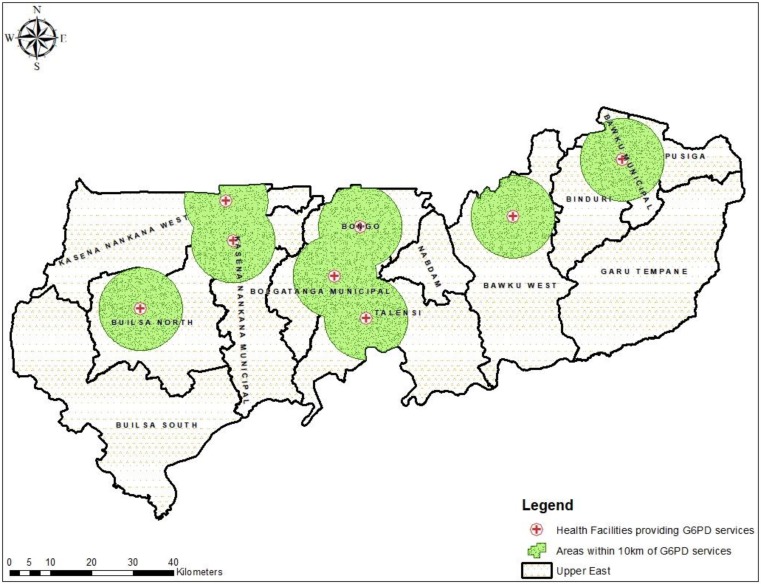
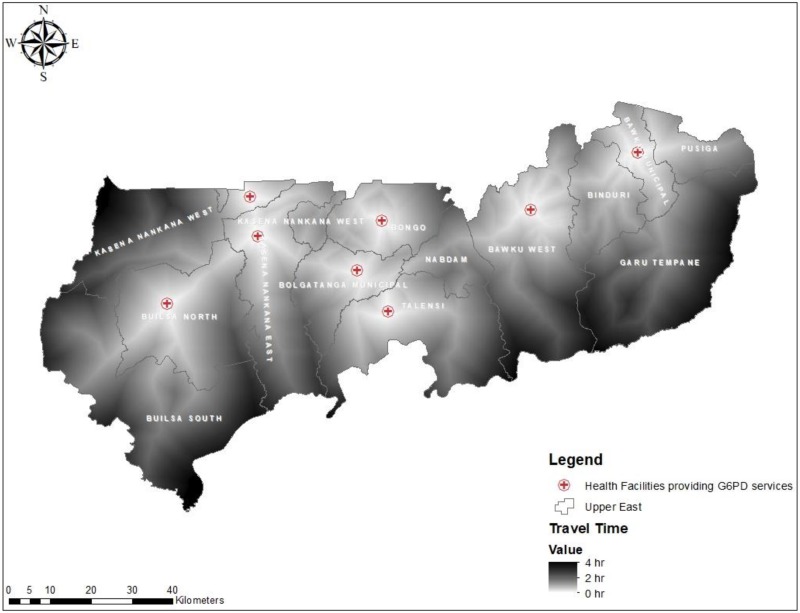
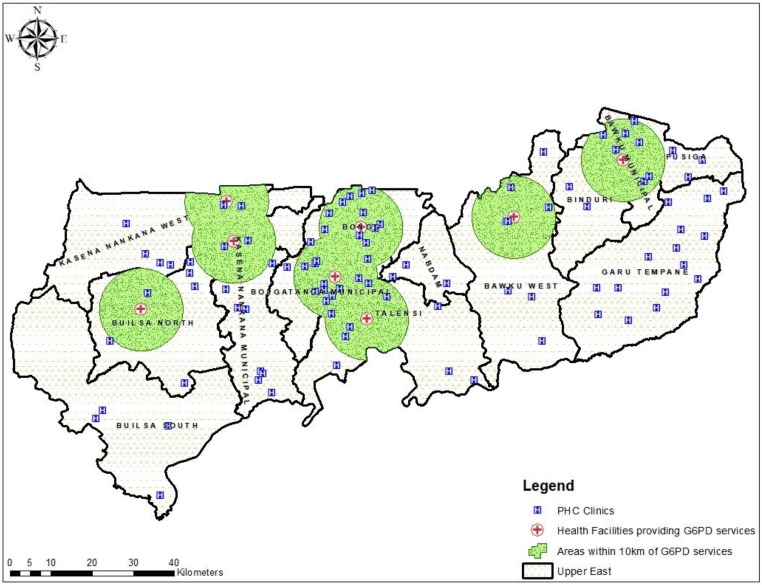
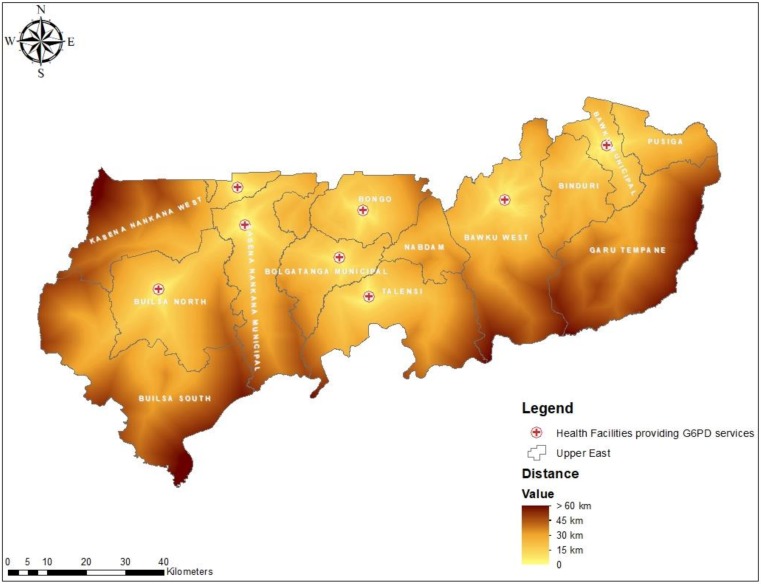
We obtained the geographic information of 100 randomly sampled clinics previously included in a cross-sectional survey. We also obtained the geolocated data of all public hospitals providing G6PD deficiency testing services in the region. Using ArcGIS 10.5, we quantified geographical access to G6PD deficiency screening test and identified clinics as well as visualize locations with poor access for targeted improvement. The travel time was estimated using an assumed speed of 20 km per hour.
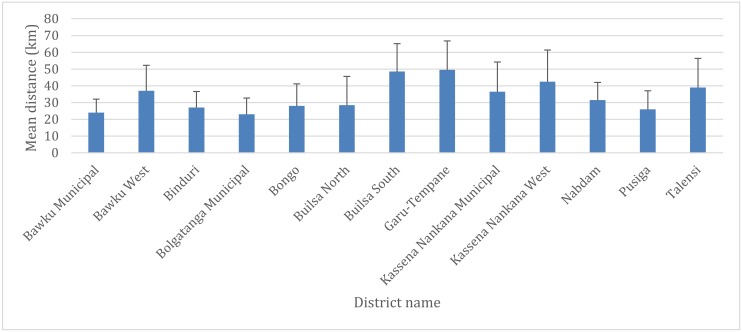
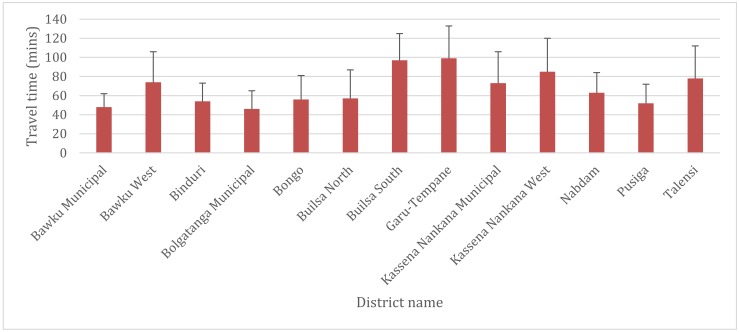
Of the 100 clinics, 58% were Community-based Health Planning and Services facilities, and 42% were sub-district health centers. The majority (92%) were Ghana Health Service facilities, and the remaining 8% were Christian Health Association of Ghana facilities. Access to G6PD deficiency screening test was varied across the districts, and G6PD deficiency screening test was available in all eight public hospitals. This implies that the health facility-to-population ratio for G6PD deficiency testing service was approximately 1:159,210 (8/1,273,677) population. The spatial analysis quantified the current mean distance to a G6PD deficiency testing service from all locations in the region to be 34 ± 14 km, and travel time (68 ± 27 min). The estimated mean distance from a clinic to a district hospital for G6PD deficiency testing services was 15 ± 11 km, and travel time (46 ± 33 min).
Access to POC testing for G6PD deficiency in Ghana was poor. Given the challenges associated with G6PD deficiency, it would be essential to improve access to G6PD deficiency POC testing to facilitate administration of sulphadoxine-pyrimethamine to pregnant women, full implementation of the malaria control program in Ghana, and treatment of COVID-19 patients with chloroquine in malaria-endemic countries. To enable the World Health Organization include appropriate G6PD POC diagnostic tests in its list of essential in-vitro diagnostics for use in resource-limited settings, we recommend a wider evaluation of available POC diagnostic tests for G6PD deficiency, particularly in malaria-endemic countries.
葡萄糖-6-磷酸脱氢酶(G6PD)缺乏症筛查试验对于疟疾治疗、防控及消除计划至关重要。G6PD缺乏症患者在使用伯氨喹、奎宁、其他含磺胺类药物及氯喹等抗疟药物时,有发生严重溶血的高风险,而氯喹最近已被证明对治疗冠状病毒病(COVID-19)有效。我们评估了疟疾流行国家加纳进行G6PD缺乏症即时检测的地理可达性。
我们获取了之前横断面调查中随机抽取的100家诊所的地理信息。我们还获取了该地区所有提供G6PD缺乏症检测服务的公立医院的地理定位数据。使用ArcGIS 10.5,我们量化了G6PD缺乏症筛查试验的地理可达性,确定了诊所,并直观显示了可达性差的地点以便有针对性地改善。出行时间是根据假定每小时20公里的速度估算的。
在这100家诊所中,58%是基于社区的卫生规划与服务设施,42%是分区卫生中心。大多数(92%)是加纳卫生服务机构设施,其余8%是加纳基督教卫生协会设施。各地区G6PD缺乏症筛查试验的可达性各不相同,所有8家公立医院均提供G6PD缺乏症筛查试验。这意味着G6PD缺乏症检测服务的卫生机构与人口比例约为1:159,210(8/1,273,677)人口。空间分析量化得出,该地区所有地点到G6PD缺乏症检测服务的当前平均距离为34±14公里,出行时间为(68±27分钟)。从诊所到提供G6PD缺乏症检测服务的 district hospital 的估计平均距离为15±11公里,出行时间为(46±33分钟)。
加纳G6PD缺乏症即时检测的可达性较差。鉴于G6PD缺乏症相关的挑战,改善G6PD缺乏症即时检测的可达性对于促进向孕妇施用磺胺多辛-乙胺嘧啶、在加纳全面实施疟疾防控计划以及在疟疾流行国家用氯喹治疗COVID-19患者至关重要。为使世界卫生组织将合适的G6PD即时诊断检测纳入其用于资源有限环境的基本体外诊断清单,我们建议对现有的G6PD缺乏症即时诊断检测进行更广泛的评估,特别是在疟疾流行国家。