Cortesão Marta, de Haas Aram, Unterbusch Rebecca, Fujimori Akira, Schütze Tabea, Meyer Vera, Moeller Ralf
Space Microbiology Research Group, Radiation Biology Department, Institute of Aerospace Medicine, German Aerospace Center, Cologne, Germany.
Department of Basic Medical Sciences for Radiation Damages, National Institutes for Quantum and Radiological Science and Technology, Chiba, Japan.
Front Microbiol. 2020 Apr 3;11:560. doi: 10.3389/fmicb.2020.00560. eCollection 2020.
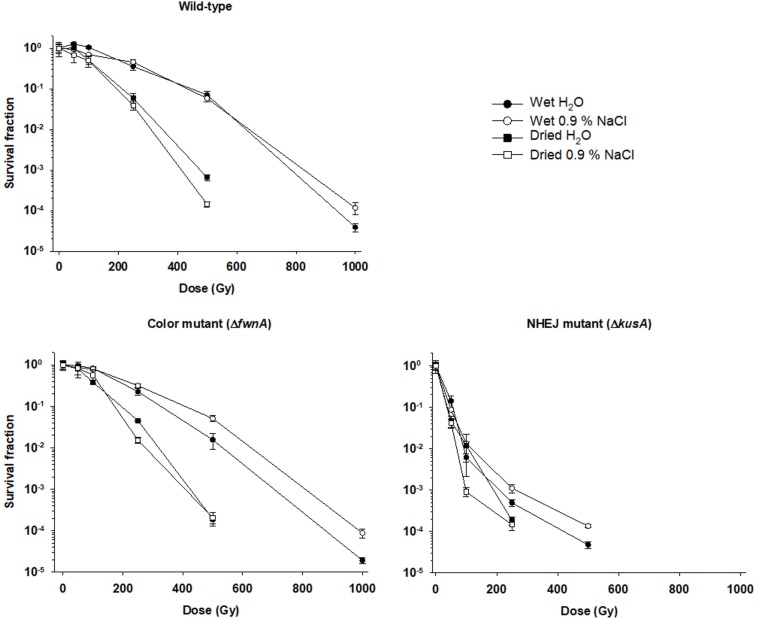
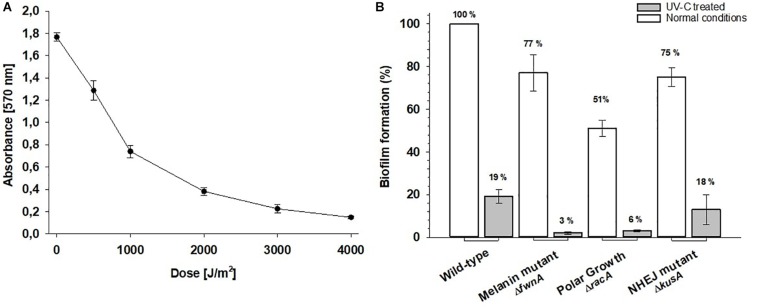
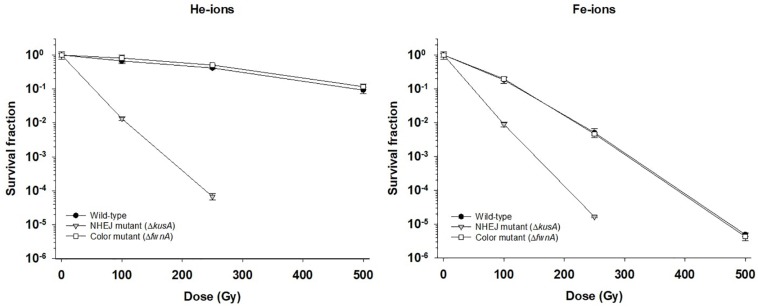
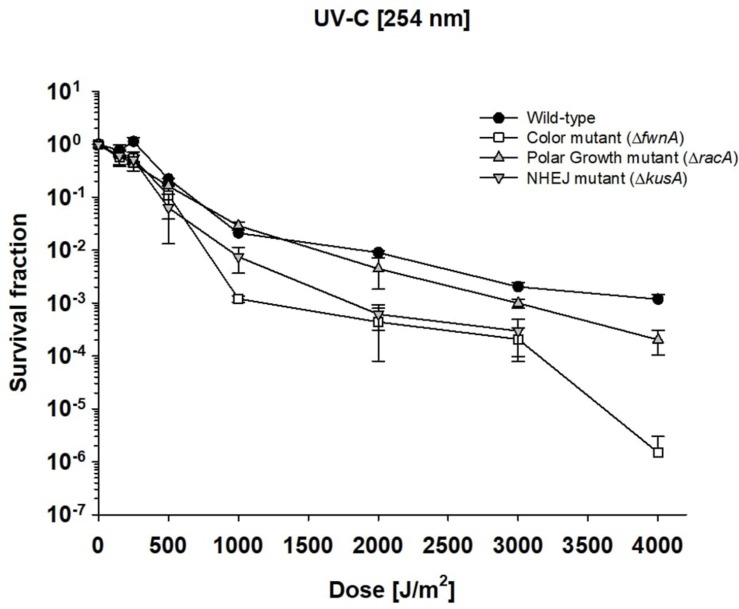
The filamentous fungus is one of the main contaminants of the International Space Station (ISS). It forms highly pigmented, airborne spores that have thick cell walls and low metabolic activity, enabling them to withstand harsh conditions and colonize spacecraft surfaces. Whether r spores are resistant to space radiation, and to what extent, is not yet known. In this study, spore suspensions of a wild-type and three mutant strains (with defects in pigmentation, DNA repair, and polar growth control) were exposed to X-rays, cosmic radiation (helium- and iron-ions) and UV-C (254 nm). To assess the level of resistance and survival limits of fungal spores in a long-term interplanetary mission scenario, we tested radiation doses up to 1000 Gy and 4000 J/m. For comparison, a 360-day round-trip to Mars yields a dose of 0.66 ± 0.12 Gy. Overall, wild-type spores of were able to withstand high doses of X-ray (LD = 360 Gy) and cosmic radiation (helium-ion LD = 500 Gy; and iron-ion LD = 100 Gy). Drying the spores before irradiation made them more susceptible toward X-ray radiation. Notably, spores are highly resistant to UV-C radiation (LD = 1038 J/m), which is significantly higher than that of other radiation-resistant microorganisms (e.g., ). In all strains, UV-C treated spores (1000 J/m) were shown to have decreased biofilm formation (81% reduction in wild-type spores). This study suggests that spores might not be easily inactivated by exposure to space radiation alone and that current planetary protection guidelines should be revisited, considering the high resistance of fungal spores.
丝状真菌是国际空间站(ISS)的主要污染物之一。它形成颜色很深的气传孢子,这些孢子具有厚厚的细胞壁和低代谢活性,使其能够抵御恶劣条件并在航天器表面定殖。这些孢子是否对空间辐射具有抗性以及抗性程度如何,目前尚不清楚。在本研究中,将野生型和三种突变菌株(在色素沉着、DNA修复和极性生长控制方面存在缺陷)的孢子悬浮液暴露于X射线、宇宙辐射(氦离子和铁离子)和UV-C(254nm)下。为了评估在长期行星际任务场景中真菌孢子的抗性水平和存活极限,我们测试了高达1000Gy和4000J/m²的辐射剂量。作为比较,一次为期360天的火星往返行程产生的剂量为0.66±0.12Gy。总体而言,[具体真菌名称未给出] 的野生型孢子能够承受高剂量的X射线(致死剂量LD = 360Gy)和宇宙辐射(氦离子LD = 500Gy;铁离子LD = 100Gy)。辐照前干燥孢子会使其对X射线辐射更敏感。值得注意的是,[具体真菌名称未给出] 的孢子对UV-C辐射具有高度抗性(LD = 1038J/m²),这明显高于其他抗辐射微生物(例如[未提及的微生物名称])。在所有菌株中,经UV-C处理的孢子(1000J/m²)显示出生物膜形成减少(野生型孢子减少81%)。这项研究表明,[具体真菌名称未给出] 的孢子可能不容易仅通过暴露于空间辐射而失活,并且考虑到真菌孢子的高抗性,当前的行星保护指南应该重新审视。